
Last verified 16 Sep 2026 · Sources
Hot sauce falls into the “minor condiments” category under 21 CFR 101.12, which sets a Reference Amount Customarily Consumed (RACC) of 1 tsp (about 5 g), the same bucket as horseradish, mustard, and Worcestershire sauce. A realistic label statement reads “1 tsp (5 g).” The regulator is FDA, though most shelf-stable hot sauce also has to answer to 21 CFR 114’s acidified food rules, since peppers are a low-acid food that’s typically brought below pH 4.6 with added vinegar. The most common mistake is treating the RACC as optional or “close enough.” It’s fixed by category regardless of how much someone actually pours on a taco, and a second, bigger mistake is skipping the acidified-food process filing because the product “just tastes like vinegar and peppers.” A Nutrition Facts panel is required once hot sauce is sold commercially outside a state cottage food exemption that allows no nutrition claims.
| Quick facts | Hot sauce |
|---|---|
| Regulator | FDA |
| Reference amount (RACC) | 1 tsp (minor condiments, e.g., horseradish, hot sauces, mustards, Worcestershire) |
| Typical serving statement | 1 tsp (5 g) |
| Typical label format | Standard vertical for a normal 5 oz retail bottle; tabular or linear only for a small sample bottle at or under 40 sq in of labelable surface |
| Exemption | Not exempt: sodium is far too significant; a package under 12 sq in with no nutrition claims may still qualify under 101.9(j)(13)(i) |
| Watch out for | Sodium %DV runs very high per tsp; small packets can trip single-serving or dual-column rules |
| Common allergens | Usually none; check soy sauce, fish sauce, or wheat in Asian-style blends |
What is the serving size for hot sauce? The FDA serving for hot sauce is 1 tsp (5g). See the full serving-size reference: single-serving cut-off, dual-column range, and servings per package.
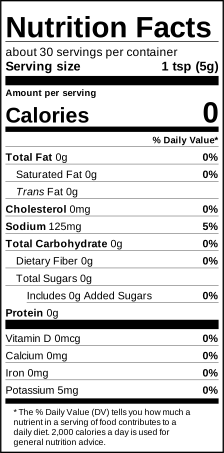
Serving size: what the RACC gives hot sauce
The 1 tsp RACC applies across the whole minor-condiments group, so hot sauce, horseradish, and mustard all share the same reference amount regardless of how concentrated or fiery the product is. Converting that to a label statement means declaring “1 tsp” with its gram equivalent for your specific formula’s density, commonly around 5 g for a thin, vinegar-forward sauce.
Because the RACC is so small, packaging size does most of the work in determining format. A standard 5 oz (148 mL, roughly 150 g) retail bottle is around 3,000% of the 5 g RACC (nowhere near the single-serving or dual-column thresholds), so it gets an ordinary multi-serving panel with a “servings per container” statement (about 30 servings at 5 g each). The thresholds only bite on small single-serve formats: a restaurant-style packet under about 10 g (less than 200% of RACC) is declared as one serving covering the whole packet under 101.9(b)(6), while a packet landing between 10 g and 15 g (200%–300% of RACC) instead triggers the dual per-serving/per-container column required by 101.9(b)(12)(i).
What the panel must show
Every mandatory nutrient under 21 CFR 101.9(c) applies: calories, total fat, saturated fat, trans fat, cholesterol, sodium, total carbohydrate, dietary fiber, total sugars, added sugars, protein, vitamin D, calcium, iron, and potassium, each with %DV and the standard footnote. Sodium is the number that matters most here: hot sauce commonly runs well over 2,000 mg per 100 g, so even a 5 g teaspoon serving can carry a real sodium %DV, and rounding under 101.9(c) pushes sodium in the 5 mg–140 mg range to the nearest 5 mg and above that to the nearest 10 mg. Total sugars and added sugars are usually near zero for a plain pepper-vinegar-salt formula, but any sauce sweetened with sugar, honey, or fruit needs an honest added-sugars split based on the recipe, not the database.
Format: which layout your package qualifies for
Standard vertical format fits the normal 5 oz bottle most hot sauce ships in, since its labelable surface comfortably clears the 40 sq in threshold in 101.9(j)(13)(ii). A small sample or mini bottle at or under 40 sq in of labelable area, whose shape can’t take a standard column, may use tabular format, or linear (string) format if it’s under 12 sq in and can’t fit tabular either. A bottle under 12 sq in that carries no nutrition claims at all may instead qualify for the small-package exemption under 101.9(j)(13)(i), provided it lists a phone number or address for nutrition information, but any claim like “low sodium” or “no sugar added” removes that exemption. NutriLabels’ builder renders standard vertical, tabular, linear, dual-column, and bilingual EN/ES for hot sauce.
Hot sauce-specific traps
The bigger trap sits outside the Nutrition Facts panel: if the finished product has a hermetically sealed, shelf-stable format and a finished pH of 4.6 or below achieved by adding acid to peppers, it meets the 21 CFR 114.3 definition of an acidified food. That triggers 21 CFR 108.25, which requires the processing establishment to register with FDA and file its scheduled process (Form FDA 2541 and 2541e) before commercial distribution, a step that has nothing to do with the label itself but stops production cold if skipped. A refrigerated, never-canned hot sauce sold cold may not fall under the same filing requirement, but that’s a process-authority determination, not a label question. Talk to a food-labeling attorney, your state regulator, or your co-packer’s process authority before assuming either way.
Ingredient statement and allergens
List ingredients in descending order by predominant weight per 21 CFR 101.4: typically peppers, vinegar, water, salt, and any garlic, spices, or gums. A plain pepper-vinegar-salt hot sauce carries none of the nine major allergens under FALCPA and the FASTER Act, but Asian-style or umami-forward blends built on soy sauce, fish sauce, or oyster sauce need those declared in a “Contains” statement, and any wheat-based thickener needs the same treatment.
Build the label
A 1 tsp serving and an accurately rounded sodium line mean your bottle reads right next to every other sauce on the shelf. Enter your recipe, then see your label: your calories, the claims you qualify for and your allergen line are free, no card required, and every other value and %DV stays hidden until you unlock it. $29 unlocks every other nutrient value and %DV, every FDA format your hot sauce bottle qualifies for, and the ingredient statement and allergen declaration, ready to print. Start your label, or compare other condiments on the product labels hub.
Hot sauce label FAQ
Why is my hot sauce's serving size only 1 teaspoon?
Hot sauce sits in the 'minor condiments' category of 21 CFR 101.12's reference amount table, alongside horseradish, mustard, and Worcestershire sauce, which sets a 1 tsp (about 5 g) Reference Amount Customarily Consumed (RACC). It isn't based on how much a customer actually pours.
Does my hot sauce have to be registered with the FDA as an acidified food?
If it's shelf-stable, hermetically sealed, and formulated with peppers (a low-acid food) brought to a finished pH of 4.6 or below with added vinegar or another acid, it typically meets the 21 CFR 114.3 definition of an acidified food, and 21 CFR 108.25 requires the processor to register the establishment and file the scheduled process with FDA before distribution. Talk to a food-labeling attorney or your co-packer's process authority to confirm your specific formula and process.
Do small hot sauce packets need a different Nutrition Facts format?
A single restaurant-style packet under roughly 10 g (200% of the 5 g RACC) is labeled as one serving covering the whole packet under 101.9(b)(6); a packet in the 10 g–15 g range (200%–300% of RACC) instead needs a dual per-serving/per-container column under 101.9(b)(12)(i).
Is my sodium %DV going to look alarming on a 1 tsp serving?
It can. Hot sauce commonly runs well over 2,000 mg of sodium per 100 g, so even a 5 g teaspoon serving can carry a meaningful sodium %DV. That's normal for the category and doesn't require a different format, just accurate rounding under 101.9(c).
Does adding soy sauce or fish sauce change my allergen declaration?
Yes. Soy and fish are two of the nine major allergens under FALCPA and the FASTER Act, so any Asian-style or umami-forward hot sauce built on soy sauce, fish sauce, or oyster sauce needs those declared in a 'Contains' statement even though a straightforward pepper-vinegar-salt hot sauce carries none.
Can I sell hot sauce under my state's cottage food exemption?
Many states classify acidified foods like hot sauce as higher-risk and exclude them from cottage food exemptions, or require additional process authority approval even if you make it at home. Check your state's specific cottage food rules before assuming hot sauce qualifies.
Related products
Salsa, BBQ sauce, Spice blends and seasonings. See the full all products.
Sources
- ecfr.gov/current/title-21/chapter-I/…101/subpart-A/section-101.12
- ecfr.gov/current/title-21/chapter-I/…-101/subpart-A/section-101.9
- ecfr.gov/current/title-21/chapter-I/…-114/subpart-A/section-114.3
- ecfr.gov/current/title-21/chapter-I/…108/subpart-B/section-108.25
- fda.gov/food/food-allergies/faster-…me-ninth-major-food-allergen
- fdc.nal.usda.gov/food-details/174527/nutrients