
Last verified 16 Sep 2026 · Sources
Soup’s Reference Amount Customarily Consumed is 245 g across every variety (about 1 cup prepared), and dry soup mixes use the RACC for “amount to make 245 g,” meaning the declared serving is whatever quantity of mix yields that one prepared cup (21 CFR 101.12). Most soup stays with FDA, but once cooked poultry meat reaches roughly 2% of the ready-to-serve product, jurisdiction generally shifts to USDA-FSIS, which uses its own poultry products labeling rules instead of the FDA’s Nutrition Facts panel. The trap most likely to catch you isn’t the serving size, it’s sodium: soup is formulated around salt for flavor and shelf stability, so it’s rarely a candidate for any kind of “insignificant nutrient” treatment. A Nutrition Facts panel (or the USDA nutrition label, if FSIS has jurisdiction) is required on essentially every commercially sold soup.
| Quick facts | Soup |
|---|---|
| Regulator | FDA; USDA-FSIS if cooked poultry meat is 2% or more (or per FSIS's meat/poultry flavor-product threshold), by ready-to-serve weight |
| Reference amount (RACC) | Soups, all varieties, 245 g; dry soup mixes, amount to make 245 g |
| Typical serving statement | 1 cup (245 g) prepared |
| Typical label format | Standard vertical for most cans and pouches; dual-column "as prepared"/"as packaged" for condensed soup and dry mixes; tabular or linear only for small packages at or under 40 sq in |
| Exemption | Not exempt: soup reliably carries more than insignificant sodium (and often fat), so 101.9(j)(4) does not apply |
| Watch out for | Sodium %DV runs high across nearly all soup; condensed and dry mixes need the "as prepared" dual column under 101.9(e) |
| Common allergens | Wheat (noodles, roux), milk (cream-based soups), soy, fish/shellfish (chowders, bisques), sesame in some broths and seasoning bases |
What is the serving size for soup? The FDA serving for soup is 1 cup (245g). See the full serving-size reference: single-serving cut-off, dual-column range, and servings per package.
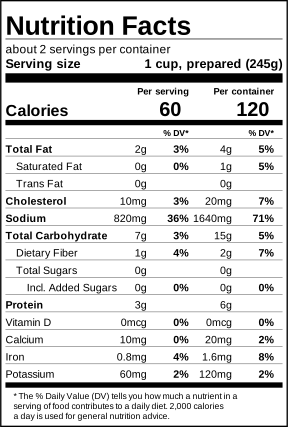
Serving size: what the RACC gives soup
The 245 g reference amount applies uniformly to “soups, all varieties” under 21 CFR 101.12. Ready-to-serve, condensed, or dehydrated, the target is the same 245 g prepared serving, translated to a label statement like “1 cup (245 g).” For a dry soup mix, the RACC is defined relative to the finished product: the reference amount is the amount of dry mix that makes 245 g of prepared soup, so a cup-of-soup packet that yields one 245 g bowl is declared as one RACC-sized serving regardless of the dry weight in the cup.
Package size still governs single-serving and dual-column rules. A ready-to-serve can holding close to one 245 g serving (up to just under 200% of the RACC) is sold individually and, under 21 CFR 101.9(b)(6), is declared as one serving covering the whole can. A can yielding roughly 2 to 3 servings when prepared (between 200% and 300% of the 245 g RACC, about 490–735 g as prepared) triggers the mandatory per-serving/per-container dual column under 101.9(b)(12)(i). Condensed soup and dry mixes carry a separate dual-column requirement under 21 CFR 101.9(e): because adding water measurably changes the nutrient profile, the label needs both an “as packaged” column and an “as prepared” column for the 245 g finished serving, which is the one most consumers actually read.
What the panel must show
All 15 mandatory nutrients under 21 CFR 101.9(c) apply: calories, total fat, saturated fat, trans fat, cholesterol, sodium, total carbohydrate, dietary fiber, total sugars, added sugars, protein, vitamin D, calcium, iron, and potassium. Sodium is the number that matters most for nearly every soup category, frequently running high enough per serving to be a meaningful chunk of a day’s %DV; saturated fat matters for cream-based and bisque-style soups. The %DV footnote and standard rounding under 101.9(c) apply to both the “as packaged” and “as prepared” columns where a dual column is required. Each column is rounded independently to its own values, not scaled proportionally from the other.
Format: which layout your package qualifies for
Standard cans and pouches use the standard vertical format. Condensed soup and dry mixes commonly need the “as prepared”/”as packaged” dual-column layout under 21 CFR 101.9(e) instead of a single-column panel. Smaller packages (cup-of-soup containers or single-serve pouches) at or under 40 sq in of total labelable surface area can use a tabular layout under 21 CFR 101.9(j)(13)(ii), or linear if the surface area is under 12 sq in or the shape can’t fit a tabular block. The NutriLabels builder renders standard vertical, tabular, linear, simplified, dual-column per serving/per container, dual-column as prepared/as packaged, and bilingual EN/ES formats.
Soup-specific traps
Jurisdiction is the biggest trap: FSIS generally treats a product with less than 2% cooked poultry meat on a ready-to-serve basis as exempt from the “poultry product” definition (9 CFR 381.15), which also means it can’t be named “Chicken Noodle Soup” without a qualifier such as “Chicken-Flavored.” Cross that line (or a comparable proportion of red meat, which FSIS evaluates case by case under the “relatively small proportion” exemption in 9 CFR 301.2) and the product generally moves to USDA-FSIS jurisdiction instead of an FDA panel. FSIS’s general rule of thumb, from its 2007 Federal Register notice on flavor products, is that a formulation with greater than 3% raw meat or poultry, or 2% or more cooked meat or poultry, is amenable to FSIS jurisdiction (72 FR 3779, “FSIS Jurisdiction Over Flavor Products Containing Meat or Poultry,” https://www.federalregister.gov/documents/2007/01/26/E7-1264/fsis-jurisdiction-over-flavor-products-containing-meat-or-poultry). Beyond jurisdiction, if you make condensed or dry soup, skipping the “as prepared” column required under 101.9(e) is the usual slip, and canned low-acid soups fall under separate thermal-processing filing requirements. It’s worth a call to your co-packer or state food-safety authority before canning shelf-stable soup for the first time.
Ingredient statement and allergens
Ingredients are listed in descending order by weight under 21 CFR 101.4, with sub-ingredients of a broth base or seasoning blend broken out as needed. Wheat shows up in noodles and roux-thickened soups, milk in cream-based and chowder-style soups, and soy and fish or shellfish in many broths, bisques, and Asian-style bases; sesame, the ninth major allergen under the FASTER Act effective January 1, 2023, appears in some broths and seasoning mixes. Any of the nine present must appear in a “Contains” statement under FALCPA, regardless of whether the product carries FDA or USDA-FSIS jurisdiction.
Build the label
An “as prepared” column built from your own recipe shows your customer the bowl they actually eat. Enter your recipe, then see your soup label: the calorie count, the nutrient content claims you qualify for and your allergen line show free, no card required, while every other value and %DV stays hidden until you unlock it. $29 unlocks every other nutrient value and %DV, every FDA format your product qualifies for, and the ingredient statement and allergen declaration, ready to print. Start your soup label, or browse other product labels.
Soup label FAQ
What serving size do I use for canned soup?
21 CFR 101.12 sets the RACC for soup, all varieties, at 245 g (about 1 cup prepared), which applies whether the soup is ready-to-serve or condensed and needs water added.
How do I label a dry soup mix packet?
Dry soup mixes use the RACC for "amount to make 245 g," meaning the declared serving is whatever quantity of dry mix yields one 245 g prepared cup, not the weight of the dry packet itself.
Does my soup need an "as prepared" column?
Condensed soup and dry mixes typically do. 21 CFR 101.9(e) requires a second column showing nutrition "as prepared" when a product needs further preparation that meaningfully changes its nutrient content, alongside the "as packaged" column.
When does my soup fall under USDA instead of FDA?
A soup containing 2% or more cooked poultry meat on a ready-to-serve basis is generally treated as a poultry product subject to FSIS jurisdiction (9 CFR 381.15); comparable meat-content thresholds apply for red meat, though the exact percentage is handled case by case under 9 CFR 301.2. Confirm your specific formulation with FSIS or a food-labeling attorney.
Can I still call a low-meat soup "Chicken Noodle Soup"?
Not necessarily. FSIS guidance under 9 CFR 381.15 states that a product with less than 2% cooked chicken on a ready-to-serve basis generally can't be labeled "Chicken Noodle Soup"; a name like "Chicken-Flavored Noodle Soup" is used instead.
Why is sodium such a common problem on soup labels?
Soup formulations are typically built with salt as a primary seasoning and preservative, so sodium routinely runs at meaningful %DV per serving, high enough that a "reduced sodium" or "low sodium" claim requires checking the specific FDA threshold before it goes on the label.
Related products
Spice blends and seasonings, Salad dressing, Granola bars. See the full all products.
Sources
- ecfr.gov/current/title-21/chapter-I/…-101/subpart-A/section-101.9
- ecfr.gov/current/title-21/chapter-I/…101/subpart-A/section-101.12
- ecfr.gov/current/title-9/chapter-III…381/subpart-C/section-381.15
- ecfr.gov/current/title-9/chapter-III…ter-A/part-301/section-301.2
- federalregister.gov/documents/2007/01/26/E7-126…s-containing-meat-or-poultry
- fdc.nal.usda.gov/food-details/172909/nutrients