
Last verified 16 Sep 2026 · Sources
The Reference Amount Customarily Consumed (RACC) for flavored, sweetened coffee is 360 mL prepared. That’s the FDA’s reference serving for this product type, and a realistic label statement is “12 fl oz (360 mL).” But plain roasted or ground coffee beans usually don’t need a Nutrition Facts panel at all.
The FDA’s insignificant-nutrient exemption at 21 CFR 101.9(j)(4) covers foods that contain insignificant amounts of every required nutrient, including “instant coffee (plain, unsweetened).” It only applies when no nutrition claim appears on the label (FDA, A Food Labeling Guide, https://www.fda.gov/files/food/published/Food-Labeling-Guide-(PDF).pdf).
The trap is adding a flavored syrup, sweetener or milk and assuming the exemption still applies. It doesn’t, because those ingredients add real amounts of sugar, fat or sodium. A panel is required once your coffee carries a nutrition claim or is sold with added nutrients. It’s also required if it simply contains more than an insignificant amount of any of the 15 nutrients on the current label. A flavored coffee can still skip the panel if your business qualifies for the FDA small-business exemption and you make no nutrition claims.
| Quick facts | Coffee |
|---|---|
| Regulator | FDA |
| Reference amount (RACC) | 360 mL prepared (coffee or tea, flavored and sweetened). Plain coffee may qualify for the 101.9(j)(4) insignificant-nutrient exemption. |
| Typical serving statement | 12 fl oz (360 mL) |
| Typical label format | Standard vertical for most bottled and canned flavored coffee drinks (tabular or linear if the labelable surface is 40 sq in or less and a standard column won't fit) |
| Exemption | May be exempt under 101.9(j)(4) if all nutrients are insignificant, as with plain roasted, ground or instant coffee. A claim or an added ingredient removes the exemption. |
| Watch out for | Added sugars and flavoring syrups trigger a full panel. Milk or creamer puts saturated fat and calcium on the label. |
| Common allergens | Usually none in plain coffee. Milk in lattes and cold brew blends. Check flavoring syrups for tree nuts or soy. |
What is the serving size for coffee? The FDA serving for coffee is 12 fl oz (360 mL). The full serving-size reference shows the single-serving cut-off, the dual-column range and the servings per package.
How big is a serving of coffee?
The reference amount table in 21 CFR 101.12 sets “coffee or tea, flavored and sweetened” at 360 mL prepared. That’s the legal serving size for a ready-to-drink flavored latte, mocha or sweetened iced coffee. You can’t pick a smaller “diet-friendly” serving to make the calories look better. Turn 360 mL into a label statement using the closest realistic household measure. Use “12 fl oz (360 mL)” for a bottle sized close to that, or a discrete-unit statement if your container is smaller or larger.
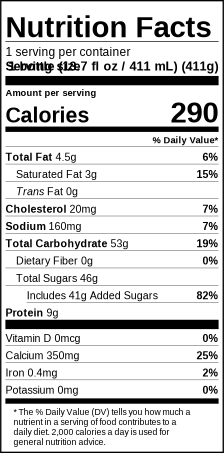
Package size changes the math. A single 12 fl oz (355 mL) bottle sits under 100% of the RACC. Since it’s packaged and sold on its own, it’s labeled as one serving under 21 CFR 101.9(b)(6), and the entire contents count as “1 serving.” A 13.7 fl oz (411 mL) bottle like the one in the sample panel above is about 114% of the RACC. That’s still under 200%, so it’s also declared as a single serving of the whole bottle.
When a single-serve bottle reaches 150% to 200% of the RACC (roughly 18 to 24 fl oz), you may add an optional second column for one RACC-sized serving. From 200% up to 300% of the RACC (about 24 to 36 fl oz), 21 CFR 101.9(b)(12)(i) requires a “per serving / per container” dual-column label.
Concentrates and drink mixes get their own rule. In the RACC table, “drink mixes, all other types” covers cold brew concentrates meant to be diluted. Their reference amount is the amount that makes 360 mL of prepared drink, not the volume of concentrate in the bottle.
What goes on the panel
Once a coffee product needs a panel, the mandatory nutrients under 21 CFR 101.9(c) are the same 15 that appear on every label. That’s calories, total fat, saturated fat, trans fat, cholesterol, sodium, total carbohydrate, dietary fiber, total sugars, added sugars, protein, vitamin D, calcium, iron and potassium.
For flavored coffee, the ones that really move are total sugars and added sugars (from syrup and sweetener) and sodium (from flavoring bases and some creamers). Saturated fat and calcium move too, from milk or cream. The % Daily Value (the percent column on the right side of the panel) is figured against the FDA’s reference daily values and must carry the standard footnote defining “% Daily Value.” Rounding follows 21 CFR 101.9(c). For example, calories under 50 round to the nearest 5 calories, and sodium under 140 mg rounds to the nearest 5 mg. That matters for a light iced coffee, where every 5-calorie bump changes the printed number.
Which layout fits your package?
Most bottled or canned flavored coffee drinks use the standard vertical Nutrition Facts format. If your package’s total labelable surface is 40 sq in or less, 21 CFR 101.9(j)(13)(ii) lets you use a tabular layout. You can use a linear (string) layout only if a tabular display won’t fit.
Packages under 12 sq in of total surface can skip the panel entirely under 101.9(j)(13)(i). That’s only if there’s no nutrition claim and the package carries an address or phone number for nutrition information. The NutriLabels builder makes standard vertical, tabular, linear, dual-column and bilingual formats for coffee products that need a panel.
Where coffee labels go wrong
The biggest trap is assuming the coffee bean exemption stays with the product after you flavor it, sweeten it or add dairy. It doesn’t. Those ingredients push nutrients above the “insignificant amount” threshold that 21 CFR 101.9(j)(4) requires for every nutrient.
A close second is claims. Printing “low calorie” or “high in antioxidants” on a plain coffee label ends the (j)(4) exemption outright, since it only applies when the label carries no nutrition claims. If you can or bottle a shelf-stable, low-acid coffee drink, the acidified and canned food process rules under 21 CFR 113–114 can also apply, depending on pH. That’s a food safety filing separate from the Nutrition Facts panel. If you’re unsure which group you’re in, it’s worth a call to your state’s processing authority.
Your ingredient list and allergens
Ingredients are listed in descending order of predominance by weight, per 21 CFR 101.4. The sub-ingredients of a flavoring base are broken out or bracketed. Plain coffee usually has no major allergens. But milk in a latte or cold brew blend, or tree nuts and soy in some flavored syrups, must appear in the ingredient list and a “Contains” statement under FALCPA. The FASTER Act added sesame as the ninth major allergen in 2023. So check your flavoring bases for sesame-derived ingredients and add it to that same line.
Build your coffee label
Once you know whether your coffee still fits the exemption or now needs a full panel, you can print the right bag or bottle the first time. Enter your recipe, then see your coffee label. Your label’s shape, calorie count, the claims you qualify for, your allergen line and the nutrient to watch show free, with no credit card required. The rest of the numbers on your label stay hidden until you buy a Single Product ($29) or the Studio plan ($299 a year). A Single Product unlocks the rest of the numbers on your label, every FDA format your coffee product qualifies for, and the ingredient statement and allergen declaration, ready to print. Start your coffee label, or check the 360 mL rule against other drinks in the serving sizes guide.
Coffee label FAQ
Does my roasted whole-bean coffee need a Nutrition Facts label?
Plain roasted or ground coffee usually qualifies for the 21 CFR 101.9(j)(4) exemption, because it has insignificant amounts of every required nutrient. That holds as long as the label carries no nutrition claim. Once you add a claim like "low calorie" or "high in antioxidants," the exemption is gone.
What serving size do I use for a flavored iced coffee drink?
Flavored and sweetened coffee falls under the RACC for "coffee or tea, flavored and sweetened," which is 360 mL prepared (21 CFR 101.12). Convert that to the closest realistic household measure for your package, such as "12 fl oz (360 mL)."
Is cold brew concentrate labeled differently than a ready-to-drink coffee?
Yes. A concentrate meant to be diluted follows the RACC for drink mixes and concentrates. That's the amount that makes 360 mL of prepared drink, not the amount in the bottle as sold.
Does adding milk to my cold brew change what's required on the panel?
Yes. Milk adds saturated fat, cholesterol and calcium in amounts that are no longer insignificant. So the (j)(4) exemption stops applying, and you need a full panel with those nutrients declared.
Can I still call my coffee "unsweetened" once it has a Nutrition Facts label?
Yes. "Unsweetened" and "no added sweeteners" are factual statements, not nutrient content claims (21 CFR 101.60(c)(3)). Make sure the statement is true for your recipe before it goes on the front of the pack.
Related products
Tea, Kombucha, Granola. See the full all products.