
Last verified 16 Sep 2026 · Sources
Kombucha follows the general beverage Reference Amount Customarily Consumed (RACC) of 360 mL under 21 CFR 101.12. A realistic label statement is “8 fl oz (240 mL),” or the whole bottle if it’s packaged and sold as a single serving. The regulator isn’t automatically the FDA, either: TTB guidance treats any kombucha that reaches 0.5% alcohol by volume at any point (during production, at bottling, or afterward from continued in-bottle fermentation) as an alcohol beverage subject to TTB jurisdiction instead (TTB Guidance G 2010-3A, https://www.ttb.gov/regulated-commodities/beverage-alcohol/kombucha). The trap you’re most likely to hit is the added sugars line: because live fermentation consumes some of the sugar used to brew the tea, the number on a finished bottle is not simply “how much sugar I poured in,” and FDA has specific guidance on how to determine what’s actually declared. A Nutrition Facts panel is required for any FDA-regulated kombucha sold at retail unless a narrow exemption (like the small-package or small-business exemptions) applies.
| Quick facts | Kombucha |
|---|---|
| Regulator | FDA (TTB if 0.5% ABV or more develops through fermentation) |
| Reference amount (RACC) | Carbonated and noncarbonated beverages, wine coolers, water | 360 mL |
| Typical serving statement | 8 fl oz (240 mL), or 1 bottle if packaged and sold as a single serving |
| Typical label format | Standard vertical for most bottled kombucha; dual-column per serving/per container required once a single bottle reaches 200–300% of the 360 mL RACC |
| Exemption | Not exempt: fermented tea with live cultures and sugar is not an insignificant-nutrient food under 101.9(j)(4) |
| Watch out for | 0.5% ABV or more moves the product to TTB jurisdiction; added sugars consumed during fermentation need documented methodology, not a guess |
| Common allergens | Usually none in plain kombucha; check flavor add-ins (fruit purees, honey, botanicals) for tree nut or other allergen carryover |
What is the serving size for kombucha? The FDA serving for kombucha is 12 fl oz (360 mL). See the full serving-size reference: single-serving cut-off, dual-column range, and servings per package.
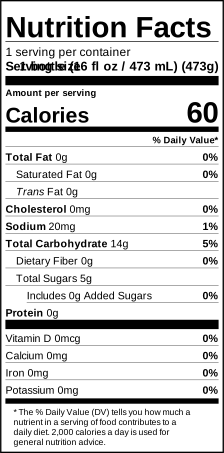
Serving size: what the RACC gives kombucha
21 CFR 101.12 puts kombucha in the general beverage category (“carbonated and noncarbonated beverages, wine coolers, water”) at 360 mL. Convert that into a label statement using the closest realistic household measure, commonly “8 fl oz (240 mL)” for smaller pours. Package size then drives single-serving versus dual-column rules the same way it does for any bottled beverage: a bottle packaged and sold individually that contains less than 200% of the RACC (up to about 24 fl oz) is labeled as one serving under 21 CFR 101.9(b)(6): the entire contents count as “1 serving,” which is how the 16 fl oz bottle in the sample panel above is declared. Once a single bottle reaches 200–300% of the RACC (roughly 24–36 fl oz), 21 CFR 101.9(b)(12)(i) requires a mandatory second column showing “per serving” and “per container” values side by side; between 150% and 200% of RACC, that second column is optional rather than required.
What the panel must show
The 15 mandatory nutrients under 21 CFR 101.9(c) apply to kombucha like any other beverage: calories, total fat, saturated fat, trans fat, cholesterol, sodium, total carbohydrate, dietary fiber, total sugars, added sugars, protein, vitamin D, calcium, iron, and potassium. For kombucha specifically, total sugars and added sugars are the values you’re most likely to get wrong, because fermentation lowers total sugars from the starting brew and added sugars has to reflect that change, not the recipe’s original sugar addition. FDA’s Nutrition and Supplement Facts Labels: Questions and Answers guidance addresses this directly: manufacturers of fermented products may either analytically determine and document a reasonable approximation of added sugars remaining in the finished product, or declare the amount of sugar added before fermentation with records to verify it, but in either case, the declared added sugars figure can never exceed total sugars on the label (Question 18, https://www.fda.gov/media/117402/download, interpreting 21 CFR 101.9(c)(6)(iii)). %DV follows the standard reference daily values and footnote.
Format: which layout your package qualifies for
Most bottled kombucha uses the standard vertical Nutrition Facts format. Packages with total labelable surface area of 40 sq in or less may use a tabular layout, or linear (string) format if the surface is under 12 sq in or the shape can’t fit a tabular display, per 21 CFR 101.9(j)(13)(ii); packages under 12 sq in total surface area can skip the panel entirely under 101.9(j)(13)(i) if there’s no nutrition claim and the label carries an address or phone number for nutrition information, a scenario unlikely for a standard 16 oz kombucha bottle but relevant for tasting-sample minis. The NutriLabels builder renders standard vertical, tabular, linear, dual-column (per serving/per container), bilingual, and infant/children formats for FDA-regulated kombucha.
Kombucha-specific traps
The single biggest trap is alcohol content drifting upward after the label is already printed: kombucha that tests under 0.5% ABV at bottling but keeps fermenting in a sealed bottle can cross into TTB territory later in its shelf life, which is why TTB’s own guidance calls out “at any time after bottling” as a trigger point (https://www.ttb.gov/regulated-commodities/beverage-alcohol/kombucha). If your product is at or approaching 0.5% ABV, that’s a conversation for a food-labeling attorney or TTB directly, not a guess on our part. The second trap is the added sugars declaration described above: using the pre-fermentation recipe amount without the documentation FDA’s guidance calls for is a common shortcut that doesn’t hold up under review. FDA does not require a “keep refrigerated” storage statement on the Nutrition Facts label; whether one belongs on a live, unpasteurized kombucha bottle is a process and shelf-life question governed by your state or local retail food code, not an FDA nutrition-labeling requirement. Many brands refrigerate to slow ongoing fermentation and manage the ABV drift issue above, but confirm the labeling requirement (as opposed to a quality choice) with your state food safety authority.
Ingredient statement and allergens
Ingredients are listed in descending order by predominance by weight under 21 CFR 101.4, and a live culture like a SCOBY (symbiotic culture of bacteria and yeast) is typically declared by its function or common name per your recipe documentation. Plain kombucha carries no major allergens, but flavor add-ins (fruit purees, honey, ginger, or botanical blends) should be checked for tree nut, milk, or other allergen carryover and declared in a FALCPA “Contains” statement. Since the FASTER Act added sesame as the ninth major allergen in 2023, review any flavor blends or botanical mixes for sesame-derived ingredients as well.
Build the label
An added sugars line backed by your own fermentation records is one you can explain when a buyer asks about it. Enter your recipe, then see your kombucha label: the calorie count, the nutrient content claims you qualify for and your allergen line show free, no card required, while every other value and %DV stays hidden until you unlock it. $29 unlocks every other nutrient value and %DV, every FDA format your kombucha qualifies for, and the ingredient statement and allergen declaration, ready to print. Start your kombucha label, or browse other product labels.
Kombucha label FAQ
What serving size does the FDA use for kombucha?
Kombucha falls under the general beverage RACC of 360 mL in 21 CFR 101.12, the same reference amount used for carbonated and noncarbonated drinks and wine coolers.
At what alcohol level does kombucha stop being an FDA-only product?
TTB guidance states that kombucha at or above 0.5% alcohol by volume at any point during production, at bottling, or afterward from continued fermentation is an alcohol beverage subject to TTB regulation (TTB Guidance G 2010-3A, ttb.gov/regulated-commodities/beverage-alcohol/kombucha).
Why doesn't my kombucha's added sugars line match how much sugar I started with?
Fermentation consumes some of the starting sugar, and FDA guidance lets you either analytically approximate the remaining added sugars with supporting records, or declare the amount of sugar added before fermentation with records to back it up, but the declared added sugars can never exceed total sugars on the label (FDA, Nutrition and Supplement Facts Labels Q&A, Question 18, https://www.fda.gov/media/117402/download).
Does kombucha need refrigeration language on the label?
FDA does not require a refrigeration statement on the Nutrition Facts label; whether your product must carry "Keep Refrigerated" depends on its process and your state or local retail food code. Check with your state food safety authority since kombucha is often sold refrigerated to slow ongoing fermentation.
Can I claim my kombucha is "probiotic" on the label?
"Probiotic" isn't a defined nutrient content claim under 21 CFR 101.9, so any such claim is a separate labeling and substantiation question. Talk to a food-labeling attorney before using it, since it can trigger other FDA scrutiny outside the Nutrition Facts panel itself.
Related products
Tea, Coffee, Granola. See the full all products.