
Last verified 16 Sep 2026 · Sources
Protein bars sit at a fork the FDA leaves to you: sell it as a conventional food, or label it as a dietary supplement, and each path uses a different panel. Marketed and labeled as a food, a bar generally falls under the “grain-based bars” Reference Amount Customarily Consumed (RACC) of 40 g that covers granola bars, and it carries a standard Nutrition Facts label. The trap you’re most likely to hit isn’t serving size. It’s the protein number itself: make any protein content claim (“high protein” and similar), and FDA requires the %DV for protein to use a protein-quality adjustment, not just raw grams. A Nutrition Facts label is required on a protein bar sold as a conventional food unless the small-business exemption applies and no claims are made.
| Quick facts | Protein bars |
|---|---|
| Regulator | FDA |
| Reference amount (RACC) | Grain-based bars with or without filling or coating (breakfast bars, granola bars, rice cereal bars): 40 g (applies when marketed as a conventional food) |
| Typical serving statement | 1 bar (60 g) |
| Typical label format | Standard vertical Nutrition Facts for a conventional-food bar over 40 sq in; a Supplement Facts panel (not a Nutrition Facts format) applies instead if the product is labeled and represented as a dietary supplement |
| Exemption | Not exempt |
| Watch out for | Conventional food vs. dietary supplement changes the whole panel; any protein claim requires a PDCAAS-adjusted %DV, not raw grams |
| Common allergens | Milk, soy (whey/soy protein isolates), tree nuts, peanuts; check sweetener systems for sugar alcohols |
What is the serving size for protein bars? The FDA serving for protein bar depends on the weight of one piece. See the full serving-size reference: single-serving cut-off, dual-column range, and servings per package.
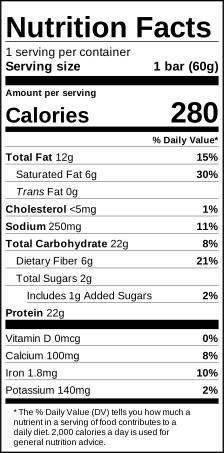
Serving size: what the RACC gives Protein bars
For a bar marketed as a conventional food, the 40 g grain-based-bars reference amount from 21 CFR 101.12 Table 2 generally applies, the same category that covers granola bars and rice cereal bars (21 CFR 101.12). From there, the discrete-unit rules in 21 CFR 101.9(b)(2)(i) decide how your specific bar weight becomes a serving statement: a unit at least 67% but under 200% of the RACC (roughly 27 g to just under 80 g) is one serving per bar; a unit at 200% up to 300% of the RACC (80 g to 120 g) has its serving set near the RACC amount with an added per-unit column. A common 60 g protein bar sits at 150% of the 40 g RACC, comfortably inside the one-bar-equals-one-serving range, so “1 bar (60 g)” is a realistic label statement. If your bar is unusually dense or protein-forward, it’s worth confirming the RACC category actually fits before assuming the grain-based-bars line applies.
The conventional food vs. dietary supplement choice
This is the decision that shapes everything else on the label. FDA guidance describes dietary supplements as capable of taking food-like forms (bars, teas, drinks) “but only if the product is not represented as a conventional food or as a sole item of a meal or the diet,” and the product must be labeled as a dietary supplement, carrying that term or an equivalent on the label (FDA, Questions and Answers on Dietary Supplements). A bar sold in the snack aisle, positioned as a meal replacement or everyday food, and carrying a standard Nutrition Facts panel is a conventional food. A bar positioned and labeled as a supplement instead uses a Supplement Facts panel, a related but distinct format with its own rules for listing dietary ingredients, servings, and “other ingredients.” This isn’t a decision NutriLabels makes for you; it follows from how you intend to market and label the product, and it’s worth confirming with a food-labeling attorney if you’re straddling the line.
What the panel must show
Assuming a conventional-food bar, the mandatory nutrients are calories, total fat, saturated fat, trans fat, cholesterol, sodium, total carbohydrate, dietary fiber, total sugars, added sugars, protein, vitamin D, calcium, iron, and potassium, rounded and expressed as %DV per 21 CFR 101.9(c). Protein needs special attention: 21 CFR 101.9(c)(7) requires that when a protein claim is made for a product represented for adults and children over age 1, %DV must be based on a “corrected amount of protein”: actual grams of protein per serving multiplied by a protein digestibility-corrected amino acid score (PDCAAS), capped at 1.00. Without a claim, you can still print raw grams of protein per serving with no adjustment; the claim is what triggers the corrected calculation, not the presence of protein itself.
Format: which layout your package qualifies for
A conventional-food bar over 40 sq in of labelable surface uses standard vertical format; a small individually wrapped bar at or under that threshold can qualify for tabular or linear format under the same rules that apply to any grain-based bar (21 CFR 101.9(j)(13)(ii)). A dietary-supplement-labeled bar doesn’t use these Nutrition Facts formats at all. It uses the Supplement Facts panel structure, which NutriLabels’ current builder does not render; that path needs a supplement-specific labeling tool or service.
Protein bar-specific traps
The two traps: choosing “conventional food” or “dietary supplement” without thinking through how the bar is actually marketed, and slapping a protein claim on the front of pack before running the PDCAAS-adjusted %DV. A bar built on lower-digestibility protein sources (collagen, some plant blends) can see its adjusted %DV come in well under what the raw gram count implies, which is a problem if the claim was written around the unadjusted number.
Ingredient statement and allergens
Ingredients list in descending order by weight, with sub-ingredients of any protein blend or coating broken out. Whey and soy protein isolates are the two most common allergen sources in protein bars and require a “Contains” statement under FALCPA for milk and soy respectively, alongside tree nuts or peanuts if used. Sesame is the ninth major allergen under the FASTER Act and must appear in that same statement if tahini or sesame-derived ingredients are present (FDA, FASTER Act). Sugar alcohols used to keep sugar content low have their own labeling line under total carbohydrate and are worth double-checking against your actual sweetener system.
Build the label
Once you’ve settled the conventional-food-versus-supplement question and confirmed your RACC, the rest follows the standard rounding, %DV, and protein-quality rules.
A protein %DV you’ve run through PDCAAS lets your front-of-pack claim stand on the number behind it. Enter your recipe, then see your protein bar label: its shape and calorie count, the claims you qualify for and your allergen line are free, no card required, and every other value and %DV stays hidden until you unlock it. $29 unlocks every other nutrient value and %DV, every FDA format your product qualifies for, and the ingredient statement and allergen declaration as print-ready files, with 12 months of edits included and downloads that never expire. Start your label free, or browse other product labels.
Protein bars label FAQ
Is a protein bar a food or a dietary supplement?
Either, depending on how you represent and label it. A bar can be sold as a dietary supplement only if it isn't presented as a conventional food or as a sole item of a meal, and its label must say "dietary supplement" or an equivalent term; otherwise, it's a conventional food.
Does that choice change the label?
Yes. A bar marketed as a food gets the standard Nutrition Facts panel under 21 CFR 101.9. A bar labeled as a dietary supplement instead uses a Supplement Facts panel, a different format with its own rules for listing dietary ingredients.
What's the RACC for a protein bar sold as a food?
If it's a conventional food, it typically falls under the same "grain-based bars" line as granola bars (40 g), unless its composition puts it in a different 101.12 category; a co-packer or consultant can confirm the fit for an unusual formulation.
Can I just put "30 g protein" on the label without more math?
You can state the actual grams of protein per serving without adjustment. But the moment you make a protein content claim ("high protein," "excellent source of protein"), the %DV for protein must be calculated using a protein quality (PDCAAS) adjustment, not the raw gram count.
What is PDCAAS and why does it matter here?
It's a digestibility- and amino-acid-corrected protein quality score, capped at 1.00, that FDA's %DV protein calculation multiplies against the actual grams of protein per serving when a protein claim is made. A bar with lower-quality protein sources can show a %DV noticeably below its raw protein gram count would suggest.
My bar has added collagen or fiber-based sweeteners. Does that change anything?
Collagen is an incomplete protein and can pull down a PDCAAS-adjusted score if you're making a protein claim, and sugar alcohols used in low-sugar bars need their own labeling treatment. Both are reasons to run the real numbers rather than assume the bar "counts" like a standard protein source.
Related products
Granola bars, Granola, Beef jerky, Candy. See the full all products.
Sources
- ecfr.gov/current/title-21/chapter-I/…101/subpart-A/section-101.12
- ecfr.gov/current/title-21/chapter-I/…-101/subpart-A/section-101.9
- fda.gov/food/information-consumers-…-answers-dietary-supplements
- fda.gov/food/nutrition-food-labelin…oods-and-dietary-supplements
- fda.gov/food/food-allergies/faster-…me-ninth-major-food-allergen
- fdc.nal.usda.gov/food-details/485276/nutrients