
Last verified 16 Sep 2026 · Sources
Beef jerky’s Reference Amount Customarily Consumed (RACC) is 30 g under the “dried meat, poultry, or fish” category (the same category that covers dried beef and pepperoni-style sausages), which is why a serving statement usually reads “about 3 pieces (30 g)” rather than a whole bag. Most beef and poultry jerky sits with USDA’s Food Safety and Inspection Service (FSIS) rather than FDA, because beef and poultry are “amenable species” USDA inspects from slaughter through the finished label (fda.gov CPG 565.100); plant-based jerky and most fish jerky stay with FDA instead. The first trap to watch is sodium: drying and marinating concentrate salt well past what a fresh cut of meat would show, and label rounding still applies down to the milligram. A nutrition label is required once jerky is offered for sale; the narrow USDA exemption in 9 CFR 317.400 covers only single-ingredient raw cuts, not a dried, seasoned product like jerky.
| Quick facts | Beef jerky |
|---|---|
| Regulator | USDA-FSIS |
| Reference amount (RACC) | 30 g (Dried meat, poultry, or fish, e.g., jerky, dried beef) |
| Typical serving statement | about 3 pieces (30 g) |
| Typical label format | Tabular for most single-serve 1-3 oz bags (40 sq in or less); standard vertical for larger multi-serve pouches and boxes |
| Exemption | Not exempt: jerky carries significant sodium, fat, and protein, so it does not qualify for the 21 CFR 101.9(j)(4)/9 CFR analog insignificant-nutrient exemption |
| Watch out for | Sodium %DV runs high from marinade/drying; jurisdiction splits by species (FSIS vs FDA) |
| Common allergens | Soy and wheat (soy sauce/marinades), sesame (teriyaki oil or seeds), fish (Worcestershire/anchovy-based marinades) |
What is the serving size for beef jerky? The FDA serving for beef jerky depends on the weight of one piece. See the full serving-size reference: single-serving cut-off, dual-column range, and servings per package.
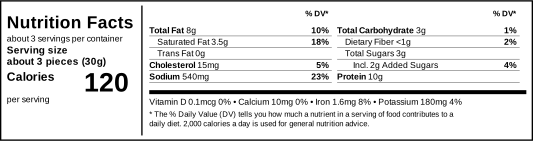
Serving size: what the RACC gives jerky
FSIS’s own reference-amount table, 9 CFR 317.312(b), lists the category verbatim as “Dried; e.g., jerky, dried beef, Parma ham” at 30 g ready-to-eat, the same 30 g FDA uses for dried meat, poultry, and fish under 21 CFR 101.12. To turn that into a label statement, weigh a typical piece: at roughly 10 g per piece, the serving reads “about 3 pieces (30 g).”
The discrete-unit math in 9 CFR 317.309 mirrors FDA’s 101.9(b)(2)(i) closely: a piece at 50%-67% of the RACC (15-20 g) may be declared as 1 or 2 units; 67%-200% (20-60 g) is one unit; 200%-300% (60-90 g) requires an added per-unit column alongside the RACC-sized serving. Package size layers on top: a single 1 oz (28 g) bag stays under 200% of RACC and labels as one serving, full contents. An 81 g (2.85 oz) bag lands at about 270% of RACC, which pulls in the same per-serving/per-container dual-column requirement FDA uses at 101.9(b)(12)(i), unless the package instead qualifies for tabular or linear format.
What the panel must show
Mandatory nutrients under 9 CFR 317.309 track FDA’s list: calories, total fat, saturated fat, trans fat, cholesterol, sodium, total carbohydrate, dietary fiber, total sugars, added sugars, protein, vitamin D, calcium, iron, and potassium, each with %DV (Percent Daily Value) and the standard footnote. Sodium is the number that matters most here: a 30 g serving commonly carries 500-800 mg. Added sugars matter too whenever the marinade uses brown sugar, honey, or a sweetened teriyaki base; that figure comes from your own recipe, not something a food database reports on its own, so calculate it from the sugar actually added rather than pulling a generic jerky number. Rounding follows the same rules FDA uses: sodium under 5 mg rounds to zero, 5-140 mg to the nearest 5 mg, and above that to the nearest 10 mg.
Format: which layout your package qualifies for
9 CFR 317.309 carries the identical surface-area thresholds as FDA’s 101.9(j)(13): a package with 40 sq in or less of labelable surface may use tabular format, and under 12 sq in may use linear (string) format, both with abbreviated nutrient names. Most single-serve 1-3 oz jerky bags fall in this range, so tabular is common; a larger multi-serving pouch or box usually has room for standard vertical. NutriLabels’ builder renders standard vertical, tabular, linear, and dual-column per serving/per container for jerky; it does not render the aggregate variety-pack format, which our expert service handles instead.
Beef jerky-specific traps
Jurisdiction is the first fork: beef and poultry jerky need FSIS inspection and label sign-off, while a plant-based “jerky” or most fish jerky stays with FDA, and a mixed formula can involve both agencies depending on meat content. FSIS’s approval system splits into generic approval (which most nutrition facts panels, factual statements, and FSIS-defined nutrient content claims qualify for without submission) and mandatory sketch approval, required for special statements like “no antibiotics ever,” “grass-fed,” religious-exempt labels, temporary labels, and export-only deviations (fsis.usda.gov Generic Final Rule overview). A defined claim such as “low fat” fits generic approval only with FSIS’s pre-approved wording; a customized version needs sketch review by FSIS’s Labeling and Program Delivery Staff. Shelf stability adds a food-safety layer on top of labeling: FSIS’s jerky compliance guideline covers the drying and lethality steps, including water activity, a small or very small establishment needs before a dried product is legally ready-to-eat. Confirm the current guideline directly at fsis.usda.gov/guidelines/2014-0010 before finalizing a process.
Ingredient statement and allergens
List ingredients in descending order by weight, the same descending-weight principle FDA uses for human food. Jerky marinades are where allergens hide: soy sauce brings soy and wheat, teriyaki and sweet glazes often carry sesame oil or seeds, and Worcestershire-based marinades can include anchovy (fish) alongside soy. Close the ingredient statement with a “Contains” line for whichever FALCPA/FASTER Act allergens apply: milk, egg, fish, shellfish, tree nuts, peanuts, wheat, soybeans, or sesame, the ninth major allergen since 2023.
Build the label
A sodium line rounded correctly and a serving built on the 30 g reference amount give you a clean panel to take into FSIS label approval. Enter your recipe, then see your label: the calorie count, the nutrient content claims you qualify for and your allergen line show free, no card required, while every other value and %DV stays hidden until you unlock it. $29 unlocks every other nutrient value and %DV, every FDA or FSIS-equivalent format your jerky package qualifies for, and the ingredient statement and allergen declaration, ready to print. Start your label, or compare other snacks on the product labels hub.
Beef jerky label FAQ
Is beef jerky FDA or USDA regulated?
Beef and poultry jerky fall under USDA's Food Safety and Inspection Service (FSIS) because beef and poultry are 'amenable species' USDA inspects from slaughter through the finished label (fda.gov CPG 565.100). Plant-based jerky and most fish jerky stay with FDA instead.
Why is my jerky's sodium %DV so high?
Drying concentrates the marinade's salt into a smaller weight of finished product, so a 30 g serving of jerky often carries 500-800 mg of sodium, a bigger share of the day's %DV than a fresh cut of the same meat would show.
What's the difference between generic and sketch label approval at FSIS?
Generic approval covers standard nutrition facts panels, factual statements, and FSIS-defined nutrient content claims with no pre-submission needed. Sketch approval is mandatory for special statements like 'no antibiotics ever,' religious-exempt labels, temporary labels, and export deviations, submitted to FSIS's Labeling and Program Delivery Staff (fsis.usda.gov Generic Final Rule overview).
Does a 2.85 oz jerky bag need a dual-column label?
At about 270% of the 30 g RACC, an 81 g bag falls in the 200%-300% band that triggers a per-serving/per-container dual column under the FSIS analog to 21 CFR 101.9(b)(12)(i), unless the package instead qualifies for tabular or linear format.
Do I need a Nutrition Facts panel on jerky sold at a farmers market?
If you're operating under a state cottage food exemption with no nutrition claims, check your state's rules first. Many cottage food laws exclude jerky or other meat products outright because FSIS jurisdiction applies regardless of sales channel. Once sold wholesale or through a retailer, a compliant panel is expected.
Is plant-based jerky labeled the same way as beef jerky?
No. Plant-based jerky (soy, mushroom, jackfruit) is FDA-regulated food, so it follows 21 CFR 101.9 and 101.12 rather than the USDA-FSIS rules in 9 CFR 317, even though the RACC amount (30 g) is the same.
Related products
Dog treats, Cheese, Candy. See the full all products.
Sources
- ecfr.gov/current/title-9/chapter-III…17/subpart-B/section-317.312
- ecfr.gov/current/title-9/chapter-III…17/subpart-B/section-317.309
- ecfr.gov/current/title-9/chapter-III…17/subpart-B/section-317.300
- fda.gov/regulatory-information/sear…er-meat-and-poultry-products
- fsis.usda.gov/sites/default/files/media_f…l-Rule-Overview-Industry.pdf
- fsis.usda.gov/guidelines/2014-0010
- fdc.nal.usda.gov/food-details/167536/nutrients