
Last verified 16 Sep 2026 · Sources
Soup’s RACC (Reference Amount Customarily Consumed, the FDA’s reference serving for your product type) is 245 g for every variety, about 1 cup prepared. Dry soup mixes use the RACC for “amount to make 245 g.” That means your declared serving is however much mix makes that one prepared cup (21 CFR 101.12).
Most soup stays with FDA. But once cooked poultry meat reaches roughly 2% of the ready-to-serve product, oversight generally moves to USDA-FSIS. FSIS uses its own poultry labeling rules instead of the FDA’s Nutrition Facts panel.
The trap most likely to catch you isn’t the serving size. It’s sodium. Soup is built around salt for flavor and shelf life, so it’s rarely a candidate for any kind of “insignificant nutrient” treatment. Essentially every soup sold commercially needs a Nutrition Facts panel, or the USDA nutrition label if FSIS has oversight. A qualifying small business can skip it if it makes no nutrition claims. The FDA small-business exemption and the FSIS version set different limits.
| Quick facts | Soup |
|---|---|
| Regulator | FDA (USDA-FSIS if cooked poultry meat is 2% or more by ready-to-serve weight, or the soup meets FSIS's meat or poultry flavor-product threshold) |
| Reference amount (RACC) | 245 g (all soups). Dry soup mixes use the amount that makes 245 g. |
| Typical serving statement | 1 cup (245 g) prepared |
| Typical label format | Standard vertical for most cans and pouches (condensed soup and dry mixes often add an optional "as prepared" column, and tabular or linear is only for packages of 40 sq in or less) |
| Exemption | This product type isn’t exempt. Soup reliably carries more than insignificant sodium, and often fat, so 101.9(j)(4) doesn't apply. The small-business exemption can still apply if you make no nutrition claims. |
| Watch out for | Sodium % Daily Value runs high in nearly all soup. Condensed soup and dry mixes usually add an "as prepared" column under 101.9(e). |
| Common allergens | Wheat (noodles, roux), milk (cream-based soups), soy, fish/shellfish (chowders, bisques), sesame in some broths and seasoning bases |
What is the serving size for soup? The FDA serving for soup is 1 cup (245g). The full serving-size reference shows the single-serving cut-off, the dual-column range and the servings per package.
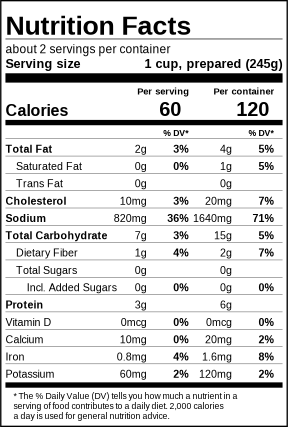
How big is a soup serving?
The 245 g reference amount applies to all “soups, all varieties” under 21 CFR 101.12. Ready-to-serve, condensed or dried, the target is the same 245 g prepared serving. On your label that reads like “1 cup (245 g).”
For a dry soup mix, the RACC is based on the finished product. The reference amount is the amount of dry mix that makes 245 g of prepared soup. So a cup-of-soup packet that makes one 245 g bowl is declared as one RACC-sized serving, whatever the dry weight in the cup.
Package size still sets the single-serving and dual-column rules. Say a ready-to-serve can holds close to one 245 g serving (up to just under 200% of the RACC) and is sold on its own. It’s declared as one serving covering the whole can (21 CFR 101.9(b)(6)). A can that makes roughly 2 to 3 servings when prepared falls between 200% and 300% of the 245 g RACC, about 490 to 735 g as prepared. That needs the mandatory per-serving and per-container dual column under 101.9(b)(12)(i).
Condensed soup and dry mixes have a separate dual-column option under 21 CFR 101.9(e). Adding water clearly changes the nutrients. So most labels add an “as prepared” column for the 245 g finished serving next to the “as packaged” column. It’s optional, but it’s the column most customers actually read.
What goes on the panel
All 15 required nutrients under 21 CFR 101.9(c) apply. They are calories, total fat, saturated fat, trans fat, cholesterol, sodium, total carbohydrate, dietary fiber, total sugars, added sugars, protein, vitamin D, calcium, iron and potassium.
Sodium matters most for nearly every kind of soup. It often runs high enough per serving to be a real chunk of a day’s % Daily Value (%DV, the percent column on the right side of the panel). Saturated fat matters for cream-based and bisque-style soups.
The %DV footnote and standard rounding under 101.9(c) apply to both the “as packaged” and “as prepared” columns when you use a dual column. Each column is rounded on its own values. You don’t scale one from the other.
Which layout fits your can or pouch?
Standard cans and pouches use the standard vertical format. Condensed soup and dry mixes often use the optional “as prepared” and “as packaged” dual-column layout under 21 CFR 101.9(e). Smaller packages (cup-of-soup containers or single-serve pouches) at or under 40 sq in of total labelable surface can use a tabular layout under 21 CFR 101.9(j)(13)(ii) if a standard column won’t fit. They can use linear only if a tabular layout won’t fit.
The NutriLabels builder makes standard vertical, tabular, linear and simplified labels. It also makes dual-column per serving and per container, dual-column as prepared and as packaged, and bilingual English and Spanish formats.
Where soup labels go wrong
The biggest trap is which agency covers your soup. FSIS generally treats a product with less than 2% cooked poultry meat, on a ready-to-serve basis, as outside the “poultry product” definition (9 CFR 381.15). That also means it can’t be named “Chicken Noodle Soup” without a qualifier such as “Chicken-Flavored.”
Cross that line and your product generally moves to USDA-FSIS instead of an FDA panel. The same goes for a similar share of red meat, which FSIS reviews case by case under the “relatively small proportion” exemption in 9 CFR 301.2. FSIS’s general rule of thumb comes from its 2007 Federal Register notice on flavor products. A recipe with greater than 3% raw meat or poultry, or 2% or more cooked meat or poultry, falls under FSIS (72 FR 3779, “FSIS Jurisdiction Over Flavor Products Containing Meat or Poultry”).
If you make condensed or dry soup, think about adding the optional “as prepared” column under 101.9(e). It shows the numbers for the bowl your customer actually eats. Canned low-acid soups also have separate thermal-processing filing requirements. Call your co-packer or state food-safety authority before you can shelf-stable soup for the first time.
Your ingredient list and allergens
Ingredients are listed in descending order by weight (21 CFR 101.4). Break out the sub-ingredients of a broth base or seasoning blend as needed.
Wheat shows up in noodles and roux-thickened soups. Milk shows up in cream-based and chowder-style soups. Soy, fish or shellfish appear in many broths, bisques and Asian-style bases. Sesame, the ninth major allergen under the FASTER Act effective January 1, 2023, appears in some broths and seasoning mixes. Any of the nine in your soup must appear in a “Contains” statement under FALCPA, whether FDA or USDA-FSIS oversees your product.
Build your soup label
An “as prepared” column built from your own recipe shows your customer the bowl they actually eat. Enter your recipe, then see your soup label. Your label’s shape, calorie count, the claims you qualify for, your allergen line and the nutrient to watch show free, with no credit card required. The rest of the numbers on your label stay hidden until you buy a Single Product or the Studio plan.
A Single Product is $29. It unlocks the rest of the numbers on your label, every FDA format your product qualifies for, and the ingredient statement and allergen declaration, ready to print. Start your soup label, or browse other product labels.
Soup label FAQ
What serving size do I use for canned soup?
The RACC for soup, all varieties, is 245 g, about 1 cup prepared (21 CFR 101.12). It applies whether your soup is ready-to-serve or condensed and needs water added.
How do I label a dry soup mix packet?
Dry soup mixes use the RACC for "amount to make 245 g." So your declared serving is however much dry mix makes one 245 g prepared cup. It's not the weight of the dry packet itself.
Does my soup need an "as prepared" column?
It's optional, but most condensed soups and dry mixes add one. You can show nutrition "as prepared" in a second column next to the "as packaged" column (21 CFR 101.9(e)). It shows the bowl people actually eat.
When does my soup fall under USDA instead of FDA?
A soup with 2% or more cooked poultry meat, on a ready-to-serve basis, is generally treated as a poultry product under FSIS (9 CFR 381.15). Similar meat-content cutoffs apply for red meat, though the exact percentage is decided case by case under 9 CFR 301.2. Confirm your specific recipe with FSIS or a food-labeling attorney.
Can I still call a low-meat soup "Chicken Noodle Soup"?
Not always. FSIS guidance under 9 CFR 381.15 says a product with less than 2% cooked chicken on a ready-to-serve basis generally can't be labeled "Chicken Noodle Soup." A name like "Chicken-Flavored Noodle Soup" is used instead.
Why is sodium such a common problem on soup labels?
Soup recipes usually rely on salt as a main seasoning and preservative. So sodium routinely shows up as a real %DV per serving. It's high enough that you need to check the specific FDA cutoff before a "reduced sodium" or "low sodium" claim goes on your label.
Related products
Spice blends and seasonings, Salad dressing, Granola bars. See the full all products.
Sources
- ecfr.gov/current/title-21/chapter-I/…-101/subpart-A/section-101.9
- ecfr.gov/current/title-21/chapter-I/…101/subpart-A/section-101.12
- ecfr.gov/current/title-9/chapter-III…381/subpart-C/section-381.15
- ecfr.gov/current/title-9/chapter-III…ter-A/part-301/section-301.2
- federalregister.gov/documents/2007/01/26/E7-126…s-containing-meat-or-poultry
- fdc.nal.usda.gov/food-details/172909/nutrients