
Last verified 16 Sep 2026 · Sources
Bread’s Reference Amount Customarily Consumed (RACC) is 50 g under 21 CFR 101.12 (that’s about two slices of standard sandwich bread), while sweet quick-type breads like banana or zucchini bread use the 55 g reference amount shared with coffee cakes and doughnuts. The regulator is FDA, and the mistake we see most is weighing your whole loaf and dividing by however many slices you cut, instead of anchoring the serving to the RACC gram amount and rounding to a sensible slice count. A Nutrition Facts panel is required once bread is sold commercially with no applicable exemption; it’s not required for bread sold under most states’ cottage food rules as long as no nutrition claim is made.
| Quick facts | Bread |
|---|---|
| Regulator | FDA |
| Reference amount (RACC) | 50 g (Breads, excluding sweet quick type, rolls); sweet quick-type breads use 55 g |
| Typical serving statement | 2 slices (50 g) |
| Typical label format | Standard vertical for most loaves; tabular or linear only if labelable surface area is 40 sq in or less and a standard column won't fit |
| Exemption | Not exempt: bread contains more than insignificant amounts of carbohydrate, sodium, and calories, so it doesn't qualify for the 101.9(j)(4) all-nutrients exemption |
| Watch out for | Sodium %DV on yeast breads; naming a standardized bread (e.g., "whole wheat bread") pulls in 21 CFR 136 composition rules |
| Common allergens | Wheat, milk, egg (egg breads), soy (lecithin/conditioners); sesame if seeded (FASTER Act) |
What is the serving size for bread? The FDA serving for bread depends on the weight of one piece. See the full serving-size reference: single-serving cut-off, dual-column range, and servings per package.
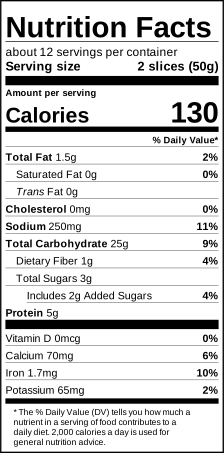
Serving size: what the RACC gives bread
Plain breads and rolls (excluding sweet quick type) get the 50 g reference amount in 21 CFR 101.12’s Table 2. To build a label statement, take your loaf’s actual slice weight and find how many slices land closest to 50 g. For a 25 g slice, that’s “2 slices (50 g)”; for a denser 40 g slice, “1 slice (40 g)” if it’s closer to a single-unit declaration, following the discrete-unit rule below.
101.9(b)(2)(i) governs single-slice or single-roll weights that don’t land neatly at the RACC: a unit that’s at least 67% and less than 200% of the RACC (about 34 g–99 g for a 50 g RACC) is declared as one unit. A dinner roll weighing 45 g, for instance, is one serving as “1 roll (45 g)” even though it’s under 50 g. Package-level rules apply too: a single-serving loaf sold individually under 200% of the RACC (under 100 g total) is one serving, full contents, per 101.9(b)(6); a small multi-roll package between 200% and 300% of the RACC (100 g–150 g) triggers the dual-column per-serving/per-container requirement under 101.9(b)(12)(i) unless the package qualifies for tabular or linear format instead.
What the panel must show
Bread carries the same mandatory nutrient list as any packaged food under 21 CFR 101.9(c): calories, total fat, saturated fat, trans fat, cholesterol, sodium, total carbohydrate, dietary fiber, total sugars, added sugars, protein, vitamin D, calcium, iron, and potassium, each with %DV where FDA has set one, plus the standard footnote. Sodium tends to be the number most likely to surprise you on yeast bread: dough conditioners, salt for gluten structure, and preservatives add up per slice, and total carbohydrate/fiber matter if you market a whole-grain product. Rounding under 101.9(c) applies as usual: sodium between 5 mg and 140 mg rounds to the nearest 5 mg, and fat or carb amounts under 5 g round to the nearest 0.5 g.
Format: which layout your package qualifies for
A standard loaf has plenty of labelable surface area for the standard vertical format our builder renders by default. Small single-roll packages or mini-loaves with 40 sq in of labelable surface or less, where a standard vertical column can’t fit anywhere on the package, may use tabular format, or linear format if under 12 sq in, per 21 CFR 101.9(j)(13)(ii). NutriLabels’ builder renders standard vertical, simplified, tabular, linear, dual-column (per serving/per container), and bilingual EN/ES for bread products; formats like aggregate labeling for a mixed multipack of different bread types go to our expert service instead.
Bread-specific traps
Naming your product with a term that has its own standard of identity is the trap unique to bread. “Bread, rolls, and buns” has a standard under 21 CFR 136.110 requiring a yeast-leavened dough with at least 62% total solids from specified farinaceous, moistening, and leavening ingredients; “whole wheat bread” carries its own composition standard under 21 CFR 136.180. Calling your product “bread” without meeting the applicable standard’s composition requirements is a labeling issue distinct from the Nutrition Facts panel. Whether your specific recipe meets a named standard of identity is a composition question best confirmed with a food-labeling attorney or your state regulator, not something our database analysis addresses. Separately, “egg bread” under 136.110 requires at least 2.56% whole egg solids and a “Contains ___ medium-sized egg(s) per pound” statement if the name references eggs.
Ingredient statement and allergens
List ingredients in descending order by predominant weight under 21 CFR 101.4. Enriched flour, standardized under 21 CFR 137.165, can be declared by that name alone or with its sub-ingredients (niacin, reduced iron, thiamine mononitrate, riboflavin, folic acid) spelled out in parentheses; 101.4(b)(2) permits either format, so match whatever your supplier’s spec sheet documents. Close with a “Contains” statement for milk, egg, wheat, soy, and tree nuts as applicable, and remember sesame seeds or sesame flour on a seeded loaf require sesame in that same line. It became the ninth major allergen under the FASTER Act effective January 1, 2023 (fda.gov/food/food-allergies/faster-act-sesame-ninth-major-food-allergen).
Build the label
A serving anchored to the 50 g reference amount means your slice count and sodium line hold up the first time a store buyer checks them. Enter your recipe, then see your label: your calories, the claims you qualify for and your allergen line are free, no card required, and every other value and %DV stays hidden until you unlock it. $29 unlocks every other nutrient value and %DV, every FDA format your bread package qualifies for, and the ingredient statement and allergen declaration, ready to print. Start your label, or check other baked goods in the serving sizes guide.
Bread label FAQ
Is the RACC for bread the same as for sweet breads like banana bread?
No. 21 CFR 101.12 gives plain breads and rolls a 50 g reference amount, but sweet quick-type breads (banana bread, zucchini bread, pumpkin bread) use the 55 g reference amount that also covers coffee cakes and doughnuts.
Do I have to spell out enriched flour's sub-ingredients on my bread label?
Not necessarily. Under 21 CFR 101.4(b)(2), a standardized compound ingredient like enriched flour can be declared by that name alone or broken out into its components (niacin, reduced iron, thiamine mononitrate, riboflavin, folic acid) in parentheses. Either is allowed.
Does calling my product "whole wheat bread" mean it has to meet a legal recipe?
Using a name with an established standard of identity, like whole wheat bread under 21 CFR 136.180, means your bread has to meet that standard's composition requirements to use the name. Talk to a food-labeling attorney if you're unsure your recipe qualifies.
What serving size goes on a label for a single dinner roll?
Rolls share the same 50 g RACC as bread. If one roll weighs close to 50 g, it's typically one serving; the discrete-unit thresholds in 21 CFR 101.9(b)(2)(i) apply the same way they do for any other unit-based food.
What format can a small loaf of artisan bread use?
If the loaf's labelable surface area is 40 sq in or less and a standard vertical panel won't fit anywhere on the package, tabular format is available under 101.9(j)(13)(ii); our builder checks your package dimensions and tells you which formats you qualify for.
Related products
Cookies, Muffins. See the full all products.
Sources
- ecfr.gov/current/title-21/chapter-I/…101/subpart-A/section-101.12
- ecfr.gov/current/title-21/chapter-I/…-101/subpart-A/section-101.9
- ecfr.gov/current/title-21/chapter-I/…36/subpart-B/section-136.110
- ecfr.gov/current/title-21/chapter-I/…-101/subpart-A/section-101.4
- fda.gov/food/food-allergies/faster-…me-ninth-major-food-allergen
- fdc.nal.usda.gov/food-details/174924/nutrients