
Last verified 16 Sep 2026 · Sources
Bakery-style muffins have a 110 g RACC (Reference Amount Customarily Consumed, the FDA’s reference serving for your product type) under 21 CFR 101.12. English muffins are a separate category, at 55 g alongside biscuits and crumpets. FDA is the regulator.
The trap most likely to catch you is assuming “1 muffin” always means “1 serving.” Check where your muffin’s actual weight falls against the RACC first. A jumbo muffin and a mini muffin from the same bakery can legally need two different serving statements. You need a Nutrition Facts panel once you sell your muffins, unless your business qualifies for the FDA small-business exemption and you make no nutrition claims.
| Quick facts | Muffins |
|---|---|
| Regulator | FDA |
| Reference amount (RACC) | 110 g (bagels, toaster pastries and muffins other than English muffins). English muffins use 55 g. |
| Typical serving statement | 1 muffin (110 g) |
| Typical label format | Standard vertical for most bakery muffins (a per-unit dual column for jumbo muffins over 220 g, tabular or linear for small multipacks of minis) |
| Exemption | This product type isn’t exempt. Muffins have more than insignificant fat, carbohydrate and sugars, so the 101.9(j)(4) exemption doesn't apply. The small-business exemption can still apply if you make no nutrition claims. |
| Watch out for | A 120 g bakery muffin is one serving, but a 60 g mini muffin needs the discrete-unit math for how many make a serving. English muffins use a different RACC entirely. |
| Common allergens | Wheat, egg, milk, soy (lecithin), tree nuts or peanuts in mix-ins, and sesame if seeded (FASTER Act) |
What is the serving size for muffins? The FDA serving for muffin depends on the weight of one piece. The full serving-size reference shows the single-serving cut-off, the dual-column range and the servings per package.
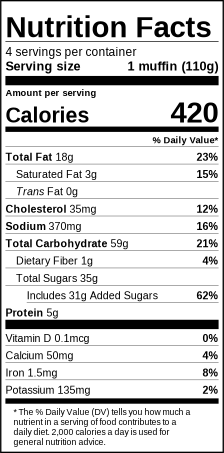
How big is a muffin serving?
The 110 g reference amount applies to bagels, toaster pastries and muffins, excluding English muffins, per Table 2 in 21 CFR 101.12. A standard bakery muffin close to 110 g is labeled simply as “1 muffin (110 g).” The details come from the rule for single pieces in 101.9(b)(2)(i). It sets three bands against the 110 g RACC.
- 50% to 67% of RACC (55 g to 74 g): You may declare 1 or 2 units as the serving. A 60 g mini muffin (55% of RACC) could be labeled “1 mini muffin (60 g)” or “2 mini muffins (120 g).” Most brands choose 2 to land closer to the RACC weight.
- 67% to 200% of RACC (74 g to 220 g): One unit is the serving, whatever its exact weight. A 120 g bakery muffin (109% of RACC) is declared as “1 muffin (120 g),” the whole muffin, at its real weight.
- 200% to 300% of RACC (220 g to 330 g): The serving is set at about the RACC amount, with a required extra per-unit column. A 240 g jumbo muffin would need a serving column for roughly a 110 g portion next to a per-muffin column.
Package rules come on top of that. A single muffin wrapped on its own and under 200% of the RACC (under 220 g) is one serving, the full contents, per 101.9(b)(6). A mini-muffin multipack between 200% and 300% of the RACC by total package weight needs the dual column (per serving and per container) under 101.9(b)(12)(i). The exception is a package that qualifies for tabular or linear format instead.
What goes on the panel
Muffins carry the standard list of required nutrients under 21 CFR 101.9(c). They are calories, total fat, saturated fat, trans fat, cholesterol, sodium, total carbohydrate, dietary fiber, total sugars, added sugars, protein, vitamin D, calcium, iron and potassium. Each gets a % Daily Value (the percent column on the right side of the panel) where one is set, plus the standard footnote.
Saturated fat and added sugars usually matter most here. Muffin batter runs on butter or oil plus a good amount of sugar. Nearly all of that sugar is added rather than natural, so total sugars and added sugars often sit close together on your panel. Standard 101.9(c) rounding applies. Sodium from 5 mg to 140 mg rounds to the nearest 5 mg. Fat under 5 g rounds to the nearest 0.5 g. Carbohydrate and protein round to the nearest gram, with “less than 1 g” below 1 g.
Which layout fits your muffin package?
A single wrapped bakery muffin or a box of 4 to 6 usually has room for the standard vertical format our builder makes by default. Jumbo muffins in the 200% to 300% RACC band need a dual-column per-unit layout, which the builder also handles. A small multipack of mini muffins may have 40 sq in or less of labelable surface where a standard column won’t fit. Then it may use tabular format under 101.9(j)(13)(ii), or linear if a tabular layout won’t fit either.
The NutriLabels builder makes standard vertical, simplified, tabular, linear, dual-column (per serving and per container, and per unit) and bilingual English and Spanish labels for muffins. Mixed-flavor boxes that need the aggregate format go to our expert service instead.
Where muffin labels go wrong
The biggest trap is mixing up English muffins. They’re a completely different RACC category (55 g, not 110 g), because FDA groups them with biscuits and crumpets rather than other muffins. A serving statement built from the wrong table is wrong from the start.
The second trap is size changes within one product. Bakery muffins are well known for varying in weight from batch to batch. If you weigh one sample muffin and lock in that serving size for good, your label can drift out of compliance as recipe or pan changes shift the real weight. Claims like “low fat” or “good source of fiber” have their own number cutoffs under FDA’s nutrient content claim rules. Check them before you print.
Your ingredient list and allergens
List your ingredients in descending order by weight, per 21 CFR 101.4. Enriched flour is a standardized food (21 CFR 137.165), so it can’t appear as “enriched flour” alone. List it as enriched flour followed by its ingredients in parentheses (wheat flour, niacin, reduced iron, thiamine mononitrate, riboflavin, folic acid, plus malted barley flour if yours has it). Or list each of those ingredients in its own place in your list (21 CFR 101.4(b)(2)).
End with a “Contains” statement covering wheat, egg and milk, which are in nearly every muffin batter. Add soy if you use lecithin, tree nuts or peanuts for any mix-in, and sesame if you use a seeded topping. Sesame became the ninth major allergen under the FASTER Act, effective January 1, 2023 (fda.gov/food/food-allergies/faster-act-sesame-ninth-major-food-allergen).
Build your muffin label
Weigh the muffin you actually bake before you print. Then your serving statement matches what your customer unwraps. Enter your recipe, then see your label. Your label’s shape, calorie count, the claims you qualify for, your allergen line and the nutrient to watch show free, with no credit card required. The rest of the numbers on your label stay hidden until you buy a Single Product or the Studio plan.
A Single Product is $29. It unlocks the rest of the numbers on your label, every FDA format your muffin package qualifies for, and the ingredient statement and allergen declaration, ready to print. Start your muffin label, or see how serving sizes work for other baked goods.
Muffins label FAQ
Why do muffins and English muffins use different serving sizes?
They're different categories in 21 CFR 101.12. Bagels, toaster pastries and muffins (excluding English muffins) get a 110 g reference amount. English muffins are grouped with biscuits, crumpets and soft pretzels at 55 g.
Is a 120 g bakery muffin one serving or more?
A 120 g muffin is 109% of the 110 g RACC. That puts it in the 67% to 200% band under 21 CFR 101.9(b)(2)(i). So it's declared as one serving, one muffin. That's the whole thing, at its actual 120 g weight.
How is a 60 g mini muffin served on the label?
A 60 g mini muffin is 55% of the 110 g RACC, in the 50% to 67% band for single pieces. So the rule lets you declare either 1 or 2 minis as a serving. Most brands pick 2 minis (120 g) to land close to the RACC.
Do I need a per-container column for a 4-pack of jumbo muffins?
Say each jumbo muffin is wrapped on its own and weighs between 220 g and 330 g (200% to 300% of the 110 g RACC). Then 21 CFR 101.9(b)(2)(i) requires the RACC-sized amount as the serving, with an added per-unit column. A simple 1 muffin equals 1 serving label won't do.
What allergens are typical for muffins?
Wheat, egg and milk are in nearly every muffin batter. Soy shows up through lecithin in liners or mix-ins. Nut or seed toppings need their own Contains declaration, including sesame under the FASTER Act.
Related products
Bread, Cookies. See the full all products.