
Last verified 16 Sep 2026 · Sources
Cookies fall under the 30 g Reference Amount Customarily Consumed (RACC) in 21 CFR 101.12, one of the smaller baked-goods categories, which is why a “serving” of cookies on a Nutrition Facts label is often 2 or 3 cookies, not 1. A typical label statement looks like “2 cookies (30 g)” or “3 cookies (30 g),” depending on your recipe’s per-cookie weight. The regulator here is FDA, and the thing most likely to go wrong on your label is assuming “1 cookie = 1 serving.” The RACC sets the serving in grams, and your individual cookie’s weight then determines whether that’s one cookie, a fraction of one, or several. A Nutrition Facts panel is required once you’re selling commercially (retail, wholesale, farmers-market co-op requiring one) rather than under a state cottage food exemption with no nutrition claims.
| Quick facts | Cookies |
|---|---|
| Regulator | FDA |
| Reference amount (RACC) | 30 g (Cookies) |
| Typical serving statement | 2 cookies (30 g) |
| Typical label format | Standard vertical for most bagged cookies; tabular or linear only if the package's labelable surface area is 40 sq in or less and a standard column won't fit |
| Exemption | Not exempt: cookies do not qualify for the 101.9(j)(4) insignificant-nutrient exemption because they contain more than insignificant fat, carbohydrate, and sugars |
| Watch out for | Discrete-unit rounding on odd cookie weights; "made with real butter" claims that don't trip a nutrient claim but read like one |
| Common allergens | Wheat, eggs, milk, soy (lecithin), tree nuts or peanuts in mix-ins; check sesame in any seed topping (FASTER Act) |
What is the serving size for cookies? The FDA serving for cookie depends on the weight of one piece. See the full serving-size reference: single-serving cut-off, dual-column range, and servings per package.
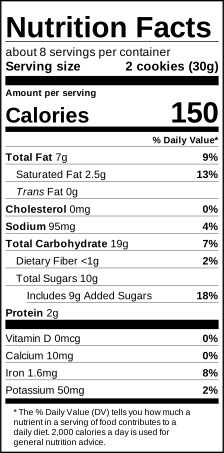
Serving size: what the RACC gives cookies
FDA’s cookie category sits at 30 g per 21 CFR 101.12’s reference amount table. To turn that into a label statement, divide 30 g by your actual single-cookie weight and round to a practical household count, then state the gram equivalent in parentheses, e.g., “3 cookies (33 g)” for an 11 g cookie.
The discrete-unit rule in 21 CFR 101.9(b)(2)(i) is what actually decides this for odd-sized cookies: – A unit that’s more than 50% but less than 67% of the RACC (15 g–20 g here) may be declared as 1 or 2 units (your choice). – A unit that’s at least 67% and less than 200% of the RACC (20 g–60 g) is declared as one unit, so a 25 g cookie (83% of RACC) is one serving, one cookie, even though it’s under 30 g. – A unit that’s at least 200% and up to 300% of the RACC (60 g–90 g) is labeled with the serving set at the amount approximating the RACC, plus a required additional per-unit column, so a 60 g jumbo cookie needs a per-serving column near 30 g (about half the cookie) alongside a per-cookie column.
Package-size rules layer on top. A single-serving container under 200% of the RACC (under 60 g total) is labeled as one serving, full contents, per 101.9(b)(6). A multi-cookie bag between 200% and 300% of the RACC (60 g–90 g total) triggers the dual-column per-serving/per-container requirement under 101.9(b)(12)(i), unless it qualifies for tabular or linear format instead.
What the panel must show
The mandatory nutrients are the same list as any packaged food under 21 CFR 101.9(c): calories, total fat, saturated fat, trans fat, cholesterol, sodium, total carbohydrate, dietary fiber, total sugars, added sugars, protein, vitamin D, calcium, iron, and potassium, each with %DV (Percent Daily Value) where established, plus the standard footnote. For cookies specifically, saturated fat and added sugars are the numbers shoppers and retailers scrutinize most: a butter- or shortening-heavy recipe pushes saturated fat, and most cookie sweetening is added sugar rather than anything naturally occurring in the dough, so nearly all of your total sugars figure will also count as added sugars.
Rounding under 101.9(c) matters here: calories round to the nearest 5 kcal below 50 and nearest 10 above; fats and carbs under 5 g round to the nearest 0.5 g; sodium under 5 mg rounds to zero, 5–140 mg to the nearest 5 mg.
Format: which layout your package qualifies for
Most bagged cookies (a 6 oz to 12 oz bag) have enough labelable surface area to run standard vertical format, which our builder renders. If your package’s total labelable surface area is 40 sq in or less and its shape can’t accommodate a standard vertical column anywhere, 21 CFR 101.9(j)(13)(ii) allows tabular format, or linear (string) format under 12 sq in. A single-serving 1-cookie sleeve under 12 sq in with no nutrition claims may also qualify for the small-package exemption under 101.9(j)(13)(i), provided it carries a phone number or address for nutrition information instead of a panel. NutriLabels’ builder renders standard vertical, simplified, tabular, linear, dual-column, and bilingual EN/ES for cookies; multi-form aggregate formats like a variety box of flavors go to our expert service instead.
Cookie-specific traps
Allergens are the biggest snag: wheat and eggs are near-universal in cookie dough, milk shows up via butter or milk solids, and soy lecithin is common in chocolate chips. Any nut-based mix-in needs a plain “Contains” declaration. If a cookie or topping uses sesame seeds or tahini, remember sesame became the ninth major allergen under the FASTER Act effective January 1, 2023 (fda.gov/food/food-allergies/faster-act-sesame-ninth-major-food-allergen), and it goes in the same “Contains” line as the other eight. Claims are the second trap: words like “low fat” or “reduced sugar” each carry a specific FDA numeric threshold under the nutrient content claims rules, and using one without meeting the number turns a fine label into a problem. A plain callout like “made with real butter” is not one of these claims.
Ingredient statement and allergens
List ingredients in descending order by predominant weight, as 21 CFR 101.4 requires. A compound ingredient with its own standard of identity (enriched flour, standardized under 21 CFR 137.165) can be declared either as “enriched flour” alone or spelled out with its sub-ingredients (niacin, reduced iron, thiamine mononitrate, riboflavin, folic acid) in parentheses; 101.4(b)(2) allows either, so match whatever your spec sheet documents. Close with a “Contains” line naming milk, egg, wheat, soy, tree nuts, peanuts, or sesame, whichever FALCPA/FASTER Act allergens apply to your recipe.
Build the label
A serving that matches your actual cookie weight means a label that makes sense to the shopper holding the bag. Enter your recipe, then see your label: the calorie count, the nutrient content claims you qualify for and your allergen line show free, no card required, while every other value and %DV stays hidden until you unlock it. $29 unlocks every other nutrient value and %DV, every FDA format your cookie package qualifies for, and the ingredient statement and allergen declaration, ready to print. Start your label, or see how other baked goods are sized in the serving sizes guide.
Cookies label FAQ
Is a 25 g cookie one serving or a fraction of one?
A single 25 g cookie is 83% of the 30 g RACC, inside the 67%-to-200% band in 21 CFR 101.9(b)(2)(i), so it's labeled as one serving, one cookie, even though it's under the RACC weight.
How many servings is a 60 g jumbo cookie?
At 200% of the 30 g RACC, a 60 g cookie sits at the edge of the 101.9(b)(2)(i) band that requires labeling the RACC-sized amount as a serving with an added per-unit column, so the label would show 1 g cookie (about 30 g, half the cookie) as the serving with a whole-cookie column alongside it.
Do I need a Nutrition Facts panel on homemade cookies I sell locally?
If you're selling under your state's cottage food exemption with no nutrition claims, likely not. Check your state's rules. Once you sell wholesale or through a retailer, or make any nutrient claim, a compliant panel is expected.
Does "made with real butter" trigger a nutrient content claim?
No. That's an ingredient statement, not a numeric claim like 'low fat' or 'reduced sugar.' Those specific claim words are what trigger FDA's nutrient content claim thresholds; a plain ingredient callout doesn't.
What format works for a small 2 oz bag of cookies?
A 2 oz bag is typically well under 40 sq in of labelable surface, so tabular or linear format is usually available under 101.9(j)(13)(ii) if a standard vertical column won't fit; our builder checks this for you from your package dimensions.
Related products
Bread, Muffins. See the full all products.