
Last verified 16 Sep 2026 · Sources
Cheese’s Reference Amount Customarily Consumed (RACC) splits three ways under 21 CFR 101.12: 30 g for cheese generally (including cream cheese), 5 g for grated hard cheeses like Parmesan, and 110 g for cottage cheese, so the first thing to confirm is which bucket your product falls into, since a 30 g serving statement on a grated-Parmesan shaker is wrong by a factor of six. FDA is the regulator, and standardized cheese types (cheddar, mozzarella, Swiss, and dozens of others) also have to meet the compositional rules in 21 CFR 133 (minimum milkfat, maximum moisture) before the name on the front of the package is legal to use at all. A Nutrition Facts panel is required for cheese sold commercially; none of the three RACC categories here qualify for the insignificant-nutrient exemption.
| Quick facts | Cheese |
|---|---|
| Regulator | FDA |
| Reference amount (RACC) | 30 g (cheese, all others, incl. cream cheese); 5 g (grated hard cheese); 110 g (cottage cheese) |
| Typical serving statement | 1 oz (30 g) |
| Typical label format | Standard vertical for blocks, shreds, and slices; tabular or linear for individually wrapped slices or grated-cheese shakers 40 sq in or less |
| Exemption | Not exempt: cheese contains significant fat, protein, and (for many types) calcium, so it doesn't qualify for the 101.9(j)(4) insignificant-nutrient exemption |
| Watch out for | Which RACC bucket applies (30 g/5 g/110 g); 21 CFR 133 milkfat/moisture limits behind the name |
| Common allergens | Milk (always); soy or wheat if add-ins use lecithin or stabilizers; sesame if a rind coating or pairing brings it in |
What is the serving size for cheese? The FDA serving for cheese depends on the weight of one piece. See the full serving-size reference: single-serving cut-off, dual-column range, and servings per package.
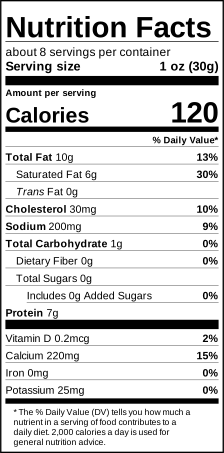
Serving size: what the RACC gives cheese
For most block, shredded, sliced, and cream cheese, 21 CFR 101.12 sets the reference amount at 30 g. A typical label statement reads “1 oz (30 g)” or “2 tbsp (30 g)” for cream cheese. Grated hard cheeses (Parmesan, Romano, and similar) use a 5 g reference amount instead, closer to “2 tsp (5 g).” Cottage cheese uses 110 g, usually stated as “1/2 cup (110 g).”
Package-size rules layer on top of whichever category applies. An 8 oz (227 g) block of cheddar is about 757% of the 30 g RACC, so it’s declared per 30 g serving with roughly 7 to 8 servings per container and no dual-column requirement, since that only applies between 200% and 300% of RACC under 101.9(b)(12)(i). A small 2 oz individually wrapped cheese stick sitting in that 200%-300% band could trigger the per-serving/per-container dual column instead, unless the package qualifies for tabular format.
What the panel must show
The mandatory nutrient list under 21 CFR 101.9(c) is the same as any packaged food: calories, total fat, saturated fat, trans fat, cholesterol, sodium, total carbohydrate, dietary fiber, total sugars, added sugars, protein, vitamin D, calcium, iron, and potassium, each with %DV. For cheese, saturated fat, sodium, and calcium are the numbers that actually move: full-fat natural cheeses commonly run well over 15 g of saturated fat per 100 g, and cheese is one of the few RACC categories where calcium clears the threshold for a genuine non-zero declaration rather than rounding to zero. Rounding follows 101.9(c): saturated fat above 5 g rounds to the nearest 1 g, sodium 5-140 mg rounds to the nearest 5 mg, and sodium above that rounds to the nearest 10 mg.
Format: which layout your package qualifies for
Most retail cheese packaging (8 oz blocks, shredded bags, sliced stacks) has plenty of labelable surface area for standard vertical format, which NutriLabels’ builder renders. Individually wrapped single slices or small grated-cheese shakers with 40 sq in or less of labelable surface may use tabular format under 21 CFR 101.9(j)(13)(ii), or linear format under 12 sq in. Our builder renders standard vertical, tabular, linear, dual-column per serving/per container, and bilingual EN/ES for cheese; a variety pack combining multiple cheese types under one label is an aggregate format handled by our expert service instead.
Cheese-specific traps
The standard-of-identity rules in 21 CFR 133 are the trap unique to cheese: calling a product “cheddar” or “mozzarella” when it doesn’t meet that section’s milkfat-and-moisture profile is a mislabeling problem independent of the Nutrition Facts panel. Cheddar, for example, needs at least 50% milkfat by weight of solids and no more than 39% moisture (21 CFR 133.113). A blended, flavored, or reduced-fat version usually needs a qualifying descriptor, such as “reduced fat cheddar cheese,” rather than the standardized name alone; 21 CFR 130.10 governs how a modified standardized food can carry the standardized name alongside a nutrient content claim like “reduced fat” once the claim’s definition and performance characteristics are met. Milk is the unavoidable major allergen in every cheese; add-ins like jalapeño-cheddar blends with soy lecithin as an anticaking agent, or cheese spreads with wheat-based stabilizers, need their own “Contains” line entries.
Ingredient statement and allergens
List ingredients in descending order by weight per 21 CFR 101.4. Standardized cheeses get two labeling shortcuts: enzymes used in cheesemaking can be declared simply as “enzymes” without naming the specific type or source, and the milk-derived components may be listed as “milkfat and nonfat milk” or “nonfat milk and milkfat,” in whichever order predominance actually runs, rather than spelling out cream, skim milk, and whey separately (21 CFR 133.113). Every cheese needs a “Contains milk” statement under FALCPA, and any additional major allergen (soy, wheat, tree nuts in a flavored variety) goes in the same line, including sesame under the FASTER Act if a rind coating or cracker pairing brings it into the product.
Build the label
The right RACC bucket on the first print means your shaker or block reads correctly the day it reaches a cheese case. Enter your recipe, then see your label: the calorie count, the nutrient content claims you qualify for and your allergen line show free, no card required, while every other value and %DV stays hidden until you unlock it. $29 unlocks every other nutrient value and %DV, every FDA format your cheese package qualifies for, and the ingredient statement and allergen declaration, ready to print. Start your label, or compare other categories on the product labels hub.
Cheese label FAQ
What RACC applies to my cheese?
30 g covers cheese generally, including cream cheese. Grated hard cheeses like Parmesan and Romano use 5 g instead, and cottage cheese uses 110 g. Check which category matches your product before setting your serving size.
How many servings are in an 8 oz block of cheddar?
An 8 oz (227 g) block is about 757% of the 30 g RACC, so it's labeled per 30 g serving with roughly 7 to 8 servings per container, well outside the 200%-300% band that would require a dual-column label.
Can I call a reduced-fat product 'cheddar cheese'?
Standardized names like cheddar carry compositional minimums (at least 50% milkfat by weight of solids, no more than 39% moisture under 21 CFR 133.113); a version that departs from those limits generally needs a qualifying descriptor rather than the plain standardized name. Modified standardized foods follow 21 CFR 130.10, which lets you use the standardized name with a nutrient content claim such as \"reduced fat cheddar\" when the food meets that claim's definition and the performance characteristics are addressed (https://www.ecfr.gov/current/title-21/chapter-I/subchapter-B/part-130/section-130.10).
Why is calcium on my cheese label significant when it's zero on some snacks?
Cheese is one of the few RACC categories where calcium routinely clears the threshold for a non-zero %DV declaration, since dairy solids concentrate calcium well above what FDA considers an insignificant amount.
Do I need a Nutrition Facts label on cheese sold at a farmers market?
If you're selling under your state's cottage food exemption with no nutrition claims, check your state's rules. Many states restrict dairy products, including cheese, from cottage food programs regardless of nutrition labeling. Once sold wholesale or through a retailer, a compliant panel is expected.
Can enzymes and milk components be simplified on the ingredient list?
Yes. 21 CFR 133.113 lets you declare cheesemaking enzymes simply as 'enzymes' without naming the type or source, and list the dairy components as 'milkfat and nonfat milk' or 'nonfat milk and milkfat' in order of predominance, rather than spelling out cream, skim milk, and whey separately.
Related products
Beef jerky, Dog treats, Candy. See the full all products.
Sources
- ecfr.gov/current/title-21/chapter-I/…101/subpart-A/section-101.12
- ecfr.gov/current/title-21/chapter-I/…-101/subpart-A/section-101.9
- ecfr.gov/current/title-21/chapter-I/…33/subpart-B/section-133.113
- ecfr.gov/current/title-21/chapter-I/subchapter-B/part-133
- fda.gov/food/food-allergies/faster-…me-ninth-major-food-allergen
- fdc.nal.usda.gov/food-details/173414/nutrients