
Last verified 16 Sep 2026 · Sources
Dog treats don’t get a Nutrition Facts label at all. Federal and state pet food rules call for a Guaranteed Analysis instead. Putting a human-style Nutrition Facts panel on a treat bag is the most common wrong turn on a first treat label.
FDA regulates pet food under the Federal Food, Drug, and Cosmetic Act. Most states enforce labeling rules modeled on those of the Association of American Feed Control Officials (AAFCO) (fda.gov/animal-veterinary/animal-foods-feeds/pet-food and aafco.org). The Guaranteed Analysis lists minimum crude protein and fat and maximum crude fiber and moisture. It doesn’t list calories, sodium or % Daily Value. A compliant label is expected once you sell treats commercially. Since Nutrition Facts was never the right panel to begin with, none of its exemptions matter here either.
| Quick facts | Dog treats |
|---|---|
| Regulator | FDA (AAFCO model for pet food) |
| Reference amount (RACC) | Not applicable (pet food uses an AAFCO Guaranteed Analysis, not a RACC) |
| Typical serving statement | Not applicable. There's no RACC serving statement, and feeding directions are optional on products labeled as a snack or treat. |
| Typical label format | Not applicable (pet treats carry a Guaranteed Analysis block, not any Nutrition Facts format) |
| Exemption | Not applicable. Nutrition Facts exemptions under 21 CFR 101.9 don't govern pet food. Treats follow AAFCO's model regulations and state feed law instead. |
| Watch out for | Putting a Nutrition Facts panel on the package at all, and skipping state feed registration |
| Common allergens | FALCPA's allergen rules in the FD&C Act are written for human food, and FDA's pet food labeling page doesn't require a 'Contains' line. Name common sources (wheat, soy, egg, peanut) plainly in the ingredient list. Any allergen statement you add is voluntary. |
Serving size. Look up the FDA serving for your product in the Serving Size Finder.
How big is a serving of dog treats?
There is no RACC for dog treats. The reference amount table in 21 CFR 101.12 covers human food, and pet food sits outside that system entirely. AAFCO’s Guaranteed Analysis reports nutrient percentages on an “as fed” basis, not per serving. So there’s no 30 g or 2 tbsp figure to work out the way there would be for a human snack.
What a treat label needs instead is a net quantity statement, by weight or volume, in both avoirdupois and metric units. If feeding directions appear at all, they state an amount per the animal’s weight, not a household-measure serving (aafco.org’s eight-required-items guidance). Feeding directions are optional for anything clearly identified as a “snack,” “treat,” or “supplement” on the principal display panel. Most treat makers skip them and rely on the ingredient statement and Guaranteed Analysis instead.
What goes on the panel
A Guaranteed Analysis belongs here, not a Nutrition Facts panel. It shows minimum % crude protein, minimum % crude fat, maximum % crude fiber and maximum % moisture, in that order. Add any extra guarantee needed to support a claim you make elsewhere on the label (aafco.org Reading Labels).
A product clearly labeled “snack” or “treat” is exempt from AAFCO’s nutritional adequacy statement. So you generally don’t have to prove it’s “complete and balanced” for any life stage. That also means you don’t need the “for intermittent or supplemental feeding only” statement. That phrase is one of AAFCO’s nutritional adequacy statements, and exempt treat labels skip the whole category.
Some makers add it anyway as a plain-English cue to pet owners. Once your front panel already says “treat,” that’s a voluntary choice, not a legal requirement. Check what your state’s feed control official expects, though. A state’s own feed rules could still expect intermittent or supplemental language on treats, even where AAFCO’s model exempts them.
Which layout fits your package?
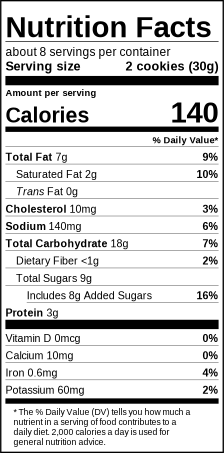
Nutrition Facts formats (vertical, tabular, linear, dual-column) don’t apply to dog treats, because the panel itself is a different document. The sample on this page is a human food Nutrition Facts panel for a comparable baked snack, a peanut butter biscuit from USDA FoodData Central. It’s there only as a size and shape reference for how our builder draws a panel.
It is NOT the panel that belongs on your dog treat package, and no dog treat should ship with a Nutrition Facts label like this. Your package needs a Guaranteed Analysis block next to the other required AAFCO items. Those are species designation, net quantity, ingredient statement, manufacturer name and address, and, if they apply, nutritional adequacy and feeding directions.
Where dog treat labels go wrong
The biggest trap is the wrong panel. A Nutrition Facts box invites confusion with human food. It doesn’t meet AAFCO’s expected format, no matter how accurate the numbers are.
The second trap is skipping state feed registration. Most states call for a pet food or treat product’s label, or the manufacturing firm itself, to be registered or licensed with the state’s department of agriculture or feed control office before sale. Fees and renewal cycles vary by state (aafco.org Registration & Licensing). This sits on top of FDA’s federal framework, not in place of it.
A third trap is claims. “Human-grade,” “complete and balanced” or a health claim like “supports joint health” each have their own AAFCO or FDA bar for proof. A product labeled as a treat loses its nutritional adequacy exemption once it makes a complete and balanced claim.
Your ingredient list and allergens
List ingredients in descending order by weight, using AAFCO-defined common names where they exist (fda.gov/animal-veterinary/animal-foods-feeds/pet-food). The allergen labeling section of the FD&C Act, 21 U.S.C. 343(w), is written for food for human consumption. FDA’s pet food labeling page does not require a “Contains” line. So any allergen statement you add to a pet product is a voluntary practice, not a FALCPA mandate. Still, naming common allergen sources like wheat, soy, egg or peanut plainly in the ingredient list is standard practice. It helps pet owners who manage a dog’s known sensitivities.
Build your label for people food
NutriLabels builds labels for human food. It doesn’t produce a Guaranteed Analysis or any other part of a pet food label. For the treat bag itself, work from AAFCO’s model regulations and your state’s feed control office.
Starting from the Guaranteed Analysis instead of a human food panel saves a reprint of treat bags you already paid for. If you also make food for people, enter that recipe, then see its label. Your calories, the claims you qualify for and your allergen line are free, no credit card required. For $29, you unlock the rest of the numbers on your label in every FDA format your product qualifies for, with the ingredient statement and allergen declaration. Start your label, or compare other categories on the product labels hub.
Dog treats label FAQ
Does my dog treat need a Nutrition Facts label like human food?
No. Pet food and treats fall under FDA's animal food framework and most states' AAFCO-based feed laws. Those call for a Guaranteed Analysis instead of a Nutrition Facts panel. Putting the human food panel on a treat bag doesn't meet either format.
What has to be on a dog treat label?
AAFCO's model lists eight required items. They are the product or brand name, species designation, net quantity, a Guaranteed Analysis, an ingredient statement, a nutritional adequacy statement (if claiming complete and balanced), feeding directions (if applicable), and the manufacturer's name and address.
Do treats need the 'for intermittent or supplemental feeding only' statement?
That phrase is one of AAFCO's nutritional adequacy statements. Products clearly labeled 'snack,' 'treat' or 'supplement' on the front panel are exempt from the nutritional adequacy statement category entirely. So for most treats, it's optional wording, not a requirement.
Do I need to register my dog treats with a state agency?
Most states call for the product label or the manufacturing firm to be registered or licensed with the state's department of agriculture or feed control office before sale. That's separate from any federal requirement. Check the specific states you ship into.
Can I say my treats are 'complete and balanced'?
Only if you can back it up with AAFCO nutrient profile formulation or feeding trials for a stated life stage. Making that claim on a treat removes the snack and treat exemption from the nutritional adequacy statement requirement.
Why does this page show a Nutrition Facts-style sample at all?
It's a size and shape reference from a comparable human snack in USDA's FoodData Central. We use it only to show how our builder draws a panel. It is not the panel format that belongs on a dog treat package.
Related products
Beef jerky, Cheese, Granola. See the full all products.
Sources
- fda.gov/animal-veterinary/animal-foods-feeds/pet-food
- fda.gov/animal-veterinary/animal-fo…labeling-and-pet-food-claims
- aafco.org/consumers/understanding-pet-food/reading-labels
- aafco.org/resources/startups/labeling-labeling-requirements
- aafco.org/wp-content/uploads/2023/01/…_required_labeilng_items.pdf
- aafco.org/resources/startups/registration-licensing
- fdc.nal.usda.gov/food-details/172727/nutrients