
Last verified 16 Sep 2026 · Sources
Dog treats don’t get a Nutrition Facts label at all. Federal and state pet food rules call for a Guaranteed Analysis instead, and putting a human-style Nutrition Facts panel on a treat bag is the single most common wrong turn on a first treat label. FDA regulates pet food under the Federal Food, Drug, and Cosmetic Act, and most states enforce labeling requirements modeled on the Association of American Feed Control Officials (AAFCO) rules (fda.gov/animal-veterinary/animal-foods-feeds/pet-food; aafco.org). The Guaranteed Analysis lists minimum crude protein and fat and maximum crude fiber and moisture, not calories, sodium, or %DV. A compliant label is expected once you sell treats commercially; because Nutrition Facts was never the applicable panel to begin with, none of its exemptions are relevant here either.
| Quick facts | Dog treats |
|---|---|
| Regulator | FDA (AAFCO model for pet food) |
| Reference amount (RACC) | Not applicable; pet food uses AAFCO Guaranteed Analysis, not RACC |
| Typical serving statement | Not applicable: no RACC serving statement; feeding directions (if included) are optional for products labeled snack/treat |
| Typical label format | Not applicable; pet treats carry a Guaranteed Analysis block, not a Nutrition Facts vertical/tabular/linear format |
| Exemption | Not applicable. Nutrition Facts exemptions under 21 CFR 101.9 don't govern pet food; treats instead follow AAFCO's model regulations and state feed law |
| Watch out for | Putting a Nutrition Facts panel on the package at all; skipping state feed registration |
| Common allergens | FALCPA's allergen-labeling section of the FD&C Act is written for food for human consumption, and FDA's pet-food labeling page does not require a 'Contains' line; name common sources (wheat, soy, egg, peanut) plainly in the ingredient list, and treat any voluntary allergen statement as just that: voluntary |
Serving size: look up the FDA serving for your product in the Serving Size Finder.
Serving size: what the RACC gives dog treats
There is no RACC for dog treats. 21 CFR 101.12’s reference-amount table governs human food; pet food sits outside that system entirely, and AAFCO’s Guaranteed Analysis reports nutrient percentages on an “as fed” basis rather than a per-serving amount, so there’s no 30 g or 2 tbsp figure to calculate the way there would be for a human snack. What a treat label needs instead is a net quantity statement (weight or volume, in both avoirdupois and metric units) and, if feeding directions appear at all, an amount stated per the animal’s weight rather than a household-measure serving (aafco.org’s eight-required-items guidance). Feeding directions are optional for anything conspicuously identified as a “snack,” “treat,” or “supplement” on the principal display panel, and most treat makers skip them and rely on the ingredient statement and Guaranteed Analysis instead.
What the panel must show
A Guaranteed Analysis is what belongs here, not a Nutrition Facts panel: minimum % crude protein, minimum % crude fat, maximum % crude fiber, and maximum % moisture, in that order, plus any additional guarantee needed to support a claim you make elsewhere on the label (aafco.org Reading Labels). Because a product conspicuously labeled “snack” or “treat” is exempt from AAFCO’s nutritional adequacy statement, you generally don’t need to prove it’s “complete and balanced” for any life stage, and that means you also don’t need the “for intermittent or supplemental feeding only” statement, since that phrase is one of AAFCO’s nutritional adequacy statements and exempt treat labels skip the whole category. Some makers add it anyway as a plain-English cue to pet owners; that’s a voluntary choice once your front panel already says “treat,” not a legal requirement. Check your specific state’s feed control official’s requirements, since an individual state’s feed regulations could still expect intermittent/supplemental language on treats even where AAFCO’s model exempts them.
Format: which layout your package qualifies for
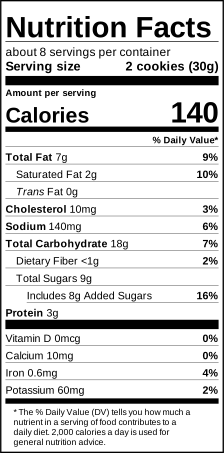
Nutrition Facts formats (vertical, tabular, linear, dual-column) don’t apply to dog treats, because the panel itself is a different document. The sample shown on this page is a human-food Nutrition Facts panel for a comparable baked snack (a peanut butter biscuit, sourced from USDA FoodData Central), included purely as a size-and-shape reference for how our builder renders a panel. It is NOT the panel that belongs on your dog treat package, and no dog treat should ship with a Nutrition Facts label formatted this way. What your package actually needs is a Guaranteed Analysis block alongside the other required AAFCO items: species designation, net quantity, ingredient statement, manufacturer name and address, and, if applicable, nutritional adequacy and feeding directions.
Dog treat-specific traps
The biggest trap is the wrong panel: a Nutrition Facts box invites confusion with human food and doesn’t meet AAFCO’s expected format regardless of how accurate the numbers are. The second is skipping state feed registration: most states require a pet food or treat product’s label, or the manufacturing firm itself, to be registered or licensed with the state’s department of agriculture or feed control office before sale, with fees and renewal cycles that vary by state (aafco.org Registration & Licensing). This sits on top of, not instead of, FDA’s federal framework. A third trap is claims: “human-grade,” “complete and balanced,” or a specific health claim like “supports joint health” each carry their own AAFCO or FDA substantiation bar, and a treat-labeled product making a complete-and-balanced claim loses its nutritional-adequacy exemption the moment it does.
Ingredient statement and allergens
Ingredients list in descending order by weight, using AAFCO-defined common names where they exist (fda.gov/animal-veterinary/animal-foods-feeds/pet-food). The FD&C Act’s allergen-labeling section, 21 U.S.C. 343(w), is written for food for human consumption, and FDA’s pet-food labeling page does not require a “Contains” line, so any allergen statement you add for a pet product is a voluntary practice rather than a FALCPA mandate. Naming common allergen sources like wheat, soy, egg, or peanut plainly in the ingredient list is standard practice regardless and helps pet owners managing a dog’s known sensitivities, even without a mandated “Contains” line.
Build the label
NutriLabels builds labels for human food. It does not produce a Guaranteed Analysis or any other part of a pet food label, so for the treat bag itself, work from AAFCO’s model regulations and your state’s feed control office.
Starting from the Guaranteed Analysis instead of a human-food panel saves a reprint of treat bags you already paid for. If you also make food for people, enter that recipe, then see its label: your calories, the claims you qualify for and your allergen line are free, no card required, and $29 unlocks every other nutrient value and %DV in every FDA format your product qualifies for, with the ingredient statement and allergen declaration. Start your label, or compare other categories on the product labels hub.
Dog treats label FAQ
Does my dog treat need a Nutrition Facts label like human food?
No. Pet food and treats are regulated under FDA's animal food framework and most states' AAFCO-based feed laws, which require a Guaranteed Analysis instead of a Nutrition Facts panel. Putting the human-food panel on a treat bag doesn't meet either format.
What has to be on a dog treat label?
AAFCO's model lists eight required items: product/brand name, species designation, net quantity, a Guaranteed Analysis, an ingredient statement, a nutritional adequacy statement (if claiming complete and balanced), feeding directions (if applicable), and manufacturer name and address.
Do treats need the 'for intermittent or supplemental feeding only' statement?
That phrase is one of AAFCO's nutritional adequacy statements, and products conspicuously labeled 'snack,' 'treat,' or 'supplement' on the front panel are exempt from the nutritional adequacy statement category entirely, so it's optional wording, not a requirement, for most treats.
Do I need to register my dog treats with a state agency?
Most states require the product label or the manufacturing firm to be registered or licensed with the state's department of agriculture or feed control office before sale, separate from any federal requirement. Check the specific states you're shipping into.
Can I say my treats are 'complete and balanced'?
Only if you can back it up with AAFCO nutrient profile formulation or feeding trials for a stated life stage; making that claim on a treat removes the snack/treat exemption from the nutritional adequacy statement requirement.
Why does this page show a Nutrition Facts-style sample at all?
It's a size-and-shape reference from a comparable human snack in USDA's FoodData Central, used only to demonstrate our builder's panel rendering. It is not the panel format that belongs on a dog treat package.
Related products
Beef jerky, Cheese, Granola. See the full all products.
Sources
- fda.gov/animal-veterinary/animal-foods-feeds/pet-food
- fda.gov/animal-veterinary/animal-fo…labeling-and-pet-food-claims
- aafco.org/consumers/understanding-pet-food/reading-labels
- aafco.org/resources/startups/labeling-labeling-requirements
- aafco.org/wp-content/uploads/2023/01/…_required_labeilng_items.pdf
- aafco.org/resources/startups/registration-licensing
- fdc.nal.usda.gov/food-details/172727/nutrients