
Last verified 16 Sep 2026 · Sources
Cheese’s Reference Amount Customarily Consumed (RACC), the FDA’s reference serving for your product type, splits three ways under 21 CFR 101.12. It’s 30 g for cheese in general (including cream cheese), 5 g for grated hard cheeses like Parmesan, and 110 g for cottage cheese. So first, confirm which group your product falls into. A 30 g serving statement on a grated Parmesan shaker is wrong by a factor of six.
FDA is the regulator. Standardized cheeses (cheddar, mozzarella, Swiss and dozens of others) also have to meet the composition rules in 21 CFR 133, like minimum milkfat and maximum moisture. Only then is the name on the front of the package legal to use at all. You need a Nutrition Facts panel once you sell your cheese, unless your business qualifies for the FDA small-business exemption and you make no nutrition claims. None of the three RACC categories here qualify for the insignificant-nutrient exemption.
| Quick facts | Cheese |
|---|---|
| Regulator | FDA |
| Reference amount (RACC) | 30 g (most cheeses, including cream cheese). Grated hard cheese uses 5 g and cottage cheese 110 g. |
| Typical serving statement | 1 oz (30 g) |
| Typical label format | Standard vertical for blocks, shreds and slices (tabular or linear for individually wrapped slices or grated-cheese shakers of 40 sq in or less) |
| Exemption | This product type isn’t exempt. Cheese has significant fat, protein and, for many types, calcium, so it doesn't qualify for the 101.9(j)(4) insignificant-nutrient exemption. The small-business exemption can still apply if you make no nutrition claims. |
| Watch out for | Which RACC applies (30 g, 5 g or 110 g), and the 21 CFR 133 milkfat and moisture limits behind the cheese's name |
| Common allergens | Milk, always. Soy or wheat if add-ins use lecithin or stabilizers. Sesame if a rind coating or pairing brings it in. |
What is the serving size for cheese? The FDA serving for cheese depends on the weight of one piece. The full serving-size reference shows the single-serving cut-off, the dual-column range and the servings per package.
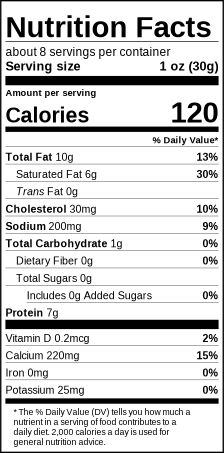
How big is a serving of cheese?
For most block, shredded, sliced and cream cheese, 21 CFR 101.12 sets the reference amount at 30 g. A typical label statement reads “1 oz (30 g),” or “2 tbsp (30 g)” for cream cheese. Grated hard cheeses (Parmesan, Romano and similar) use a 5 g reference amount instead, closer to “2 tsp (5 g).” Cottage cheese uses 110 g, usually stated as “1/2 cup (110 g).”
Package size rules sit on top of whichever category applies. An 8 oz (227 g) block of cheddar is about 757% of the 30 g RACC. So it’s declared per 30 g serving, with roughly 7 to 8 servings per container and no dual column. The dual column only applies between 200% and 300% of the RACC (101.9(b)(12)(i)). A small 2.5 oz cheese pack in that 200% to 300% band could need the per-serving and per-container dual column instead, unless the package qualifies for tabular format.
What goes on the panel
The mandatory nutrient list under 21 CFR 101.9(c) is the same as for any packaged food. That’s calories, total fat, saturated fat, trans fat, cholesterol, sodium, total carbohydrate, dietary fiber, total sugars, added sugars, protein, vitamin D, calcium, iron and potassium, each with % Daily Value (the percent column on the right side of the panel).
For cheese, saturated fat, sodium and calcium are the numbers that really move. Full-fat natural cheeses commonly run well over 15 g of saturated fat per 100 g. Cheese is also one of the few RACC categories where calcium clears the threshold for a real non-zero declaration instead of rounding to zero. Rounding follows 101.9(c). Saturated fat above 5 g rounds to the nearest 1 g. Sodium from 5 to 140 mg rounds to the nearest 5 mg, and sodium above that rounds to the nearest 10 mg.
Which layout fits your package?
Most retail cheese packaging (8 oz blocks, shredded bags, sliced stacks) has plenty of labelable surface for standard vertical format, which the NutriLabels builder makes. Individually wrapped single slices or small grated cheese shakers with 40 sq in or less of labelable surface may use tabular format under 21 CFR 101.9(j)(13)(ii). If even a tabular display won’t fit, they may use linear format. Our builder makes standard vertical, tabular, linear, dual-column (per serving and per container) and bilingual EN/ES labels for cheese. A variety pack with several cheeses under one label is an aggregate format, and our expert service handles it instead.
Where cheese labels go wrong
The trap unique to cheese is the standard of identity rules in 21 CFR 133. Calling a product “cheddar” or “mozzarella” when it doesn’t meet that section’s milkfat and moisture profile is a mislabeling problem, apart from the Nutrition Facts panel. Cheddar, for example, needs at least 50% milkfat by weight of solids and no more than 39% moisture (21 CFR 133.113).
A blended, flavored or reduced-fat version usually needs a qualifying descriptor, such as “reduced fat cheddar cheese,” not the standardized name alone. A modified standardized food can carry the standardized name next to a nutrient content claim like “reduced fat,” under the rules in 21 CFR 130.10. That works once the claim’s definition and performance characteristics are met.
Milk is the allergen every cheese carries. Add-ins bring their own “Contains” line entries. Examples are a jalapeño cheddar blend with soy lecithin as an anticaking agent, or a cheese spread with wheat-based stabilizers.
Your ingredient list and allergens
List ingredients in descending order by weight, per 21 CFR 101.4. Standardized cheeses get two labeling shortcuts under 21 CFR 133.113. Enzymes used in cheesemaking can be declared simply as “enzymes,” without naming the type or source. And the milk-derived parts may be listed as “milkfat and nonfat milk” or “nonfat milk and milkfat,” in whichever order matches predominance. You don’t have to spell out cream, skim milk and whey separately.
Every cheese needs a “Contains milk” statement under FALCPA. Any other major allergen (soy, wheat, tree nuts in a flavored variety) goes in the same line. That includes sesame under the FASTER Act, if a rind coating or cracker pairing brings it into the product.
Build your cheese label
With the right RACC group on your first print, your shaker or block reads correctly the day it reaches a cheese case. Enter your recipe, then see your cheese label. Your label’s shape, calorie count, the claims you qualify for, your allergen line and the nutrient to watch show free, with no credit card required. The rest of the numbers on your label stay hidden until you buy a Single Product ($29) or the Studio plan ($299 a year). A Single Product unlocks the rest of the numbers on your label, every FDA format your package qualifies for, and the ingredient statement and allergen declaration, ready to print. Start your cheese label, or browse other product labels.
Cheese label FAQ
What RACC applies to my cheese?
30 g covers cheese in general, including cream cheese. Grated hard cheeses like Parmesan and Romano use 5 g instead, and cottage cheese uses 110 g. Check which category matches your product before you set your serving size.
How many servings are in an 8 oz block of cheddar?
An 8 oz (227 g) block is about 757% of the 30 g RACC. So it's labeled per 30 g serving, with roughly 7 to 8 servings per container. That's well outside the 200% to 300% band that would call for a dual-column label.
Can I call a reduced-fat product 'cheddar cheese'?
Standardized names like cheddar come with composition minimums. Cheddar needs at least 50% milkfat by weight of solids and no more than 39% moisture under 21 CFR 133.113. A version that departs from those limits generally needs a qualifying descriptor, not the plain standardized name. Modified standardized foods follow 21 CFR 130.10. It lets you use the standardized name with a nutrient content claim, such as "reduced fat cheddar," when the food meets that claim's definition and the performance characteristics are addressed (https://www.ecfr.gov/current/title-21/chapter-I/subchapter-B/part-130/section-130.10).
Why is calcium on my cheese label significant when it's zero on some snacks?
Cheese is one of the few RACC categories where calcium routinely clears the threshold for a non-zero % Daily Value. Dairy solids concentrate calcium well above what FDA considers an insignificant amount.
Do I need a Nutrition Facts label on cheese sold at a farmers market?
If you sell under your state's cottage food exemption with no nutrition claims, check your state's rules. Many states keep dairy products, including cheese, out of cottage food programs, whatever the labeling. Stores and wholesale buyers usually expect a compliant panel, even when the law doesn't require one.
Can enzymes and milk components be simplified on the ingredient list?
Yes. You can declare cheesemaking enzymes simply as 'enzymes,' without naming the type or source (21 CFR 133.113). You can list the dairy parts as 'milkfat and nonfat milk' or 'nonfat milk and milkfat,' in order of predominance. You don't have to spell out cream, skim milk and whey separately.
Related products
Beef jerky, Dog treats, Candy. See the full all products.
Sources
- ecfr.gov/current/title-21/chapter-I/…101/subpart-A/section-101.12
- ecfr.gov/current/title-21/chapter-I/…-101/subpart-A/section-101.9
- ecfr.gov/current/title-21/chapter-I/…33/subpart-B/section-133.113
- ecfr.gov/current/title-21/chapter-I/subchapter-B/part-133
- fda.gov/food/food-allergies/faster-…me-ninth-major-food-allergen
- fdc.nal.usda.gov/food-details/173414/nutrients