
Last verified 16 Sep 2026 · Sources
Granola bars fall under the FDA’s “grain-based bars with or without filling or coating” category, which sets a Reference Amount Customarily Consumed (RACC) of 40 g regardless of how the bar is marketed: breakfast bar, granola bar, or rice cereal bar all share this line. The quirk to watch isn’t the RACC itself; it’s what happens next, because the FDA’s discrete-unit rules compare your bar’s actual weight to that 40 g reference amount and can force a single bar to be labeled as more than one serving. A 45 g bar and a 90 g bar, both technically “a granola bar,” end up with different label structures. A Nutrition Facts label is required on virtually every packaged granola bar sold at retail, absent the small-business exemption and no nutrition claims.
| Quick facts | Granola bars |
|---|---|
| Regulator | FDA |
| Reference amount (RACC) | Grain-based bars with or without filling or coating (breakfast bars, granola bars, rice cereal bars): 40 g |
| Typical serving statement | 1 bar (45 g) |
| Typical label format | Standard vertical for a single wrapped bar over 40 sq in of labelable surface; tabular or linear for small individually wrapped bars at or under that threshold |
| Exemption | Not exempt |
| Watch out for | Discrete-unit rule can force one bar to be labeled as two servings; added sugars from coatings run high |
| Common allergens | Tree nuts, peanuts, oats (gluten cross-contact); check chocolate or yogurt coating for milk and soy |
What is the serving size for granola bars? The FDA serving for granola bar depends on the weight of one piece. See the full serving-size reference: single-serving cut-off, dual-column range, and servings per package.
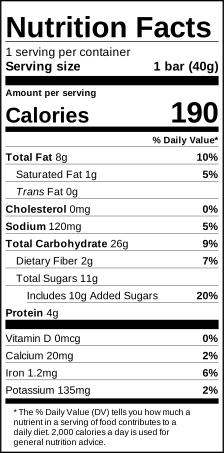
Serving size: what the RACC gives Granola bars
The reference amount is 40 g under 21 CFR 101.12 Table 2’s grain-based bars line (21 CFR 101.12). Because granola bars are sold as discrete units rather than scooped or poured, the label doesn’t simply print “40 g.” It applies the discrete-unit test in 21 CFR 101.9(b)(2)(i): a unit that’s more than 50% but under 67% of the RACC may be declared as 1 or 2 units; a unit that’s at least 67% and under 200% of the RACC is labeled as one serving, full stop; and a unit at 200% up to 300% of the RACC has its serving set at the amount approximating the RACC, with a required additional per-unit column.
Run the numbers on two common sizes: a 45 g bar is 112.5% of 40 g, comfortably inside the 67%–200% band, so the whole 45 g bar is one serving and the label reads “1 bar (45 g).” A 90 g bar is 225% of 40 g, landing in the 200%–300% band. Here the serving size is set at roughly the RACC amount (about 40 g, not the full bar), and the panel must carry a second column for the whole 90 g bar so a shopper can see both the “per serving” and “per bar” numbers side by side. Get this wrong in either direction (serving a 90 g bar as “1 bar” or splitting a 45 g bar into fractional servings) and every nutrient and %DV downstream is off.
What the panel must show
Calories, total fat, saturated fat, trans fat, cholesterol, sodium, total carbohydrate, dietary fiber, total sugars, added sugars, protein, vitamin D, calcium, iron, and potassium are all mandatory, rounded and expressed as %DV under 21 CFR 101.9(c). Added sugars are usually the number that matters most here: binders like corn syrup, honey, and brown rice syrup can put added sugars close to or above total sugars once the finished-bar recipe is accounted for, and that figure comes from your own formulation, not a database default. Sodium is the other line worth double-checking. It’s easy to assume a “sweet” bar runs low on sodium, but salt is a common flavor balancer and binder-setting aid in granola bars.
Format: which layout your package qualifies for
A single wrapped bar with more than 40 sq in of labelable surface area uses standard vertical format. Individually wrapped bars small enough to have 40 sq in or less can qualify for tabular format, or linear format if the wrapper is under 12 sq in or genuinely can’t fit a tabular block (21 CFR 101.9(j)(13)(ii)). Multi-bar boxes sold as one package (rather than each bar labeled individually) follow the same single-serving and dual-column math described above, based on total package weight against the 40 g RACC. The NutriLabels builder renders standard vertical, tabular, linear, and dual-column per serving/per container, which covers most granola-bar packaging including the discrete-unit dual-column case.
Granola bar-specific traps
The recurring mistake is treating “1 bar = 1 serving” as a universal rule instead of running the discrete-unit math for your specific bar weight. A close second is underestimating added sugars in a coated or filled bar: chocolate drizzle, yogurt coating, and fruit filling all add sugars beyond what the base oat mixture contributes, and that has to be counted from your actual recipe.
Ingredient statement and allergens
List ingredients in descending order by weight, breaking out sub-ingredients for any coating or filling. Tree nuts and peanuts are common in granola bars and require a “Contains” statement under FALCPA if present, alongside milk or soy from chocolate or yogurt coatings. If a bar uses sesame seeds or tahini, sesame is the ninth major allergen under the FASTER Act and belongs in that same statement (FDA, FASTER Act). Oats themselves aren’t a major allergen, but shared-line gluten cross-contact is worth verifying before making any gluten-free claim.
Build the label
Once you’ve weighed your actual bar and run it against the discrete-unit test, the rest of the panel follows the standard rounding and %DV rules, and your wrapper carries the right number of columns the first time. Enter your recipe, then see your granola bar label: free with no card required, you see your calories, the claims you qualify for, your allergen line and the nutrient to watch, and every other value and %DV stays hidden until you unlock it. $29 unlocks every other nutrient value and %DV, every FDA format your product qualifies for, and the ingredient statement and allergen declaration as print-ready files, with 12 months of edits included and downloads that never expire. Start your label free, or see how other bars and snacks are sized in the serving sizes guide.
Granola bars label FAQ
What's the RACC for a granola bar?
40 g, under the "grain-based bars with or without filling or coating" line that also covers breakfast bars and rice cereal bars. The actual weight of your bar then decides how that 40 g translates into a serving statement.
If my bar weighs 45 g, is the serving the whole bar?
Generally yes. A discrete unit that's at least 67% but under 200% of the RACC is labeled as one serving per unit, and 45 g is about 112% of the 40 g RACC, so the whole 45 g bar is one serving.
What about a 90 g bar?
A 90 g bar is 225% of the 40 g RACC, which falls in the 200%–300% bracket, so the serving is the amount approximating the RACC (roughly half the bar), and the label must add a second column showing per-unit (whole-bar) values alongside it.
Why does my bar's sodium look high for something sweet?
Granola bars often use salt to balance sweeteners and to help binders set, so sodium can be more significant per serving than the "sweet snack" framing suggests. Check the real %DV rather than assuming it's low.
Can a small wrapped bar use a simpler label format?
If its labelable surface area is 40 square inches or less, it may qualify for tabular format, or linear if it's under 12 square inches or a tabular layout won't physically fit.
Do I need a "Contains" statement for oats?
Oats aren't one of the nine major allergens, but tree nuts, peanuts, milk (from chocolate or yogurt coatings), and soy are common in granola bars and do require a "Contains" statement if present.
Related products
Granola, Protein bars, Candy, Muffins. See the full all products.