
Last verified 16 Sep 2026 · Sources
Jam and jelly fall under the “Honey, jams, jellies, fruit butter, molasses, fruit pastes, fruit chutneys” category in 21 CFR 101.12, which sets a Reference Amount Customarily Consumed (RACC) of 1 tbsp, around 20 g for a typical fruit spread. A realistic label statement looks like “1 tbsp (20 g).” The regulator is FDA, and the most common mistake is treating the whole jar as one serving instead of using the 1 tbsp RACC. A jar’s size doesn’t change the legal serving, and it also means a normal retail jar can never qualify for dual-column labeling, which surprises people who’ve seen dual-column panels on other small jars. A Nutrition Facts panel is required once the jam or jelly is sold commercially rather than under a state cottage food exemption with no nutrition claims.
| Quick facts | Jam and Jelly |
|---|---|
| Regulator | FDA |
| Reference amount (RACC) | 1 tbsp (Honey, jams, jellies, fruit butter, molasses, fruit pastes, fruit chutneys) |
| Typical serving statement | 1 tbsp (20 g) |
| Typical label format | Standard vertical for the usual 8–32 oz retail jar; tabular or linear only applies to a small sample-size jar (roughly 2 oz or less) whose labelable surface is 40 sq in or less and can't fit a standard column |
| Exemption | Not exempt: jam and jelly carry significant calories, carbohydrate, and sugars, so the 101.9(j)(4) insignificant-nutrient exemption doesn't apply |
| Watch out for | A jar's size means it never triggers dual-column; added sugars ≠ the fruit's own sugar |
| Common allergens | Usually none; some fruit butters or specialty spreads add nuts, coconut, or pectin derived from citrus, so check the recipe |
What is the serving size for jam and jelly? The FDA serving for jelly is 1 tbsp (21g). See the full serving-size reference: single-serving cut-off, dual-column range, and servings per package.
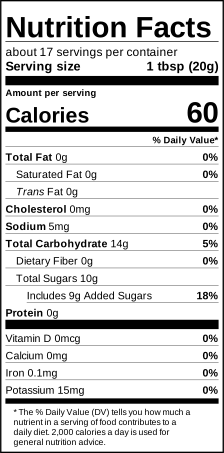
Serving size: what the RACC gives jam and jelly
The 1 tbsp RACC applies whether you’re making strawberry jam, grape jelly, apple butter, or fruit chutney; they’re grouped together in 21 CFR 101.12’s reference amount table. Converting that to a label statement means declaring “1 tbsp” alongside its gram equivalent for your specific recipe’s density, commonly around 20 g; a thicker preserve with more fruit pieces may weigh slightly more per tablespoon.
Package size is where jam and jelly diverge sharply from most products. The single-serving-container rule in 21 CFR 101.9(b)(6) makes a package labeled as one serving (whole contents) when it holds less than 200% of the RACC, under about 40 g here. The dual-column per-serving/per-container rule in 101.9(b)(12)(i) applies only between 200% and 300% of the RACC: a 40 g to 60 g package. A standard 8 oz to 32 oz (227 g to 907 g) retail jar is somewhere between roughly 1,100% and 4,500% of the RACC (nowhere near either threshold), so it gets an ordinary multi-serving panel with a plain “servings per container” statement (about 17 servings for a 12 oz jar at 20 g each), never a dual column. The only place these thresholds actually bite is a small sample or restaurant-style jar: a 1 oz (28 g) mini jar sits at about 140% of the RACC, so 101.9(b)(6) makes it one serving, whole-jar; nothing in typical retail jam packaging lands in the 40 g–60 g dual-column window at all.
What the panel must show
Every mandatory nutrient under 21 CFR 101.9(c) applies: calories, total fat, saturated fat, trans fat, cholesterol, sodium, total carbohydrate, dietary fiber, total sugars, added sugars, protein, vitamin D, calcium, iron, and potassium, each with %DV (Percent Daily Value) and the standard footnote. For jam and jelly, added sugars is the number that matters most: fruit contributes some of the total sugars naturally, but the sugar added during cooking is what has to be declared separately, and that split comes from your recipe, not from a nutrient database. Total carbohydrate and calories also run high relative to other pantry items because of the concentrated fruit-and-sugar cook-down.
Rounding under 101.9(c) applies as usual: sugars and carbohydrate under 1 g round to increments of 0.5 g or “less than 1 g”; sodium in the 5 mg–140 mg range (typical for most fruit spreads) rounds to the nearest 5 mg.
Format: which layout your package qualifies for
Standard vertical format is the norm for the glass or plastic jars most jam and jelly is sold in, since their labelable surface area comfortably exceeds the 40 sq in threshold in 21 CFR 101.9(j)(13)(ii). A small 1 oz to 2 oz sample jar with 40 sq in or less of labelable area, and a shape that can’t accommodate a standard column, may use tabular format, or linear (string) format if it’s under 12 sq in. NutriLabels’ builder renders standard vertical, simplified, tabular, linear, dual-column, and bilingual EN/ES; a multi-flavor gift set with several distinct jams under one label goes to our expert service instead.
Jam and jelly-specific traps
The standard-of-identity rules in 21 CFR 150.140 (fruit jelly) and 150.160 (fruit preserves and jams) set the naming and composition bar: both require a finished soluble-solids content of not less than 65%, and jelly’s basic recipe minimum is 45 parts fruit juice ingredient to 55 parts sweetener by weight (jam/preserves uses a similar 45:55 ratio, or 47:55 when made only with Group I fruits). Calling a product “jelly” when it’s actually made from fruit pulp, or vice versa, doesn’t match the standard of identity for that name. The other trap is claims: “no sugar added” only holds up under 21 CFR 101.60 if no sugar, honey, or juice concentrate functioning as a sweetener was added during processing. That’s a claim your recipe may not actually support even if it “tastes less sweet.”
Ingredient statement and allergens
List ingredients in descending order by predominant weight per 21 CFR 101.4: typically fruit, sugar, pectin, and citric acid or lemon juice for pH adjustment. Jam and jelly themselves carry no major allergens, but fruit butters or specialty spreads that add nuts, coconut, or nut-based thickeners need a “Contains” statement under FALCPA and the FASTER Act’s nine major allergens (including sesame, if a seed-based mix-in is used).
Build the label
A 1 tbsp serving and an added-sugars split taken from your own recipe mean a jar label that holds up when a shop owner turns it over. Enter your recipe, then see your label: the calorie count, the nutrient content claims you qualify for and your allergen line show free, no card required, while every other value and %DV stays hidden until you unlock it. $29 unlocks every other nutrient value and %DV, every FDA format your jam or jelly package qualifies for, and the ingredient statement and allergen declaration, ready to print. Start your label, or compare honey and other 1 tbsp foods in the serving sizes guide.
Jam and Jelly label FAQ
Why doesn't my 12 oz jam jar ever need dual-column Nutrition Facts?
Dual-column per-serving/per-container labeling under 21 CFR 101.9(b)(12)(i) only applies to a package containing 200% to 300% of the RACC. For jam's 1 tbsp (about 20 g) RACC, that's a 40 g to 60 g package. A 12 oz (340 g) jar is over 1,600% of the RACC, so it's labeled with an ordinary servings-per-container statement instead.
Is a 1 oz mini jam jar labeled as one serving?
Likely yes. A 28 g mini jar is about 140% of the 20 g RACC, which falls under the less-than-200% threshold in 101.9(b)(6), so it's declared as one serving covering the whole jar rather than a fraction of a serving.
Do I have to call it 'jelly' or can I call it 'jam' if I use whole fruit?
The names are legally distinct under 21 CFR 150.140 (jelly, made from fruit juice) and 150.160 (jam/preserves, made with fruit pulp or pieces); using the wrong one for your process can misbrand the product. Check your standard of identity before you print labels.
Is all the sugar in my jam 'added sugars'?
No. Fruit itself contributes some naturally occurring sugar, and only the sugar you add during cooking counts as Added Sugars on the panel. FoodData Central's total-sugars figure doesn't separate the two, so this split has to come from your own recipe's sugar-to-fruit ratio, not the database.
What's the biggest labeling mistake to avoid with jam?
Treating the jar as the serving. The RACC sets a 1 tbsp serving regardless of jar size, so a home-recipe jar that assumes 'the whole jar is one serving' understates servings per container and misstates every %DV on the panel.
Does a 'no sugar added' fruit spread still need an added sugars line?
It still needs the Added Sugars line on the panel, typically showing 0 g, but making that claim only holds up if no sugar, syrup, or juice concentrate functioning as a sweetener was added during processing. Check 21 CFR 101.60 before printing the claim.
Related products
Honey, Bread, Granola. See the full all products.
Sources
- ecfr.gov/current/title-21/chapter-I/…101/subpart-A/section-101.12
- ecfr.gov/current/title-21/chapter-I/…-101/subpart-A/section-101.9
- ecfr.gov/current/title-21/chapter-I/…50/subpart-B/section-150.140
- ecfr.gov/current/title-21/chapter-I/…50/subpart-B/section-150.160
- fdc.nal.usda.gov/food-details/169641/nutrients