
Last verified 16 Sep 2026 · Sources
Honey falls under the same “honey, jams, jellies” category in 21 CFR 101.12 as fruit spreads, giving it a 1 tbsp RACC (about 21 g), so a typical label statement reads “1 tbsp (21 g).” The regulator is FDA. The single biggest mistake with honey is assuming your pure, single-ingredient product doesn’t need an Added Sugars line. It does. Under 21 CFR 101.9(c)(6)(iii), FDA’s definition of added sugars explicitly includes “sugars from syrups and honey,” so 100% of honey’s naturally occurring sugar is declared as Added Sugars on the panel. A Nutrition Facts panel is required once honey is sold commercially rather than under a cottage food exemption with no nutrition claims.
| Quick facts | Honey |
|---|---|
| Regulator | FDA |
| Reference amount (RACC) | 1 tbsp (Honey, jams, jellies, fruit butter, molasses, fruit pastes, fruit chutneys) |
| Typical serving statement | 1 tbsp (21 g) |
| Typical label format | Standard vertical for jars and squeeze bottles; a 2 oz honey bear sits in the dual-column band, and a small honey stick under 12 sq in may qualify for the small-package exemption |
| Exemption | Not exempt: pure honey's sugars still require the Added Sugars declaration on the panel |
| Watch out for | All of honey's sugar counts as Added Sugars (†); a 2 oz bear bottle needs dual-column |
| Common allergens | None inherent from honey itself; flavored or infused honey may add tree nuts, spices, or other allergen-bearing ingredients, so check add-ins |
What is the serving size for honey? The FDA serving for honey is 1 tbsp (21g). See the full serving-size reference: single-serving cut-off, dual-column range, and servings per package.
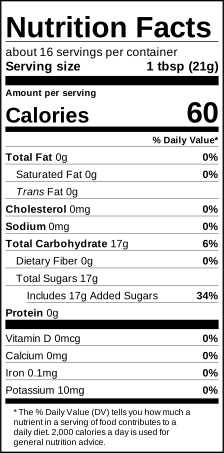
Serving size: what the RACC gives honey
Honey shares its RACC category with jams and jellies: 1 tbsp per 21 CFR 101.12, which converts to roughly 21 g for most honey given its density. The label statement is “1 tbsp (21 g),” adjusted slightly if your specific honey’s density differs.
Package size determines format math here more than for most products, because honey is commonly sold in small squeeze bottles as well as large jars. The single-serving rule in 101.9(b)(6) covers anything under 200% of the RACC (under about 42 g). A small honey stick or single-use packet, typically a few grams, is comfortably inside this band and labeled as one serving, whole contents. The dual-column rule in 101.9(b)(12)(i) kicks in between 200% and 300% of the RACC: 42 g to 63 g. A standard 2 oz honey bear bottle (about 57 g) lands squarely inside that window, so it needs both a per-serving and a per-container column. A 12 oz (340 g) jar, by contrast, is over 1,600% of the RACC (far past the dual-column band), so it’s labeled with an ordinary per-serving panel and a servings-per-container count (about 16 servings at 21 g each).
What the panel must show
Every mandatory nutrient under 21 CFR 101.9(c) is required: calories, total fat, saturated fat, trans fat, cholesterol, sodium, total carbohydrate, dietary fiber, total sugars, added sugars, protein, vitamin D, calcium, iron, and potassium, each with %DV and the standard footnote. For honey, Added Sugars is the number the whole page is built around, because honey’s sugars are 100% “added” by FDA’s definition, total sugars and added sugars are declared as the same figure. FDA’s June 2019 final guidance for single-ingredient honey and maple syrup (fda.gov/media/127928/download) recommends, but doesn’t require, adding a dagger (†) symbol after the Added Sugars %DV linking to a footnote reading “One serving adds [X]g of sugar to your diet and represents [X]% of the Daily Value for Added Sugars” (fda.gov/media/127968/download), wording meant to clarify that the sugar is inherent to honey, not a mixed-in sweetener like corn syrup.
Format: which layout your package qualifies for
Standard vertical is the norm for jars and most squeeze bottles, which typically clear the 40 sq in labelable-surface threshold in 21 CFR 101.9(j)(13)(ii). A 2 oz honey bear or similar small bottle with 40 sq in or less of labelable area, and a shape that can’t fit a standard column, may use tabular format instead, or linear (string) format under 12 sq in. A tiny honey stick under 12 sq in with no nutrition claims may also qualify for the small-package exemption in 101.9(j)(13)(i), provided it carries a phone number or address for nutrition information. NutriLabels’ builder renders standard vertical, simplified, tabular, linear, dual-column, and bilingual EN/ES for honey; a multi-flavor variety box goes to our expert service instead.
Honey-specific traps
Beyond the Added Sugars rule, watch labeling terms tied to FDA’s honey guidance (fda.gov/media/110846/download): the common or usual name should be “honey” (or the varietal, like “clover honey”) without misleading floral-source or geographic-origin claims that aren’t accurate, and any added ingredient (flavoring, another sweetener) takes the product out of “pure honey” territory and changes both the name and the ingredient statement. Sugar-related nutrient content claims like “no added sugar” don’t fit a product FDA already treats as 100% added sugar on the label.
Ingredient statement and allergens
A single-ingredient honey product’s ingredient statement is simply “Honey.” Flavored, infused, or creamed honey with add-ins (cinnamon, chili, nuts) needs those listed in descending order by weight under 21 CFR 101.4, plus a “Contains” statement under FALCPA and the FASTER Act if tree nuts, sesame, or another of the nine major allergens is used.
Build the label
An Added Sugars line you can explain, with the dagger footnote if you want it, means fewer puzzled questions from shoppers reading your jar. Enter your recipe, then see your label: free with no card required, you see your calories, the claims you qualify for, your allergen line and the nutrient to watch, and every other value and %DV stays hidden until you unlock it. $29 unlocks every other nutrient value and %DV, every FDA format your honey package qualifies for, and the ingredient statement and allergen declaration, ready to print. Start your label, or compare jams and other 1 tbsp foods in the serving sizes guide.
Honey label FAQ
Does pure honey really have to list Added Sugars if nothing was added to it?
Yes. Under 21 CFR 101.9(c)(6)(iii), 'added sugars' includes sugars from syrups and honey by definition, so a single-ingredient honey product declares its full sugar content as Added Sugars, not zero.
What's the dagger (†) footnote FDA recommends for honey labels?
FDA's illustrated label examples for its June 2019 guidance show the wording 'One serving adds [X]g of sugar to your diet and represents [X]% of the Daily Value for Added Sugars,' tied to a † placed after the Added Sugars %DV, so shoppers understand the sugar is inherent to honey, not a mixed-in sweetener (fda.gov/media/127968/download).
Is the dagger footnote required or optional?
FDA's June 2019 final guidance treats it as a recommended, not mandatory, way to add context. The Added Sugars gram amount and %DV themselves are still required on the panel regardless of whether you add the footnote.
Why does my 2 oz honey bear need a dual-column label but my 12 oz jar doesn't?
A 2 oz (about 57 g) bottle is roughly 271% of honey's 21 g RACC, inside the 200%–300% band in 21 CFR 101.9(b)(12)(i) that requires an added per-container column. A 12 oz (340 g) jar is over 1,600% of the RACC, well past that band, so it gets an ordinary per-serving panel with a servings-per-container count instead.
Can I call my honey 'no sugar added'?
That claim is misleading for a product FDA classifies as entirely added sugar on the label. Talk to a food-labeling attorney before using sugar-related claims on a single-ingredient sweetener.
Does creamed or whipped honey change any of this?
No. Creaming is a physical process (controlled crystallization), not an added ingredient, so the same RACC, Added Sugars, and formatting rules apply as for liquid honey.
Related products
Jam and Jelly, Granola, Coffee. See the full all products.
Sources
- ecfr.gov/current/title-21/chapter-I/…101/subpart-A/section-101.12
- ecfr.gov/current/title-21/chapter-I/…-101/subpart-A/section-101.9
- fda.gov/media/127928/download
- fda.gov/media/127968/download
- fda.gov/food/hfp-constituent-update…acts-label-honey-maple-syrup
- fdc.nal.usda.gov/food-details/169640/nutrients