
Last verified 16 Sep 2026 · Sources
Bread’s Reference Amount Customarily Consumed (RACC) is 50 g under 21 CFR 101.12. That’s the FDA’s reference serving for your product type, and for standard sandwich bread it’s about two slices. Sweet quick-type breads like banana or zucchini bread use the 55 g reference amount, shared with coffee cakes and doughnuts. FDA is the regulator.
The mistake we see most is weighing your whole loaf and dividing by however many slices you cut. Instead, anchor the serving to the RACC gram amount and round to a sensible slice count. You need a Nutrition Facts panel once you sell your bread, unless your business qualifies for the FDA small-business exemption and you make no nutrition claims.
| Quick facts | Bread |
|---|---|
| Regulator | FDA |
| Reference amount (RACC) | 50 g (breads other than sweet quick breads, and rolls). Sweet quick breads use 55 g. |
| Typical serving statement | 2 slices (50 g) |
| Typical label format | Standard vertical for most loaves (tabular or linear only if the labelable surface is 40 sq in or less and a standard column won't fit) |
| Exemption | This product type isn’t exempt. Bread has more than insignificant carbohydrate, sodium and calories, so it doesn't qualify for the 101.9(j)(4) all-nutrients exemption. The small-business exemption can still apply if you make no nutrition claims. |
| Watch out for | Sodium % Daily Value on yeast breads. A standardized name like "whole wheat bread" brings in the 21 CFR 136 composition rules. |
| Common allergens | Wheat, milk, egg (egg breads), soy (lecithin or dough conditioners), and sesame if seeded (FASTER Act) |
What is the serving size for bread? The FDA serving for bread depends on the weight of one piece. The full serving-size reference shows the single-serving cut-off, the dual-column range and the servings per package.
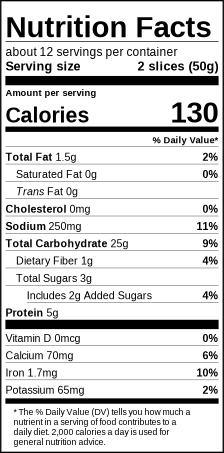
How big is a serving of bread?
Plain breads and rolls (not the sweet quick type) get the 50 g reference amount in Table 2 of 21 CFR 101.12. To build your label statement, weigh your actual slices and find how many come closest to 50 g. For a 25 g slice, that’s “2 slices (50 g).” For a denser 40 g slice, it’s “1 slice (40 g)” if that’s closer to a single-unit declaration, following the discrete-unit rule below.
The discrete-unit rule covers slices or rolls whose weight doesn’t land neatly on the RACC (101.9(b)(2)(i)). A unit that’s at least 67% and less than 200% of the RACC (about 34 g to 99 g for a 50 g RACC) is declared as one unit. So a 45 g dinner roll is one serving, “1 roll (45 g),” even though it’s under 50 g.
Package rules apply too. A single-serving loaf sold on its own at under 200% of the RACC (under 100 g total) is one serving, the full contents, per 101.9(b)(6). A small multi-roll package between 200% and 300% of the RACC (100 g to 150 g) needs dual per-serving and per-container columns under 101.9(b)(12)(i). The exception is a package that qualifies for tabular or linear format instead.
What goes on the panel
Bread carries the same mandatory nutrient list as any packaged food under 21 CFR 101.9(c). That’s calories, total fat, saturated fat, trans fat, cholesterol, sodium, total carbohydrate, dietary fiber, total sugars, added sugars, protein, vitamin D, calcium, iron and potassium. Each gets its % Daily Value (the percent column on the right side of the panel) where FDA has set one, plus the standard footnote.
On yeast bread, sodium is the number most likely to surprise you. Dough conditioners, salt for gluten structure and preservatives add up per slice. Total carbohydrate and fiber matter if you market a whole-grain product. The usual rounding under 101.9(c) applies. Sodium between 5 mg and 140 mg rounds to the nearest 5 mg. Fat under 5 g rounds to the nearest 0.5 g. Carbohydrate and protein round to the nearest gram, with “less than 1 g” below 1 g.
Which layout fits your package?
A standard loaf has plenty of labelable surface for the standard vertical format our builder uses by default. Some single-roll packages or mini-loaves have 40 sq in of labelable surface or less, and a standard vertical column can’t fit anywhere on them. Those may use tabular format under 21 CFR 101.9(j)(13)(ii). Linear format is allowed only if even a tabular display won’t fit. The NutriLabels builder makes standard vertical, simplified, tabular, linear, dual-column (per serving and per container) and bilingual EN/ES labels for bread. Formats like aggregate labeling for a mixed multipack of different breads go to our expert service instead.
Where bread labels go wrong
The trap unique to bread is naming your product with a term that has its own standard of identity. “Bread, rolls, and buns” has a standard under 21 CFR 136.110. It calls for a yeast-leavened dough with at least 62% total solids from specified farinaceous, moistening and leavening ingredients. “Whole wheat bread” has its own composition standard under 21 CFR 136.180.
Calling your product “bread” without meeting the standard that applies is a labeling issue, separate from the Nutrition Facts panel. Whether your recipe meets a named standard of identity is a composition question. Confirm it with a food-labeling attorney or your state regulator, since our database analysis doesn’t cover it. Separately, “egg bread” under 136.110 needs at least 2.56% whole egg solids. If the name refers to eggs, it also needs a “Contains ___ medium-sized egg(s) per pound” statement.
Your ingredient list and allergens
List ingredients in descending order by predominant weight under 21 CFR 101.4. Enriched flour is a standardized food (21 CFR 137.165), so it can’t appear as “enriched flour” alone. List it as enriched flour followed by its ingredients in parentheses (wheat flour, niacin, reduced iron, thiamine mononitrate, riboflavin, folic acid, plus malted barley flour if yours has it). Or list each of those ingredients in its own place in your list (21 CFR 101.4(b)(2)). Your supplier’s spec sheet shows what your flour contains.
Close with a “Contains” statement for milk, egg, wheat, soy and tree nuts, as they apply. If your loaf has sesame seeds or sesame flour, sesame goes in that same line. It became the ninth major allergen under the FASTER Act, effective January 1, 2023 (fda.gov/food/food-allergies/faster-act-sesame-ninth-major-food-allergen).
Build your bread label
When your serving is anchored to the 50 g reference amount, your slice count and sodium line hold up the first time a store buyer checks them. Enter your recipe, then see your bread label. Your label’s shape, calorie count, the claims you qualify for, your allergen line and the nutrient to watch show free, with no credit card required. The rest of the numbers on your label stay hidden until you buy a Single Product ($29) or the Studio plan ($299 a year). A Single Product unlocks the rest of the numbers on your label, every FDA format your package qualifies for, and the ingredient statement and allergen declaration, ready to print. Start your bread label, or check other baked goods in the serving sizes guide.
Bread label FAQ
Is the RACC for bread the same as for sweet breads like banana bread?
No. Plain breads and rolls get a 50 g reference amount (21 CFR 101.12). Sweet quick-type breads (banana bread, zucchini bread, pumpkin bread) use the 55 g reference amount, which also covers coffee cakes and doughnuts.
Do I have to spell out enriched flour's sub-ingredients on my bread label?
Yes, one way or the other. Enriched flour has two or more ingredients, so you list it as enriched flour followed by its ingredients in parentheses (wheat flour, niacin, reduced iron, thiamine mononitrate, riboflavin, folic acid). Or you list each of those ingredients in its own place in your list (21 CFR 101.4(b)(2)).
Does calling my product "whole wheat bread" mean it has to meet a legal recipe?
Some names come with a standard of identity, like whole wheat bread under 21 CFR 136.180. If you use that name, your bread has to meet that standard's composition requirements. Talk to a food-labeling attorney if you're unsure your recipe qualifies.
What serving size goes on a label for a single dinner roll?
Rolls share the same 50 g RACC as bread. If one roll weighs close to 50 g, it's usually one serving. The discrete-unit thresholds in 21 CFR 101.9(b)(2)(i) apply the same way they do for any other food sold in units.
What format can a small loaf of artisan bread use?
Tabular format is available under 101.9(j)(13)(ii) if the loaf's labelable surface area is 40 sq in or less and a standard vertical panel won't fit anywhere on the package. Our builder checks your package dimensions and tells you which formats you qualify for.
Related products
Cookies, Muffins. See the full all products.
Sources
- ecfr.gov/current/title-21/chapter-I/…101/subpart-A/section-101.12
- ecfr.gov/current/title-21/chapter-I/…-101/subpart-A/section-101.9
- ecfr.gov/current/title-21/chapter-I/…36/subpart-B/section-136.110
- ecfr.gov/current/title-21/chapter-I/…-101/subpart-A/section-101.4
- fda.gov/food/food-allergies/faster-…me-ninth-major-food-allergen
- fdc.nal.usda.gov/food-details/174924/nutrients