
Last verified 16 Sep 2026 · Sources
Bakery-style muffins carry a 110 g Reference Amount Customarily Consumed (RACC) under 21 CFR 101.12. English muffins are a separate category entirely, at 55 g alongside biscuits and crumpets. The regulator is FDA, and the trap most likely to catch you is treating “1 muffin” as automatically “1 serving” without checking where the muffin’s actual weight falls against the RACC: a jumbo muffin and a mini muffin from the same bakery can legally need two different serving statements. A Nutrition Facts panel is required for commercial sale outside a state’s cottage food exemption, or the moment a nutrition claim appears on the package.
| Quick facts | Muffins |
|---|---|
| Regulator | FDA |
| Reference amount (RACC) | 110 g (Bagels, toaster pastries, muffins, excluding English muffins); English muffins fall under the 55 g category instead |
| Typical serving statement | 1 muffin (110 g) |
| Typical label format | Standard vertical for most bakery muffins; dual-column per-unit for jumbo muffins over 220 g; tabular or linear for small multipacks of minis |
| Exemption | Not exempt: muffins contain more than insignificant fat, carbohydrate, and sugars, so the 101.9(j)(4) exemption doesn't apply |
| Watch out for | A 120 g bakery muffin is one serving, but a 60 g mini muffin needs the discrete-unit count-per-serving math; English muffins use a different RACC entirely |
| Common allergens | Wheat, egg, milk, soy (lecithin); tree nuts/peanuts in mix-ins; sesame if seeded (FASTER Act) |
What is the serving size for muffins? The FDA serving for muffin depends on the weight of one piece. See the full serving-size reference: single-serving cut-off, dual-column range, and servings per package.
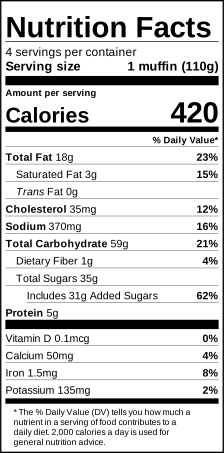
Serving size: what the RACC gives muffins
The 110 g reference amount applies to bagels, toaster pastries, and muffins excluding English muffins, per 21 CFR 101.12’s Table 2. A standard bakery muffin close to 110 g labels simply as “1 muffin (110 g).” Where it gets specific is the discrete-unit rule in 101.9(b)(2)(i), which sets three bands relative to the 110 g RACC:
- 50%–67% of RACC (55 g–74 g): the rule lets you declare 1 or 2 units as the serving. A 60 g mini muffin (55% of RACC) could be labeled as “1 mini muffin (60 g)” or “2 mini muffins (120 g).” Most brands choose 2 to land closer to the RACC weight.
- 67%–200% of RACC (74 g–220 g): one unit is the serving, regardless of exact weight. A 120 g bakery muffin (109% of RACC) is declared as “1 muffin (120 g),” the whole muffin, at its real weight.
- 200%–300% of RACC (220 g–330 g): the serving is set at the RACC-approximating amount, with a required additional per-unit column. A 240 g jumbo muffin would need roughly a 110 g-equivalent-portion serving column alongside a per-muffin column.
Package rules layer on: an individually wrapped single muffin under 200% of the RACC (under 220 g) is one serving, full contents, per 101.9(b)(6); a mini-muffin multipack between 200% and 300% of the RACC by total package weight triggers the dual-column per-serving/per-container requirement under 101.9(b)(12)(i) unless it instead qualifies for tabular or linear format.
What the panel must show
Muffins carry the standard mandatory nutrient list under 21 CFR 101.9(c): calories, total fat, saturated fat, trans fat, cholesterol, sodium, total carbohydrate, dietary fiber, total sugars, added sugars, protein, vitamin D, calcium, iron, and potassium, with %DV where established, plus the standard footnote. Saturated fat and added sugars typically matter most here: muffin batter runs on butter or oil plus a meaningful amount of sugar, and virtually all of that sugar is added rather than naturally occurring, so total sugars and added sugars often sit close together on the panel. Standard 101.9(c) rounding applies: sodium 5 mg–140 mg rounds to the nearest 5 mg, fat and carbohydrate under 5 g round to the nearest 0.5 g.
Format: which layout your package qualifies for
A standard single-wrapped bakery muffin or a 4-to-6 count box usually has enough labelable surface for the standard vertical format our builder renders by default. Jumbo muffins in the 200%-300% RACC band need dual-column per-unit formatting, which the builder also handles. A small multipack of mini muffins with 40 sq in or less of labelable surface, where a standard column won’t fit, may use tabular format under 101.9(j)(13)(ii), or linear if under 12 sq in. NutriLabels’ builder renders standard vertical, simplified, tabular, linear, dual-column (per serving/per container and per unit), and bilingual EN/ES for muffins; multi-flavor aggregate boxes go to our expert service instead.
Muffin-specific traps
The English muffin mix-up is the single biggest trap: it’s a completely different RACC category (55 g, not 110 g) because FDA groups it with biscuits and crumpets rather than with other muffins, so a serving statement built off the wrong table will be wrong from the start. The second trap is size variance within one SKU. Bakery muffins are notoriously inconsistent in weight batch to batch, and if you weigh one sample muffin and lock that serving size in permanently, your label risks drifting out of compliance as recipe or pan changes shift the real weight. Nutrient content claims like “low fat” or “made with whole grains” carry their own numeric thresholds under FDA’s nutrient content claim rules and are worth checking before printing.
Ingredient statement and allergens
List ingredients in descending order by predominant weight per 21 CFR 101.4. Enriched flour, standardized under 21 CFR 137.165, may be declared as “enriched flour” alone or spelled out with its sub-ingredients (niacin, reduced iron, thiamine mononitrate, riboflavin, folic acid) in parentheses; 101.4(b)(2) allows either. Close with a “Contains” statement covering wheat, egg, and milk (nearly universal in muffin batter), plus soy if lecithin is used, tree nuts or peanuts for any mix-in, and sesame if a seeded topping is used. Sesame became the ninth major allergen under the FASTER Act effective January 1, 2023 (fda.gov/food/food-allergies/faster-act-sesame-ninth-major-food-allergen).
Build the label
Weighing the muffin you actually bake before you print means your serving statement matches what your customer unwraps. Enter your recipe, then see your label: free with no card required, you see your calories, the claims you qualify for, your allergen line and the nutrient to watch, and every other value and %DV stays hidden until you unlock it. $29 unlocks every other nutrient value and %DV, every FDA format your muffin package qualifies for, and the ingredient statement and allergen declaration, ready to print. Start your muffin label, or see how serving sizes work for other baked goods.
Muffins label FAQ
Why do muffins and English muffins use different serving sizes?
21 CFR 101.12 treats them as different categories: bagels, toaster pastries, and muffins (excluding English muffins) get a 110 g reference amount, while English muffins are grouped with biscuits, crumpets, and soft pretzels at 55 g.
Is a 120 g bakery muffin one serving or more?
At 109% of the 110 g RACC, a 120 g muffin falls in the 67%-to-200% band under 21 CFR 101.9(b)(2)(i), so it's declared as one serving, one muffin: the whole thing, at its actual 120 g weight.
How is a 60 g mini muffin served on the label?
A 60 g mini muffin is 55% of the 110 g RACC, in the 50%-to-67% discrete-unit band, so the rule lets you declare either 1 or 2 minis as a serving. Most brands pick 2 minis (120 g) to land close to the RACC.
Do I need a per-container column for a 4-pack of jumbo muffins?
If each jumbo muffin is individually wrapped and weighs between 220 g and 330 g (200%-300% of the 110 g RACC), 21 CFR 101.9(b)(2)(i) requires the RACC-sized amount as the serving with an added per-unit column, not a simple 1-muffin-equals-1-serving label.
What allergens are typical for muffins?
Wheat, egg, and milk are near-universal in muffin batter; soy shows up via lecithin in liners or mix-ins, and nut or seed toppings need their own Contains declaration, including sesame under the FASTER Act.
Related products
Bread, Cookies. See the full all products.