
Last verified 16 Sep 2026 · Sources
The Reference Amount Customarily Consumed (RACC) for carbonated and noncarbonated beverages, wine coolers, and water is 360 mL (21 CFR 101.12), which is the legal serving size regulators expect on a soda label regardless of how big your bottle is. A typical label statement looks like “12 fl oz (355 mL).” The thing you’re most likely to get wrong isn’t the serving size itself. It’s the container-size math that decides whether a bottle needs a second column of numbers. A Nutrition Facts panel is required on essentially every soda and craft beverage package unless the labelable surface area is under 12 sq in and the label carries no nutrition claim (21 CFR 101.9(j)(13)(i)).
| Quick facts | Soda and craft beverages |
|---|---|
| Regulator | FDA |
| Reference amount (RACC) | Carbonated and noncarbonated beverages, wine coolers, water | 360 mL |
| Typical serving statement | 12 fl oz (355 mL) |
| Typical label format | Standard vertical for single-serving cans/bottles up to about 20 fl oz; mandatory dual-column (per serving/per container) for 1 L and similar multi-serving bottles per 21 CFR 101.9(b)(12)(i) |
| Exemption | Not exempt for standard cans and bottles; only packages with under 12 sq in of labelable surface and no nutrition claims may skip the panel under 101.9(j)(13)(i) |
| Watch out for | Dual-column math on 1 L+ bottles; added sugars on flavored/craft sodas |
| Common allergens | Usually none; check flavor bases, cream-soda dairy notes, and shared-line cross-contact |
What is the serving size for soda and craft beverages? The FDA serving for beverage is 12 fl oz (360 mL). See the full serving-size reference: single-serving cut-off, dual-column range, and servings per package.
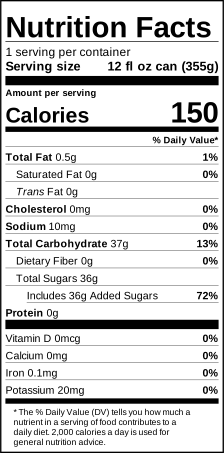
Serving size: what the RACC gives soda and craft beverages
The RACC table sets carbonated and noncarbonated beverages at 360 mL, and that number doesn’t shrink or grow with your can size. It’s the fixed reference the FDA uses to decide serving size and single-serving/dual-column status (https://www.ecfr.gov/current/title-21/chapter-I/subchapter-B/part-101/subpart-A/section-101.12). To turn 360 mL into a label statement, use the closest realistic household measure in fluid ounces (beverages are allowed to state fluid ounces instead of cups under 21 CFR 101.9), followed by the metric equivalent in parentheses, e.g., “12 fl oz (355 mL).”
Package size drives the format decision. A 12 fl oz (355 mL) can is 355 ÷ 360 = 98.6% of RACC: under 200%, so as a product packaged and sold individually it’s declared as one serving, the entire can (21 CFR 101.9(b)(6)). A 20 fl oz (591 mL) bottle is 591 ÷ 360 = 164.2% of RACC. That’s inside the 150–200% band, where the rule allows an optional additional per-RACC column on the left but doesn’t require one, so a 20 oz bottle can still ship as a single-serving label. A 1 L (1,000 mL) bottle is 1,000 ÷ 360 = 277.8% of RACC. That crosses the 200% line and stays under 300%, which means 21 CFR 101.9(b)(12)(i) makes a dual-column label mandatory: one column for the 360 mL serving, one for the full 1 L container.
What the panel must show
Every full Nutrition Facts panel carries the same 15 mandatory nutrients under 21 CFR 101.9(c): calories, total fat, saturated fat, trans fat, cholesterol, sodium, total carbohydrate, dietary fiber, total sugars, added sugars, protein, vitamin D, calcium, iron, and potassium. For soda, the nutrients that actually move are total carbohydrate, total sugars, and added sugars. In a straight cola, nearly all the sugar is added, not naturally occurring, so total sugars and added sugars often print as the same number. Sodium matters too, especially for craft sodas built on flavored syrup bases with sodium-containing preservatives. The %DV column requires the standard footnote explaining “% Daily Value,” and rounding follows 21 CFR 101.9(c). For example, calories between 5 and 50 round to the nearest 5-calorie increment, which is why a 42-calorie-per-100 g cola prints as “45” or “50” per serving depending on the exact can size.
Format: which layout your package qualifies for
Most single-serving cans and bottles up to roughly 20 fl oz use the standard vertical Nutrition Facts format. If your package’s total labelable surface area is 40 sq in or less, 21 CFR 101.9(j)(13)(ii) allows a tabular layout, or linear (string) format if the surface is under 12 sq in or the package genuinely can’t accommodate a tabular display. Once a single container’s volume pushes it into the 200–300% RACC band (a 1 L bottle, for instance), the dual-column per-serving/per-container format under 21 CFR 101.9(b)(12)(i) becomes mandatory, and that dual-column exception doesn’t apply to products already using the tabular or linear exemptions. The NutriLabels builder renders standard vertical, tabular, linear, and dual-column (per serving/per container) formats, so both a 12 fl oz can and a 1 L bottle are formats it handles; multi-pack aggregate labels for variety packs are handled by the expert service instead.
Soda and craft beverage-specific traps
The most common mistake is treating every bottle size as “one serving” out of habit and skipping the dual-column check on 1 L and larger single-container bottles. That’s the fastest way to fail a co-packer’s label review. A second trap is added sugars: a “craft” or “small-batch” positioning doesn’t exempt a soda from declaring added sugars, and claims like “low sugar” or “reduced sugar” carry their own numeric thresholds under 21 CFR 101.60/101.62 that a straight cola or fruit soda usually can’t meet. If you’re canning or bottling a shelf-stable beverage with real fruit purée or juice, acidified or low-acid canned food rules under 21 CFR 113–114 can also apply depending on final pH. That’s a separate food-safety filing from the Nutrition Facts panel, and worth confirming with your state’s food-safety program before your first commercial run.
Ingredient statement and allergens
Ingredients are listed in descending order by predominance by weight under 21 CFR 101.4, with any multi-part ingredient (like a flavor base or colorant blend) broken out into its own sub-ingredients. Plain sodas usually carry no major allergens, but cream sodas and some craft flavors use dairy-derived ingredients, and certain natural flavor bases include tree nut extracts. Both need to appear in the ingredient list and in a “Contains” statement under FALCPA. Since the FASTER Act added sesame as the ninth major allergen in 2023, check any flavoring syrups or spice-forward craft sodas for sesame-derived ingredients and fold it into the same “Contains” line if present.
Build the label
Running the dual-column check on every bottle size before you print gives your 1 L bottle the column a co-packer’s label review looks for. Enter your recipe, then see your soda label: your calories, the claims you qualify for and your allergen line are free, no card required, and every other value and %DV stays hidden until you unlock it. $29 unlocks every other nutrient value and %DV, every FDA format your beverage qualifies for, and the ingredient statement and allergen declaration, ready to print. Start your soda label, or check the serving sizes for other drinks.
Soda and craft beverages label FAQ
What serving size do I use for a 12 oz soda can?
The RACC for carbonated beverages is 360 mL (21 CFR 101.12). A 12 fl oz (355 mL) can is well under 200% of that, so it's declared as one serving, "1 can (355 mL)," with the whole can as the serving size.
Does a 20 oz soda bottle need a dual-column label?
No. A 20 fl oz (591 mL) bottle is about 164% of the 360 mL RACC, which sits in the 150–200% band where a second per-RACC column is optional, not required (21 CFR 101.9(b)(6)).
Why does my 1 liter bottle need two columns?
A 1 L bottle is about 278% of the 360 mL RACC. Once an individually packaged, single container hits 200% up to 300% of RACC, 21 CFR 101.9(b)(12)(i) requires a mandatory dual-column panel showing per-serving and per-container values.
Do I have to declare added sugars on a craft soda?
Yes. Added sugars is one of the mandatory nutrients under 21 CFR 101.9(c) for any product needing a panel, and it's usually the number that matters most on a soda label since nearly all of the sugar is added, not naturally occurring.
Can a small soda sample bottle skip the Nutrition Facts panel?
Only if its total labelable surface area is under 12 sq in and the label carries no nutrition claim, per 21 CFR 101.9(j)(13)(i), and even then it needs an address or phone number for nutrition information.
Related products
Energy drinks, Juice, Coffee. See the full all products.