
Last verified 16 Sep 2026 · Sources
Juice and juice drinks carry a 240 mL Reference Amount Customarily Consumed (RACC) under 21 CFR 101.12, so the standard label statement is “8 fl oz (240 mL)” for 100% juice and juice-and-water blends alike. What usually trips you up on a juice label isn’t the serving size. It’s the percent-juice declaration required by 21 CFR 101.30 on top of the ordinary Nutrition Facts panel, and, for juice that hasn’t gone through pasteurization or another validated pathogen-reduction step, the specific warning statement required by 21 CFR 101.17(g). A Nutrition Facts panel and the percent-juice statement are both required on essentially every commercial juice product; there’s no general exemption for “natural” or small-batch juice.
| Quick facts | Juice |
|---|---|
| Regulator | FDA |
| Reference amount (RACC) | Juices, nectars, fruit drinks | 240 mL |
| Typical serving statement | 8 fl oz (240 mL) |
| Typical label format | Standard vertical for most single-serve and multi-serve juice bottles; mandatory dual-column (per serving/per container) once an individually packaged bottle reaches 200–300% of the 240 mL RACC |
| Exemption | Not exempt; 100% juice and juice drinks both need a Nutrition Facts panel, plus the percent-juice declaration under 101.30 |
| Watch out for | Percent-juice declaration placement/type size (101.30); untreated-juice warning statement wording (101.17(g)) |
| Common allergens | Usually none in single-fruit juice; check blended juices and smoothies for tree nut, coconut, or soy add-ins |
What is the serving size for juice? The FDA serving for juice is 8 fl oz (240 mL). See the full serving-size reference: single-serving cut-off, dual-column range, and servings per package.
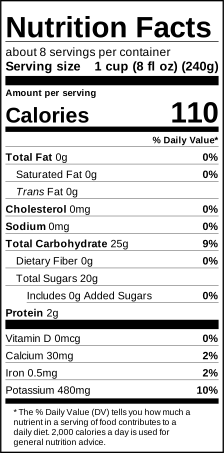
Serving size: what the RACC gives juice
The RACC table sets “juices, nectars, fruit drinks” at 240 mL, distinct from the 360 mL used for soda and other beverages (https://www.ecfr.gov/current/title-21/chapter-I/subchapter-B/part-101/subpart-A/section-101.12). That translates to a label statement of “8 fl oz (240 mL)” or “1 cup (240 mL).” Container size then decides single-serving versus dual-column status. A 12 fl oz (355 mL) single-serve bottle is 355 ÷ 240 = 147.9% of RACC, just under the 150% line, so it’s a straightforward single-serving label under 21 CFR 101.9(b)(6), no optional second column needed. Push that same bottle to 16 fl oz (473 mL) and you’re at 473 ÷ 240 = 197.1% of RACC, inside the 150–200% band, where an optional additional per-RACC column becomes available but isn’t required. A 20 fl oz (591 mL) single-container bottle is 591 ÷ 240 = 246.3% of RACC, crossing into the 200–300% range where 21 CFR 101.9(b)(12)(i) makes a mandatory per-serving/per-container dual column apply.
What the panel must show
The panel carries the same 15 mandatory nutrients under 21 CFR 101.9(c): calories, total fat, saturated fat, trans fat, cholesterol, sodium, total carbohydrate, dietary fiber, total sugars, added sugars, protein, vitamin D, calcium, iron, and potassium. For 100% juice, the number that matters most is total sugars, which runs naturally high from fruit sugar even though added sugars correctly declares 0 g. The sample panel above shows 8.4 g total sugars per 100 g of orange juice with no added sugar in the recipe. For juice drinks and nectars with added sweetener, added sugars becomes the nutrient to watch closely, and that figure comes from your own recipe, not a database lookup. Vitamin C content is common on juice labels as a voluntary nutrient, and rounding for the required nutrients follows the standard 21 CFR 101.9(c) increments.
Format: which layout your package qualifies for
Most bottled and cartoned juice (single-serve bottles and standard multi-serve cartons alike) uses the standard vertical Nutrition Facts format. Packages with 40 sq in or less of labelable surface area can use tabular or linear formats under 21 CFR 101.9(j)(13)(ii) if the shape genuinely can’t accommodate a standard vertical column. Once an individually packaged single bottle reaches the 200–300% RACC band described above, the mandatory dual-column format under 21 CFR 101.9(b)(12)(i) applies instead of a single-serving vertical layout. The NutriLabels builder renders standard vertical, tabular, linear, and dual-column per-serving/per-container formats, which covers the common juice bottle and carton sizes; it doesn’t handle the two-forms-of-the-same-food dual column sometimes used for concentrate-versus-reconstituted juice comparisons, which the expert service covers instead.
Juice-specific traps
The percent-juice declaration under 21 CFR 101.30 is the trap unique to this category: any beverage that purports to contain fruit or vegetable juice must state the percentage, placed near the top of the information panel with no other printed information above it except the brand name, product name, logo, or UPC, and in boldface type at least as large as the largest type on that panel apart from a short list of exceptions like “Nutrition Facts” and the calorie figure (https://www.ecfr.gov/current/title-21/chapter-I/subchapter-B/part-101/subpart-B/section-101.30). The second trap is juice safety classification: juice processing generally falls under Juice HACCP at 21 CFR Part 120 (https://www.ecfr.gov/current/title-21/chapter-I/subchapter-B/part-120), and juice that hasn’t been processed to achieve the pathogen reduction that regulation calls for typically needs the warning statement at 21 CFR 101.17(g): “WARNING: This product has not been pasteurized and, therefore, may contain harmful bacteria that can cause serious illness in children, the elderly, and persons with weakened immune systems,” with “WARNING” in bold and the whole statement boxed in hairlines, placed prominently on the information panel or principal display panel. 21 CFR 120.1(b) exempts retailers who make and sell juice directly to consumers only; juice sold to other businesses stays covered by Part 120. Confirm your exact processing setup against the regulation or your state regulator before deciding the warning doesn’t apply to you.
Ingredient statement and allergens
Ingredients list in descending order by predominance by weight under 21 CFR 101.4, and multi-juice blends need every component juice broken out, not lumped as “juice blend.” Single-fruit or single-vegetable juice usually carries no major allergens, but smoothie-style blends and juices with add-ins like almond milk, coconut, or protein boosters need those allergens flagged in a FALCPA “Contains” statement, and any sesame-derived ingredient folded into that same line per the FASTER Act.
Build the label
Getting the percent-juice line and the bottle-size column right on the first print run saves relabeling bottles you already filled. Enter your recipe, then see your juice label: the calorie count, the nutrient content claims you qualify for and your allergen line show free, no card required, while every other value and %DV stays hidden until you unlock it. $29 unlocks every other nutrient value and %DV, every FDA format your juice qualifies for, and the ingredient statement and allergen declaration, ready to print. Start your juice label, or check the serving sizes for other drinks.
Juice label FAQ
What serving size do I use for bottled juice?
Juices, nectars, and fruit drinks have a 240 mL RACC (21 CFR 101.12), so the standard label statement is "8 fl oz (240 mL)" or "1 cup (240 mL)" regardless of whether the juice is 100% juice or a juice drink.
Do I have to state the percent juice on the label?
Yes. Any beverage that purports to contain fruit or vegetable juice must carry a percent-juice declaration under 21 CFR 101.30, placed and sized according to that section's rules, whether the true figure is "100%" or a lower blended percentage.
When do I need the unpasteurized-juice warning statement?
If your juice hasn't been processed to achieve the pathogen reduction required for juice HACCP under 21 CFR Part 120, you generally need the warning statement specified in 21 CFR 101.17(g); check the exact scope and any exemptions with your state regulator or a food-safety consultant before skipping it.
Does 100% orange juice have added sugars on the label?
No. Straight 100% juice with nothing added declares 0 g added sugars, but total sugars is still high because the natural fruit sugar counts fully toward that line. Don't confuse "no added sugars" with "low sugar."
Does a 20 oz juice bottle need a dual-column label?
A 20 fl oz (591 mL) bottle is about 246% of the 240 mL RACC, which lands in the 200–300% range where 21 CFR 101.9(b)(12)(i) requires a mandatory per-serving/per-container dual-column panel if it's packaged and sold as one individual container.
Related products
Soda and craft beverages, Energy drinks, Coffee. See the full all products.
Sources
- ecfr.gov/current/title-21/chapter-I/…-101/subpart-A/section-101.9
- ecfr.gov/current/title-21/chapter-I/…101/subpart-A/section-101.12
- ecfr.gov/current/title-21/chapter-I/…101/subpart-B/section-101.30
- ecfr.gov/current/title-21/chapter-I/…101/subpart-B/section-101.17
- ecfr.gov/current/title-21/chapter-I/subchapter-B/part-120
- fdc.nal.usda.gov/food-details/169098/nutrients