
Last verified 16 Sep 2026 · Sources
The Reference Amount Customarily Consumed (RACC) for flavored, sweetened tea is 360 mL prepared (a realistic label statement is “12 fl oz (360 mL)”), but plain loose-leaf or bagged tea usually needs no Nutrition Facts panel at all. FDA’s insignificant-nutrient exemption at 21 CFR 101.9(j)(4) covers foods that contribute insignificant amounts of every required nutrient, provided the label carries no nutrition claim; FDA’s A Food Labeling Guide lists plain tea leaves alongside plain instant coffee and most spices as the kind of product this exemption was written for (https://www.fda.gov/files/food/published/Food-Labeling-Guide-(PDF).pdf). The trap you’re most likely to hit is assuming that exemption survives once fruit pieces, sugar, or a sweetened flavor base are added. It doesn’t, because those ingredients bring real amounts of carbohydrate and sugar onto the label. A panel is required as soon as a tea product carries a nutrition claim or contains more than insignificant amounts of any of the 15 required nutrients.
| Quick facts | Tea |
|---|---|
| Regulator | FDA |
| Reference amount (RACC) | Coffee or tea, flavored and sweetened | 360 mL prepared (plain tea leaves/bags: see 101.9(j)(4) insignificant-nutrient exemption) |
| Typical serving statement | 12 fl oz (360 mL) |
| Typical label format | Standard vertical for most bottled sweetened tea; tabular or linear if total labelable surface area is 40 sq in or less and the package can't fit a standard vertical column |
| Exemption | May be exempt under 101.9(j)(4) if all nutrients are insignificant (plain loose-leaf or bagged tea), but added fruit, sugar, or a claim removes the exemption |
| Watch out for | Added sugar in bottled/sweetened tea; herbal blends with dried fruit or sugar lose the plain-tea exemption |
| Common allergens | Usually none; check herbal blends for added milk powder, soy lecithin, or tree nut pieces |
Serving size: look up the FDA serving for your product in the Serving Size Finder.
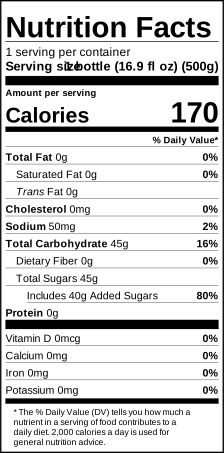
Serving size: what the RACC gives tea
21 CFR 101.12’s reference amount table puts “coffee or tea, flavored and sweetened” at 360 mL prepared, the same category flavored coffee uses. That’s the legal serving size for a sweetened bottled tea or a prepared chai, turned into a household statement like “12 fl oz (360 mL).” Package size then decides whether you need one column or two: a single bottle under 200% of the RACC (up to about 24 fl oz) is packaged and sold individually and gets labeled as one serving under 21 CFR 101.9(b)(6): the entire contents. In the sample panel above, a 16.9 fl oz (500 mL) bottle runs about 139% of the RACC, so the whole bottle is the serving; between 150% and 200% of the RACC (an 18.5 fl oz bottle, say), 101.9(b)(6) permits, but doesn’t require, an optional second column showing one RACC-sized serving alongside the whole-bottle serving. Push the bottle size to 200–300% of the RACC (roughly 24–36 fl oz) and 21 CFR 101.9(b)(12)(i) makes that second “per serving / per container” column mandatory.
A tea concentrate or chai base meant to be diluted follows the RACC table’s “drink mixes, all other types” line: the reference amount is the quantity of concentrate that makes 360 mL of prepared drink, not the volume in the bottle as sold.
What the panel must show
Once a panel is required, the same 15 mandatory nutrients apply to tea as to any beverage under 21 CFR 101.9(c): calories, total fat, saturated fat, trans fat, cholesterol, sodium, total carbohydrate, dietary fiber, total sugars, added sugars, protein, vitamin D, calcium, iron, and potassium. For sweetened tea, total sugars and added sugars are the numbers that actually move, since plain tea contributes essentially none; sodium can also shift with some flavor bases. %DV is calculated against FDA’s reference daily values and needs the standard “% Daily Value” footnote. Rounding follows 21 CFR 101.9(c). For instance, sugars under 1 g round to “0” only if truly below the insignificant threshold, and total carbohydrate under 1 g must be declared as “less than 1 gram” rather than zero.
Format: which layout your package qualifies for
Bottled sweetened tea almost always uses the standard vertical Nutrition Facts format. If a package’s total labelable surface area is 40 sq in or less, 21 CFR 101.9(j)(13)(ii) allows a tabular layout, or linear (string) format if the surface area is under 12 sq in or the shape can’t accommodate a tabular display. A tiny loose-tea pouch or single-serve chai concentrate stick with total surface area under 12 sq in can skip the panel entirely under 101.9(j)(13)(i), as long as there’s no nutrition claim and the package lists an address or phone number for nutrition information. The NutriLabels builder renders standard vertical, tabular, linear, dual-column (per serving/per container and as prepared/as packaged), bilingual, and infant/children formats for tea products that do need a panel.
Tea-specific traps
The main trap is treating a “tea” label as automatically exempt: the exemption in 21 CFR 101.9(j)(4) belongs to plain tea leaves with insignificant nutrients, not to every product with “tea” on the front label. Add dried fruit, sugar, or a flavored syrup base, and the exemption is gone because those ingredients push carbohydrate and sugar above the insignificant-amount threshold. Herbal blends are a common surprise: a chamomile-mint blend with dried apple pieces or a sweetened matcha mix no longer qualifies for the plain-leaf exemption even though it still reads as “tea” to a shopper. Nutrient content claims are the other fast way to lose an exemption: printing “antioxidant-rich” or “low calorie” on an otherwise-exempt tea voids 101.9(j)(4), since that provision only applies when the label carries no nutrition claim or information.
Ingredient statement and allergens
Ingredients are listed in descending order by predominance by weight under 21 CFR 101.4, with sub-ingredients of any flavor base or blend broken out. Plain tea carries no major allergens, but check flavored blends and chai mixes for milk powder (common in chai bases), soy lecithin, or tree nut pieces, and declare them in a FALCPA “Contains” statement. Since the FASTER Act added sesame as the ninth major allergen in 2023, review any spice or flavor blends for sesame-derived ingredients and fold that into the same “Contains” line.
Build the label
Once your blend picks up fruit or sugar, a panel built from your own recipe gives a shop buyer the numbers they ask for. Enter your recipe, then see your tea label: the calorie count, the nutrient content claims you qualify for and your allergen line show free, no card required, while every other value and %DV stays hidden until you unlock it. $29 unlocks every other nutrient value and %DV, every FDA format your tea product qualifies for, and the ingredient statement and allergen declaration, ready to print. Start your tea label, or check the serving sizes for other drinks.
Tea label FAQ
Does my loose-leaf or bagged tea need a Nutrition Facts label?
Plain tea (loose leaf or in bags, unsweetened, unflavored) usually qualifies for the 21 CFR 101.9(j)(4) exemption for foods with insignificant amounts of every required nutrient, as long as the label carries no nutrition claim.
What serving size applies to a sweetened bottled iced tea?
Flavored, sweetened tea uses the same RACC category as flavored coffee ("coffee or tea, flavored and sweetened," 360 mL prepared under 21 CFR 101.12), so a realistic label statement is "12 fl oz (360 mL)."
Does adding dried fruit to my herbal tea blend change the labeling rules?
Yes. Once a tea blend includes added fruit pieces or sugar, it's no longer contributing only insignificant amounts of nutrients, so the 101.9(j)(4) exemption for plain tea leaves no longer applies and a full panel is needed.
How do I label a chai or tea concentrate meant to be diluted?
A concentrate follows the RACC table's "drink mixes, all other types" category: the reference amount is whatever volume of concentrate makes 360 mL of prepared drink, not the full bottle as packaged.
Can herbal tea claim "no added sugar" if it never had sugar at all?
That's a nutrient content claim with its own FDA rules under 21 CFR 101.60/101.62, and some versions of the claim require the product to be one that normally does contain sugar; check the exact claim language against the regulation before printing it.
Related products
Coffee, Kombucha, Granola. See the full all products.