
Last verified 16 Sep 2026 · Sources
Cakes and cupcakes fall under FDA’s cake reference amounts in 21 CFR 101.12, and the number you use depends on which of three weight classes your product sits in: 55 g for lightweight cakes without icing or filling (angel food, chiffon, sponge), 80 g for mediumweight cakes (most chemically leavened layer cakes and cupcakes, iced or not), and 125 g for heavyweight cakes like cheesecake and pound-type cakes (21 CFR 101.12). A typical label statement looks like “1 cupcake (80 g)” or “1 slice (125 g).” The most common mistake isn’t the RACC itself. It’s assuming your single cupcake automatically counts as one serving. Whether it does depends on how its actual weight compares to the RACC for its weight class, not on how you intend it to be eaten. A Nutrition Facts panel is required on any packaged cake or cupcake sold at retail unless a specific exemption applies, such as the small-package exemption for wrappers under 12 square inches carrying no nutrition claims.
| Quick facts | Cakes and cupcakes |
|---|---|
| Regulator | FDA |
| Reference amount (RACC) | Cakes, mediumweight (chemically leavened, with/without icing) 80 g; heavyweight (cheesecake etc.) 125 g; lightweight (angel food, chiffon, or sponge cake without icing or filling) 55 g |
| Typical serving statement | 1 cupcake (80 g) |
| Typical label format | Standard vertical for boxed multi-packs (8–12 count); discrete single-unit vertical for one wrapped cupcake or slice sold alone |
| Exemption | Not exempt |
| Watch out for | Which weight class your cake falls in; whether a single cupcake counts as 1 serving or 2 under the discrete-unit rule |
| Common allergens | Wheat, egg, milk, soy (lecithin), tree nuts if used in filling/topping; sesame if seeds/tahini are in the recipe |
What is the serving size for cakes and cupcakes? The FDA serving for cupcake depends on the weight of one piece. See the full serving-size reference: single-serving cut-off, dual-column range, and servings per package.
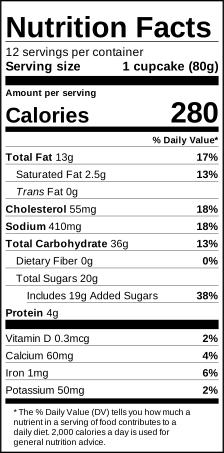
Serving size: what the RACC gives cakes and cupcakes
Once you know the weight class, converting to a label statement is straightforward: state the household measure the consumer will recognize (1 cupcake, 1 slice, 1/8 cake) alongside the gram weight that’s closest to the RACC. For a boxed assortment of individually wrapped cupcakes, each cupcake is usually its own labeled unit, and the box declares the count as “servings per container.”
The rule that actually decides the label, though, is the discrete-unit rule in 21 CFR 101.9(b)(2)(i): if one cupcake weighs at least 67% but less than 200% of its RACC, the whole cupcake is one serving. A mediumweight cupcake (80 g RACC) that actually weighs 60–90 g stays a one-unit serving. If a jumbo cupcake weighs 200–300% of the RACC (160–240 g), the label must declare the reference-amount portion as the serving and add a per-unit column showing the whole cupcake’s values too. And if the cupcake is unusually small (40–53 g, or 50–67% of RACC), the label may declare it as “1 or 2 units” at your discretion. For a full cake sold whole (not pre-sliced), single-serving and dual-column rules under 101.9(b)(6) and (b)(12)(i) apply the same way they would to any packaged food: a cake containing less than 200% of the RACC is one serving for the whole package; 200–300% requires a per-container column alongside the per-serving column.
What the panel must show
Every cake and cupcake panel needs the full mandatory nutrient list: calories, total fat, saturated fat, trans fat, cholesterol, sodium, total carbohydrate, dietary fiber, total sugars, added sugars, protein, vitamin D, calcium, iron, and potassium, each with %DV per the footnote required by 21 CFR 101.9(c). For cakes, added sugars is the number that matters most: frosting and cake batter both carry substantial added sugar, and that’s a separate declared line from total sugars, not implied by it. Saturated fat also runs high in butter- or shortening-based cakes and cheesecake. Rounding follows 101.9(c): calories round to the nearest 5-calorie increment below 50, and the nearest 10 above; fat and carbohydrate values round to the nearest 0.5 g below 5 g and whole grams above.
Format: which layout your package qualifies for
Most boxed cupcakes and sliced cakes use the standard vertical format. A single wrapped cupcake or a small individually packaged slice may qualify for the small-package formats in 21 CFR 101.9(j)(13): tabular or linear display if total label surface area is 40 square inches or less and a standard vertical column won’t fit, or full exemption from the panel if the wrapper is under 12 square inches and carries no nutrition claims (an address or phone number for nutrition information is still required). NutriLabels’ builder renders standard vertical, tabular, linear, and dual-column formats; it does not render aggregate/variety-pack labels, which matter if you’re boxing an assortment of different cake flavors under one label.
Cakes and cupcakes-specific traps
Icing and filling determine whether a cake can even use the lightweight 55 g category. The regulation’s wording is “without icing or filling,” so an iced angel food cake moves to the mediumweight 80 g bucket. Allergens are the other recurring issue: wheat, egg, milk, and soy lecithin appear in nearly every recipe, tree nuts and sesame (tahini, seeds) show up in specialty flavors, and any of the nine FALCPA/FASTER Act major allergens must appear in the “Contains” statement. There’s no acidified-food or canned-food angle here (21 CFR 114 doesn’t apply to baked goods), but claims like “low sugar” or “reduced fat” trigger nutrient content claim thresholds that a plain iced layer cake usually can’t meet.
Ingredient statement and allergens
List ingredients in descending order by weight, with sub-ingredients of compound items (like a filling or glaze) broken out in parentheses. The “Contains” statement must name each major allergen present (wheat, egg, milk, soy, tree nuts, and sesame are the common ones in cake and cupcake recipes) in plain English immediately after or near the ingredient list, per FALCPA and the FASTER Act’s 2023 addition of sesame as the ninth major allergen.
Build the label
Getting the weight class and the one-cupcake serving right the first time saves a reprint of labels you already paid for. Enter your recipe, then see your label: your calories, the claims you qualify for and your allergen line are free, no card required, and every other value and %DV stays hidden until you unlock it. $29 unlocks every other nutrient value and %DV, every FDA format your cake or cupcake package qualifies for, and the ingredient statement and allergen declaration, all in one download, with 12 months of edits included and downloads that never expire. Start your label, or see how other baked goods are sized in the serving sizes guide.
Cakes and cupcakes label FAQ
Is a cupcake one serving or two?
If a single wrapped cupcake weighs at least 67% but less than 200% of the RACC for its cake weight class, it's declared as one serving: the whole cupcake (21 CFR 101.9(b)(2)(i)). Most bakery-style cupcakes (60–90 g) land in that range.
Which RACC applies to my cake: 55 g, 80 g, or 125 g?
Lightweight cakes without icing or filling (angel food, chiffon, sponge) use 55 g; most iced, chemically leavened layer cakes and cupcakes use 80 g; heavyweight cakes like cheesecake or pound cake use 125 g (21 CFR 101.12 Table 2).
Does icing change the RACC?
Icing keeps a cake in the mediumweight 80 g category rather than moving it to lightweight, per the category wording, which specifies lightweight cakes must be "without icing or filling."
Do I need a Nutrition Facts panel on a bakery box of assorted cupcakes?
Yes, unless the package qualifies for a specific exemption (like the under-12-square-inch small-package exemption with no nutrition claims). A boxed assortment sold at retail is not automatically exempt just because it's baked fresh.
What's the biggest labeling mistake with cakes?
Using a "slice" as the serving size instead of the RACC weight class, or forgetting that a cheesecake's heavyweight 125 g RACC gives a very different %DV picture than a light sponge cake's 55 g.
Related products
Candy, Chocolate, Muffins. See the full all products.