
Last verified 16 Sep 2026 · Sources
Chocolate’s serving size under FDA rules is the same “all other candies” reference amount as most other candy: 30 g for a bar meant to be eaten as-is, or 15 g for baking chips and other baking-use chocolate (21 CFR 101.12). A typical label statement for a standard bar reads “About 1/2 bar (30 g).” Chocolate isn’t a separate FDA regulator or a special serving-size category; what’s actually distinct about chocolate is that the name on the wrapper (milk chocolate, sweet chocolate, semisweet, bittersweet, unsweetened) is a legal standard of identity under 21 CFR part 163, not a marketing choice. The number most likely to surprise you is saturated fat: a 30 g serving of a typical semisweet bar can carry over 20% of the Daily Value for saturated fat in one reference-amount serving. A Nutrition Facts panel is required on any packaged chocolate product sold at retail unless a specific small-package exemption applies.
| Quick facts | Chocolate |
|---|---|
| Regulator | FDA |
| Reference amount (RACC) | All other candies 30 g (chocolate bars, eating chocolate); baking candies (chips) 15 g |
| Typical serving statement | About 1/2 bar (30 g) |
| Typical label format | Standard vertical for full-size bars; tabular or linear for fun-size/mini bars 40 sq in or less; possible full exemption under 12 sq in with no claims |
| Exemption | Not exempt |
| Watch out for | Saturated fat often runs 20–30% DV at a 30 g serving; the name on the wrapper (milk, sweet, semisweet, bittersweet, unsweetened) is a legal standard, not marketing |
| Common allergens | Milk (even in dark chocolate, from shared lines); soy lecithin; tree nuts; may contain wheat/gluten (malt, cookie inclusions) |
What is the serving size for chocolate? The FDA serving for chocolate depends on the weight of one piece. See the full serving-size reference: single-serving cut-off, dual-column range, and servings per package.
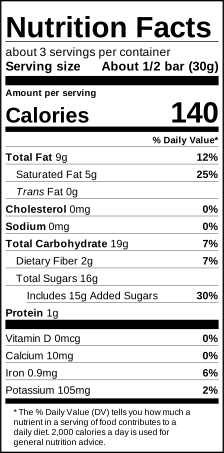
Serving size: what the RACC gives chocolate
Convert the 30 g (or 15 g for baking chips) reference amount into a household measure using your actual bar or piece weight: a 60 g bar splits into two 30 g servings, so the label reads “About 1/2 bar (30 g).” A bag of baking chips uses the 15 g reference amount, roughly 1 tablespoon, depending on chip size.
Single-serving and dual-column rules follow the same thresholds as other packaged foods. A fun-size or snack bar containing less than 200% of its RACC (under 60 g for a full bar, under 30 g for baking chips) is declared as one serving for the whole package under 21 CFR 101.9(b)(6). A bar between 200% and 300% of RACC needs a dual-column label (per-serving and per-container side by side) under 101.9(b)(12)(i), unless the package is small enough to qualify for tabular or linear format instead, which removes the dual-column requirement. A standard 3.5 oz (100 g) bar, well over 300% of the 30 g RACC, is simply labeled with servings per container (about 3) and the RACC-based serving size.
What the panel must show
The full mandatory nutrient list applies: calories, total fat, saturated fat, trans fat, cholesterol, sodium, total carbohydrate, dietary fiber, total sugars, added sugars, protein, vitamin D, calcium, iron, and potassium, with %DV per 21 CFR 101.9(c). Saturated fat is the line that matters most for chocolate: cocoa butter and chocolate liquor are naturally high in saturated fat, so a 30 g serving of a semisweet bar carrying roughly 17 g saturated fat per 100 g works out to about 5 g per serving, or roughly 26% of the 20 g Daily Value for saturated fat set in 21 CFR 101.9(c)(9). That’s a meaningfully higher %DV than you might expect from a “reasonable-looking” serving size. Added sugars is the other nutrient to watch: cacao itself carries almost no natural sugar, so in a sweetened bar, total sugars and added sugars land close to the same number, which is worth calling out to a customer who assumes some of the sugar is “natural” to the cocoa.
Format: which layout your package qualifies for
A full-size chocolate bar typically uses the standard vertical format. Fun-size or mini bars with 40 square inches or less of labeling surface may use tabular format, or linear (string) format if the surface is under 12 square inches and tabular won’t fit (21 CFR 101.9(j)(13)(ii)). A very small individually wrapped piece under 12 square inches can skip the panel entirely if it carries no nutrition claims, provided an address or phone number for nutrition information appears (101.9(j)(13)(i)). NutriLabels’ builder renders standard vertical, tabular, linear, and dual-column (per serving/per container) formats; it does not render the aggregate format used for variety boxes mixing different chocolate types under one label.
Chocolate-specific traps
The recurring trap is naming: 21 CFR 163.130 requires “milk chocolate” to contain not less than 10% chocolate liquor by weight, plus minimums for milkfat (3.39%) and total milk solids (12%); “sweet chocolate” under 163.123 needs at least 15% chocolate liquor, and “semisweet chocolate” or “bittersweet chocolate” (the regulation treats these as interchangeable names) needs at least 35% chocolate liquor. Chocolate liquor itself may be labeled “unsweetened chocolate,” “bitter chocolate,” “baking chocolate,” or “cooking chocolate” under 163.111, provided it contains 50–60% cacao fat by weight. Calling a bar “milk chocolate” or “semisweet” when it doesn’t meet the underlying percentage is a labeling violation independent of anything on the Nutrition Facts panel itself. The second trap is cross-contact: even a dairy-free dark chocolate bar made on shared equipment often carries a “may contain milk” advisory, and that’s a separate decision from the standard-of-identity name.
Ingredient statement and allergens
Ingredients list in descending order by weight: cacao-derived ingredients (chocolate liquor, cocoa butter, cocoa) alongside sweeteners, milk solids if used, soy lecithin as an emulsifier, and any inclusions like nuts or cookie pieces. Milk, soy, and tree nuts are the major allergens that show up most often in chocolate, and each present ingredient (plus any shared-line “may contain” advisory you choose to add) needs a plain-English “Contains” statement under FALCPA; sesame, if present in an inclusion, has been the ninth major allergen since the FASTER Act took effect in 2023.
Build the label
A wrapper name that matches your cacao percentages and a saturated fat line you have already seen means no surprises when a retailer reviews your bar. Enter your recipe, then see your label: your calories, the claims you qualify for and your allergen line are free, no card required, and every other value and %DV stays hidden until you unlock it. $29 unlocks every other nutrient value and %DV (including the saturated fat number that often runs higher than you expect), every FDA format your bar or chip package qualifies for, and the ingredient statement and allergen declaration, with 12 months of edits included and downloads that never expire. Start your label, or compare other categories on the product labels hub.
Chocolate label FAQ
What RACC does a chocolate bar use?
A bar meant to be eaten as-is uses the "all other candies" reference amount of 30 g; baking chips and similar baking-use chocolate use the lower 15 g baking-candies reference amount (21 CFR 101.12).
Can I call my bar "dark chocolate" on the label?
"Dark chocolate" isn't itself a defined standard-of-identity term in 21 CFR part 163; the legally defined names are sweet chocolate (at least 15% chocolate liquor) and semisweet or bittersweet chocolate (at least 35% chocolate liquor). Products sold as dark chocolate are usually labeled with the standardized name they meet, e.g., "semisweet chocolate" or "bittersweet chocolate," with "dark chocolate" used as a fanciful name.
Why is my saturated fat %DV so high for a small serving?
Chocolate liquor and cocoa butter are naturally high in saturated fat, so even a 30 g reference-amount serving of a typical semisweet bar can run 20–30% of the 20 g Daily Value for saturated fat (21 CFR 101.9(c)(9)).
Does "milk chocolate" require a minimum amount of milk?
Yes. 21 CFR 163.130 requires not less than 10% chocolate liquor by weight along with minimums for milkfat (3.39%) and total milk solids (12%).
Is "baking chocolate" the same as "unsweetened chocolate"?
Under 21 CFR 163.111, chocolate liquor may be labeled "unsweetened chocolate," "bitter chocolate," "baking chocolate," or "cooking chocolate." They're alternate names for the same standardized product.
Related products
Candy, Cakes and cupcakes, Cookies. See the full all products.
Sources
- ecfr.gov/current/title-21/chapter-I/…101/subpart-A/section-101.12
- ecfr.gov/current/title-21/chapter-I/…-101/subpart-A/section-101.9
- ecfr.gov/current/title-21/chapter-I/…r-B/part-163/section-163.123
- ecfr.gov/current/title-21/chapter-I/…r-B/part-163/section-163.130
- ecfr.gov/current/title-21/chapter-I/…r-B/part-163/section-163.111