
Last verified 16 Sep 2026 · Sources
Jam and jelly fall under the “Honey, jams, jellies, fruit butter, molasses, fruit pastes, fruit chutneys” category in 21 CFR 101.12. It sets a Reference Amount Customarily Consumed (RACC), the FDA’s reference serving for your product type, of 1 tbsp. That’s around 20 g for a typical fruit spread. A realistic label statement looks like “1 tbsp (20 g).”
FDA is the regulator. The most common mistake is treating the whole jar as one serving instead of using the 1 tbsp RACC. A jar’s size doesn’t change the legal serving. It also means a normal retail jar never qualifies for dual-column labeling, which surprises people who’ve seen dual-column panels on other small jars. You need a Nutrition Facts panel once you sell your jam or jelly, unless your business qualifies for the FDA small-business exemption and you make no nutrition claims.
| Quick facts | Jam and Jelly |
|---|---|
| Regulator | FDA |
| Reference amount (RACC) | 1 tbsp (Honey, jams, jellies, fruit butter, molasses, fruit pastes, fruit chutneys) |
| Typical serving statement | 1 tbsp (20 g) |
| Typical label format | Standard vertical for the usual 8–32 oz retail jar (tabular or linear only for a sample jar of about 2 oz or less with 40 sq in or less of labelable surface that can't fit a standard column) |
| Exemption | This product type isn’t exempt. Jam and jelly carry significant calories, carbohydrate and sugars, so the 101.9(j)(4) insignificant-nutrient exemption doesn't apply. The small-business exemption can still apply if you make no nutrition claims. |
| Watch out for | A normal retail jar never triggers the dual column, though a 2 oz sample jar can. Added sugars are not the same as the fruit's own sugar. |
| Common allergens | Usually none. Some fruit butters or specialty spreads add nuts, coconut or citrus pectin, so check the recipe. |
What is the serving size for jam and jelly? The FDA serving for jelly is 1 tbsp (21g). The full serving-size reference shows the single-serving cut-off, the dual-column range and the servings per package.
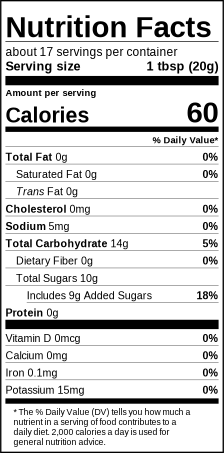
How big is a serving of jam or jelly?
The 1 tbsp RACC applies whether you make strawberry jam, grape jelly, apple butter or fruit chutney. They’re grouped together in the reference amount table of 21 CFR 101.12. On your label, you declare “1 tbsp” plus its gram weight for your recipe’s density, commonly around 20 g. A thicker preserve with more fruit pieces may weigh slightly more per tablespoon.
Package size is where jam and jelly differ sharply from most products. The single-serving container rule in 21 CFR 101.9(b)(6) labels a package as one serving (the whole contents) when it holds less than 200% of the RACC. Here, that’s under about 40 g. The dual per-serving and per-container rule in 101.9(b)(12)(i) applies only between 200% and 300% of the RACC, which is a 40 g to 60 g package.
A standard 8 oz to 32 oz (227 g to 907 g) retail jar is somewhere between roughly 1,100% and 4,500% of the RACC. That’s nowhere near either threshold. So it gets an ordinary multi-serving panel with a plain “servings per container” statement, never a dual column. A 12 oz jar at 20 g per serving holds about 17 servings.
The only place these thresholds really matter is a small sample or restaurant-style jar. A 1 oz (28 g) mini jar sits at about 140% of the RACC, so 101.9(b)(6) makes it one serving, the whole jar. A 2 oz (57 g) sample jar is different. It’s about 285% of the RACC, inside the 40 g to 60 g dual-column window, so it needs per-serving and per-container columns.
What goes on the panel
Every mandatory nutrient under 21 CFR 101.9(c) applies. That’s calories, total fat, saturated fat, trans fat, cholesterol, sodium, total carbohydrate, dietary fiber, total sugars, added sugars, protein, vitamin D, calcium, iron and potassium. Each comes with its % Daily Value (the percent column on the right side of the panel) and the standard footnote.
For jam and jelly, added sugars is the number that matters most. Fruit brings some of the total sugars naturally. But the sugar added during cooking has to be declared separately, and that split comes from your recipe, not a nutrient database. Total carbohydrate and calories also run high compared with other pantry items, because of the concentrated fruit and sugar cook-down.
The usual rounding under 101.9(c) applies. Sugars and carbohydrate under 0.5 g can read 0, and from 0.5 g to under 1 g they read “less than 1 g.” Sodium from 5 mg to 140 mg, typical for most fruit spreads, rounds to the nearest 5 mg.
Which layout fits your jar?
Standard vertical format is the norm for the glass or plastic jars most jam and jelly comes in. Their labelable surface easily goes past the 40 sq in threshold in 21 CFR 101.9(j)(13)(ii). A small 1 oz to 2 oz sample jar may have 40 sq in or less of labelable area and a shape that can’t fit a standard column. Then it may use tabular format. Linear (string) format is allowed only if even a tabular display won’t fit. The NutriLabels builder makes standard vertical, simplified, tabular, linear, dual-column and bilingual EN/ES labels. A multi-flavor gift set with several different jams under one label goes to our expert service instead.
Where jam and jelly labels go wrong
The standard of identity rules set the naming and composition bar. They’re in 21 CFR 150.140 (fruit jelly) and 150.160 (fruit preserves and jams).
- Both need a finished soluble solids content of not less than 65%.
- Jelly’s basic recipe minimum is 45 parts fruit juice ingredient to 55 parts sweetener by weight.
- Jam and preserves use a similar 45:55 ratio, or 47:55 when made only with Group I fruits.
Calling a product “jelly” when it’s actually made from fruit pulp, or the other way around, doesn’t match the standard of identity for that name.
The other trap is claims. “No sugar added” only holds up if no sugar, honey or juice concentrate working as a sweetener was added during processing (21 CFR 101.60). Your recipe may not support that claim, even if it “tastes less sweet.”
Your ingredient list and allergens
List ingredients in descending order by predominant weight, per 21 CFR 101.4. That’s usually fruit, sugar, pectin, and citric acid or lemon juice to adjust pH. Jam and jelly themselves carry no major allergens. But fruit butters or specialty spreads that add nuts, coconut or nut-based thickeners need a “Contains” statement. That follows FALCPA and the FASTER Act’s nine major allergens, including sesame if you use a seed-based mix-in.
Build your jam or jelly label
With a 1 tbsp serving and an added sugars split from your own recipe, your jar label holds up when a shop owner turns it over. Enter your recipe, then see your jam or jelly label. Your label’s shape, calorie count, the claims you qualify for, your allergen line and the nutrient to watch show free, with no credit card required. The rest of the numbers on your label stay hidden until you buy a Single Product ($29) or the Studio plan ($299 a year). A Single Product unlocks the rest of the numbers on your label, every FDA format your jar qualifies for, and the ingredient statement and allergen declaration, ready to print. Start your jam label, or compare honey and other 1 tbsp foods in the serving sizes guide.
Jam and Jelly label FAQ
Why doesn't my 12 oz jam jar ever need dual-column Nutrition Facts?
Dual per-serving and per-container labeling under 21 CFR 101.9(b)(12)(i) only applies to a package with 200% to 300% of the RACC. For jam's 1 tbsp (about 20 g) RACC, that's a 40 g to 60 g package. A 12 oz (340 g) jar is over 1,600% of the RACC, so it gets an ordinary servings per container statement instead.
Is a 1 oz mini jam jar labeled as one serving?
Likely, yes. A 28 g mini jar is about 140% of the 20 g RACC, which is under the less-than-200% threshold in 101.9(b)(6). So it's declared as one serving covering the whole jar, not a fraction of a serving.
Do I have to call it 'jelly' or can I call it 'jam' if I use whole fruit?
The names are legally distinct. Jelly is made from fruit juice, under 21 CFR 150.140. Jam and preserves are made with fruit pulp or pieces, under 150.160. Using the wrong name for your process can misbrand the product. Check your standard of identity before you print labels.
Is all the sugar in my jam 'added sugars'?
No. Fruit itself brings some natural sugar, and only the sugar you add during cooking counts as Added Sugars on the panel. FoodData Central's total sugars figure doesn't separate the two. So this split has to come from your own recipe's sugar-to-fruit ratio, not the database.
What's the biggest labeling mistake to avoid with jam?
Treating the jar as the serving. The RACC sets a 1 tbsp serving whatever the jar size. A home-recipe jar that assumes 'the whole jar is one serving' understates servings per container and gets every % Daily Value on the panel wrong.
Does a 'no sugar added' fruit spread still need an added sugars line?
Yes. It still needs the Added Sugars line on the panel, usually showing 0 g. The claim itself only holds up if no sugar, syrup or juice concentrate working as a sweetener was added during processing. Check 21 CFR 101.60 before you print the claim.
Related products
Honey, Bread, Granola. See the full all products.
Sources
- ecfr.gov/current/title-21/chapter-I/…101/subpart-A/section-101.12
- ecfr.gov/current/title-21/chapter-I/…-101/subpart-A/section-101.9
- ecfr.gov/current/title-21/chapter-I/…50/subpart-B/section-150.140
- ecfr.gov/current/title-21/chapter-I/…50/subpart-B/section-150.160
- fdc.nal.usda.gov/food-details/169641/nutrients