
Last verified 16 Sep 2026 · Sources
The RACC (Reference Amount Customarily Consumed, the FDA’s reference serving for your product type) for carbonated and noncarbonated beverages, wine coolers and water is 360 mL (21 CFR 101.12). That’s the legal serving size regulators expect on a soda label, no matter how big your bottle is. A typical label statement looks like “12 fl oz (355 mL).”
The thing you’re most likely to get wrong isn’t the serving size itself. It’s the container-size math that decides whether a bottle needs a second column of numbers. Essentially every soda and craft beverage package needs a Nutrition Facts panel. There are two exceptions, and both need no nutrition claim on the label. One is a package with under 12 sq in of labelable surface (21 CFR 101.9(j)(13)(i)). The other is the FDA small-business exemption.
| Quick facts | Soda and craft beverages |
|---|---|
| Regulator | FDA |
| Reference amount (RACC) | 360 mL (carbonated and noncarbonated beverages, wine coolers, water) |
| Typical serving statement | 12 fl oz (355 mL) |
| Typical label format | Standard vertical for single-serving cans and bottles up to about 20 fl oz (1 L bottles need a per-serving and per-container dual column under 21 CFR 101.9(b)(12)(i)) |
| Exemption | This product type isn’t exempt. for standard cans and bottles. Packages under 12 sq in (101.9(j)(13)(i)) or a qualifying small business may skip the panel if they make no nutrition claims. |
| Watch out for | Dual-column math on 1 L bottles, and added sugars on flavored and craft sodas |
| Common allergens | Usually none. Check flavor bases, dairy in cream sodas, and shared-line cross-contact. |
What is the serving size for soda and craft beverages? The FDA serving for beverage is 12 fl oz (360 mL). The full serving-size reference shows the single-serving cut-off, the dual-column range and the servings per package.
How big is a soda serving?
The RACC table sets carbonated and noncarbonated beverages at 360 mL. That number doesn’t shrink or grow with your can size. It’s the fixed reference the FDA uses to decide serving size and whether you need one column or two (21 CFR 101.12). To turn 360 mL into a label statement, use the closest realistic household measure in fluid ounces. Drinks may state fluid ounces instead of cups (21 CFR 101.9). Follow it with the metric amount in parentheses, for example “12 fl oz (355 mL).”
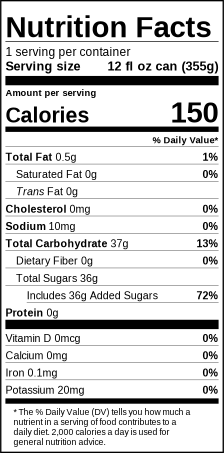
Your package size drives the format. A 12 fl oz (355 mL) can is 355 ÷ 360 = 98.6% of the RACC. That’s under 200%, so a can sold on its own is declared as one serving, the entire can (21 CFR 101.9(b)(6)).
A 20 fl oz (591 mL) bottle is 591 ÷ 360 = 164.2% of the RACC. That’s inside the 150% to 200% band. The rule allows an optional extra per-RACC column on the left but doesn’t require one, so a 20 oz bottle can still ship with a single-serving label.
A 1 L (1,000 mL) bottle is 1,000 ÷ 360 = 277.8% of the RACC. That crosses the 200% line and stays under 300%. So 21 CFR 101.9(b)(12)(i) makes a dual-column label mandatory. One column covers the 360 mL serving, and one covers the full 1 L container.
What goes on the panel
Every full Nutrition Facts panel carries the same 15 required nutrients under 21 CFR 101.9(c). They are calories, total fat, saturated fat, trans fat, cholesterol, sodium, total carbohydrate, dietary fiber, total sugars, added sugars, protein, vitamin D, calcium, iron and potassium.
For soda, the numbers that actually move are total carbohydrate, total sugars and added sugars. In a straight cola, nearly all the sugar is added, not natural. So total sugars and added sugars often print as the same number. Sodium matters too, especially for craft sodas built on flavored syrup bases with preservatives that contain sodium.
The % Daily Value column, the percent column on the right side of the panel, needs the standard footnote explaining it. Rounding follows 21 CFR 101.9(c). For example, calories above 50 round to the nearest 10. So a cola with 42 calories per 100 g prints as “150” on a 12 fl oz can (149 calories before rounding).
Which layout fits your can or bottle?
Most single-serving cans and bottles up to roughly 20 fl oz use the standard vertical Nutrition Facts format. If your package has 40 sq in or less of total labelable surface and a standard column won’t fit, 21 CFR 101.9(j)(13)(ii) allows a tabular layout. It allows linear (string) format only if a tabular layout won’t fit.
Once a single container reaches the 200% to 300% RACC band (a 1 L bottle, for instance), the per-serving and per-container dual column under 21 CFR 101.9(b)(12)(i) becomes mandatory. That dual-column exception doesn’t apply to products already using the tabular or linear exemptions. The NutriLabels builder makes standard vertical, tabular, linear and dual-column (per serving and per container) formats. So it handles both a 12 fl oz can and a 1 L bottle. Our expert service handles aggregate labels for variety multi-packs instead.
Where soda labels go wrong
The most common mistake is treating every bottle size as “one serving” out of habit. Then the dual-column check gets skipped on 1 L bottles. That’s the fastest way to fail a co-packer’s label review.
A second trap is added sugars. Calling a soda “craft” or “small-batch” doesn’t exempt it from declaring added sugars. Claims like “sugar free” or “reduced sugar” have their own number cutoffs under 21 CFR 101.60(c). A straight cola or fruit soda usually can’t meet them.
If you can or bottle a shelf-stable drink with real fruit purée or juice, the acidified or low-acid canned food rules under 21 CFR 113 and 114 can also apply, depending on final pH. That’s a separate food-safety filing from the Nutrition Facts panel. Check with your state’s food-safety program before your first commercial run.
Your ingredient list and allergens
Ingredients are listed in descending order by weight (21 CFR 101.4). Any ingredient with several parts (like a flavor base or color blend) gets its own sub-ingredients listed.
Plain sodas usually carry no major allergens. Cream sodas and some craft flavors use dairy ingredients, though, and certain natural flavor bases include tree nut extracts. Both need to appear in the ingredient list and in a “Contains” statement under FALCPA. The FASTER Act added sesame as the ninth major allergen in 2023. So check any flavoring syrups or spice-forward craft sodas for sesame ingredients, and add sesame to the same “Contains” line if it’s there.
Build your soda label
Run the dual-column check on every bottle size before you print. Then your 1 L bottle has the column a co-packer’s label review looks for. Enter your recipe, then see your soda label. Your label’s shape, calorie count, the claims you qualify for, your allergen line and the nutrient to watch show free, with no credit card required. The rest of the numbers on your label stay hidden until you buy a Single Product or the Studio plan.
A Single Product is $29. It unlocks the rest of the numbers on your label, every FDA format your beverage qualifies for, and the ingredient statement and allergen declaration, ready to print. Start your soda label, or check the serving sizes for other drinks.
Soda and craft beverages label FAQ
What serving size do I use for a 12 oz soda can?
The RACC for carbonated beverages is 360 mL (21 CFR 101.12). A 12 fl oz (355 mL) can is well under 200% of that. So it's declared as one serving, "1 can (355 mL)," with the whole can as the serving size.
Does a 20 oz soda bottle need a dual-column label?
No. A 20 fl oz (591 mL) bottle is about 164% of the 360 mL RACC. That sits in the 150% to 200% band, where a second per-RACC column is optional, not required (21 CFR 101.9(b)(6)).
Why does my 1 liter bottle need two columns?
A 1 L bottle is about 278% of the 360 mL RACC. Once a single container sold on its own hits 200% up to 300% of the RACC, 21 CFR 101.9(b)(12)(i) requires a dual-column panel. It shows per-serving and per-container values.
Do I have to declare added sugars on a craft soda?
Yes. Added sugars is one of the required nutrients under 21 CFR 101.9(c) for any product that needs a panel. It's usually the number that matters most on a soda label, since nearly all of the sugar is added, not natural.
Can a small soda sample bottle skip the Nutrition Facts panel?
Only if its total labelable surface is under 12 sq in and the label makes no nutrition claim, per 21 CFR 101.9(j)(13)(i). Even then, it needs an address or phone number for nutrition information.
Related products
Energy drinks, Juice, Coffee. See the full all products.