
Last verified 16 Sep 2026 · Sources
Pickles fall under the “Pickles and pickled vegetables, all types” category in 21 CFR 101.12, which sets a Reference Amount Customarily Consumed (RACC) of 30 g. The regulation’s own label statement example reads “1 oz (28 g/visual unit of measure),” which in practice you’d usually translate to a household count like “2 spears (30 g)” or “3 chips (30 g).” The regulator is FDA, and the number most likely to trip you up is sodium: brine-based preservation pushes it well past the level where “low sodium” or similar claims become legally available. A Nutrition Facts panel is required once pickles are sold commercially rather than under a cottage food exemption with no nutrition claims, and, separately from the panel, most cucumber pickles are also an acidified food subject to FDA process filing before they can legally be produced at all.
| Quick facts | Pickles |
|---|---|
| Regulator | FDA |
| Reference amount (RACC) | 30 g (Pickles and pickled vegetables, all types) |
| Typical serving statement | 2 spears (30 g) |
| Typical label format | Standard vertical for the usual 16–32 oz jar; a small 2–3 oz snack cup of spears can land in the dual-column band, and tabular/linear applies only if labelable area is 40 sq in or less |
| Exemption | Not exempt: sodium levels in brined pickles are far above the insignificant-amount threshold in 101.9(j)(4) |
| Watch out for | Sodium often 700–1,200 mg per 100 g; acidified-food process filing is separate from the label |
| Common allergens | Usually none; check garlic, mustard seed, or soy-based brine blends and any spice mix with sesame |
What is the serving size for pickles? The FDA serving for pickles depends on the weight of one piece. See the full serving-size reference: single-serving cut-off, dual-column range, and servings per package.
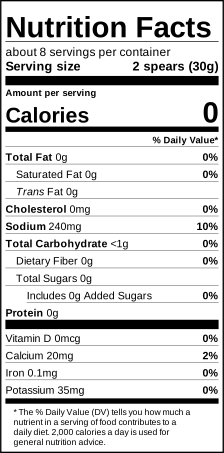
Serving size: what the RACC gives pickles
The 30 g reference amount applies across pickle types: dill, bread-and-butter, gherkins, pickled peppers and other vegetables. Because pickles are a discrete-unit food (spears, chips, whole small pickles), 21 CFR 101.9(b)(2)(i) governs how you convert 30 g into a household count: a unit that’s at least 67% and under 200% of the RACC (roughly 20 g–60 g) is declared as one unit, so a single 25 g spear is one serving even though it’s under 30 g; smaller chips or slices get grouped (“2 chips,” “3 chips”) to approximate 30 g.
Package size math follows the same bands as other RACC categories. A single-serving container under 200% of the RACC (under 60 g) is one serving, whole contents, per 101.9(b)(6). The dual-column rule in 101.9(b)(12)(i) applies between 200% and 300% of the RACC (60 g to 90 g), which is where a small 2 oz to 3 oz snack cup of spears can land, requiring both a per-serving and a per-container column. A standard 16 oz to 32 oz jar is far beyond 90 g of drained product, so it’s labeled with an ordinary per-serving panel and a servings-per-container count instead (the count is the drained product weight divided by the 30 g serving).
What the panel must show
The mandatory nutrient list under 21 CFR 101.9(c) is unchanged: calories, total fat, saturated fat, trans fat, cholesterol, sodium, total carbohydrate, dietary fiber, total sugars, added sugars, protein, vitamin D, calcium, iron, and potassium, each with %DV and the standard footnote. Sodium is the nutrient that matters most for pickles: a typical dill or kosher pickle runs from roughly 700 mg to over 1,200 mg of sodium per 100 g depending on brine concentration, which shows up as a meaningful %DV even at a modest 30 g serving. Total sugars matter more for sweeter styles like bread-and-butter pickles, where sugar is added to the brine; a plain dill pickle typically has little to no added sugar.
Rounding under 101.9(c) applies as usual: sodium in the 5 mg–140 mg range rounds to the nearest 5 mg, and above 140 mg rounds to the nearest 10 mg, relevant here because most pickle servings sit well above that 140 mg line.
Format: which layout your package qualifies for
Standard vertical format fits the usual 16 oz to 32 oz jar, which clears the 40 sq in labelable-surface threshold in 21 CFR 101.9(j)(13)(ii) comfortably. A small snack cup or pouch with 40 sq in or less of labelable area, and a shape that can’t accommodate a standard column, may use tabular format, or linear (string) format under 12 sq in. NutriLabels’ builder renders standard vertical, simplified, tabular, linear, dual-column, and bilingual EN/ES for pickles; a mixed-vegetable variety jar with multiple distinct pickled items under one label goes to our expert service instead.
Pickle-specific traps
Most pickles are an acidified food under 21 CFR 114: a low-acid food (cucumbers, peppers, green beans) to which acid is added to reach a finished equilibrium pH of 4.6 or below. Part 114’s scope explicitly covers foods “called, or may purport to be, ‘pickles’ or ‘pickled ___.’” Before the Nutrition Facts panel is even the issue, a commercial processor typically registers as a food canning establishment on Form FDA 2541 and files a scheduled process on Form FDA 2541e under 21 CFR 108.25, which sets a 10-day deadline for registration and a 60-day deadline for process filing; both are done through the FDA Industry Systems (FURLS) LACF portal. This is a separate track from the label itself, but it’s usually the bigger hurdle if you’re moving from cottage food to wholesale. On the label side, the sodium level makes “low sodium” (140 mg or less per RACC) and similar claims unreachable for most traditional brine recipes.
Ingredient statement and allergens
List ingredients in descending order by predominant weight under 21 CFR 101.4, typically cucumbers (or other vegetable), water, vinegar, salt, and spices like dill, garlic, or mustard seed. Plain vinegar-brined pickles carry none of the nine major allergens, but soy sauce in Asian-style brines, mustard seed, or a spice blend containing sesame each need a “Contains” statement under FALCPA and the FASTER Act, which added sesame as the ninth major allergen effective January 1, 2023.
Build the label
A sodium figure calculated from your own brine gives a retail buyer a number they can check against the jar. Enter your recipe, then see your pickle label: your calories, the claims you qualify for and your allergen line are free, no card required, and every other value and %DV stays hidden until you unlock it. $29 unlocks every other nutrient value and %DV, every FDA format your pickle package qualifies for, and the ingredient statement and allergen declaration, ready to print. Start your pickle label, or browse other product labels.
Pickles label FAQ
What's the RACC for pickles?
30 g, under the 'Pickles and pickled vegetables, all types' entry in 21 CFR 101.12 Table 2, with a label statement given as '1 oz (28 g/visual unit of measure)'. In practice, you'd usually state it as a household count like '2 spears' or '3 chips' alongside the gram equivalent.
Do pickles need FDA process filing before I can even worry about the label?
If your product has a finished equilibrium pH of 4.6 or below with added acid (the definition of an acidified food in 21 CFR 114.3), 21 CFR 108.25 sets a 10-day deadline to register your facility (Form FDA 2541) and a 60-day deadline to file your scheduled process (Form FDA 2541e), both before the Nutrition Facts panel is the relevant issue. FDA's Acidified/Low-Acid Canned Foods registration and process filing is done through the FDA Industry Systems (FURLS) LACF portal.
Why is sodium the number retailers scrutinize on a pickle label?
Brining relies on salt for safety and flavor, so sodium routinely runs 700 mg to over 1,200 mg per 100 g depending on brine strength, high enough that a 'low sodium' claim (which requires 140 mg or less per RACC under FDA's nutrient content claim rules) is out of reach for most traditional recipes.
Does a small snack cup of pickles need dual-column labeling?
It can. The dual-column rule in 21 CFR 101.9(b)(12)(i) applies between 200% and 300% of the 30 g RACC (60 g to 90 g). A 2 oz to 3 oz snack cup of spears falls in or near that range, while a full 16 oz to 32 oz jar is far beyond it and uses an ordinary servings-per-container statement instead.
Are refrigerated 'fresh-pack' pickles regulated differently than shelf-stable ones?
Refrigerated acidified products still fall under 21 CFR 114 if they meet the acidified-food definition; refrigeration affects your process design and labeling (e.g., 'Keep Refrigerated'), not whether Part 114 applies. Confirm your specific process classification with a process authority.
What allergens actually show up in pickles?
Cucumbers and vinegar brine carry none of the nine major allergens on their own; the risk comes from add-ins like soy sauce in Asian-style brines, mustard seed, or a spice blend containing sesame, which needs a 'Contains' statement under FALCPA and the FASTER Act.
Related products
Jam and Jelly, Honey. See the full all products.
Sources
- ecfr.gov/current/title-21/chapter-I/…101/subpart-A/section-101.12
- ecfr.gov/current/title-21/chapter-I/…-101/subpart-A/section-101.9
- ecfr.gov/current/title-21/chapter-I/subchapter-B/part-114
- ecfr.gov/current/title-21/chapter-I/…108/subpart-B/section-108.25
- fdc.nal.usda.gov/food-details/168558/nutrients