
Last verified 16 Sep 2026 · Sources
Trail mix and nuts fall under FDA’s “nuts, seeds and mixtures, all types” category, which sets the legal serving size at 30 g (about 1/4 cup) no matter what state you’re selling in or how big your bag is (21 CFR 101.12). FDA is the regulator here, not USDA, since neither nuts nor dried fruit falls under meat/poultry inspection. The trap you’re most likely to hit isn’t the serving size. It’s the allergen line: FDA guidance requires you to name each tree nut individually (almonds, cashews, pecans), not lump them together as “tree nuts.” A Nutrition Facts panel is required on virtually any packaged trail mix sold at retail or wholesale; only very small packages (under 12 sq in of total labeling surface) with no nutrition claims can skip it.
| Quick facts | Trail mix and nuts |
|---|---|
| Regulator | FDA |
| Reference amount (RACC) | 30 g (nuts, seeds and mixtures, all types) |
| Typical serving statement | 1/4 cup (30 g) |
| Typical label format | Standard vertical for most bags; tabular or linear under 40 sq in if the package can't fit a standard column; dual-column per serving/container between 200% and 300% of RACC (60 g to 90 g) |
| Exemption | Not exempt |
| Watch out for | Name each tree nut, not "tree nuts"; the 1.5 oz claim needs FDA's exact wording |
| Common allergens | Tree nuts (name each type), peanuts; may include soy or milk in coated or yogurt-covered mixes |
What is the serving size for trail mix and nuts? The FDA serving for trail mix depends on the weight of one piece. See the full serving-size reference: single-serving cut-off, dual-column range, and servings per package.
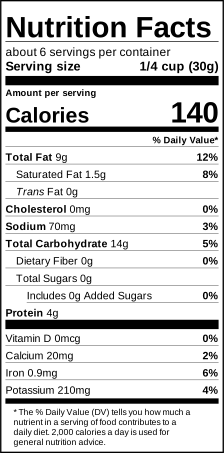
Serving size: what the RACC gives trail mix and nuts
The reference amount customarily consumed (RACC) for “nuts, seeds and mixtures, all types” is 30 g (21 CFR 101.12). On the label, that becomes a serving statement combining a household measure and the gram weight: “1/4 cup (30 g)” is standard for a loose mix of nuts, seeds, and dried fruit. Package size determines what else you need. A small 1.5 oz (42 g) single-serve pouch is about 140% of the RACC, still under 200%, so under 21 CFR 101.9(b)(6) it’s labeled as one serving, period, with the whole pouch as the serving size. Push that pouch to 2.5 oz (71 g) and you’re at roughly 236% of RACC, landing in the 200%–300% band where 21 CFR 101.9(b)(12)(i) requires a dual-column label: one column per serving (30 g), one for the entire container. Go much bigger: a 12 oz (340 g) trail mix bag is over 1,100% of RACC, and you’re back to a standard multi-serving label with a “servings per container” statement (about 11 servings), no dual column required.
What the panel must show
Every mandatory nutrient applies: calories, total fat, saturated fat, trans fat, cholesterol, sodium, total carbohydrate, dietary fiber, total sugars, added sugars, protein, vitamin D, calcium, iron, and potassium, each with its %DV footnote defined in 21 CFR 101.9(c). Sodium and saturated fat matter most here: salted or oil-roasted nuts and seeds can push both higher than shoppers expect, and added sugars show up fast in yogurt-covered or honey-roasted pieces. Rounding follows 21 CFR 101.9(c): calories round to the nearest 5-calorie increment below 50 and the nearest 10 above, and fat/carb/protein round to the nearest 0.5 g below 5 g and the nearest whole gram above, small enough that a chocolate-chip trail mix and a plain nut mix can round to visibly different numbers even with similar recipes.
Format: which layout your package qualifies for
Most trail mix bags run a standard vertical Nutrition Facts panel. If your total labeling surface is 40 sq in or less and the package shape genuinely can’t fit a standard vertical column (think narrow stand-up pouches), tabular or linear formats become available under 21 CFR 101.9(j)(13)(ii), and the NutriLabels builder renders all three (vertical, tabular, linear). Bilingual EN/ES panels are also available if you sell in markets that expect them. What the builder doesn’t render: aggregate labels for variety packs of different trail-mix flavors in one box. That goes to the expert service.
Trail mix and nuts-specific traps
Tree nuts are the headline allergen issue: FDA’s allergen labeling Q&A confirms the “Contains” statement and ingredient list must identify each tree nut species by name rather than the generic term “tree nuts” (FDA allergen Q&A, Question C.5). Peanuts get the same species-level treatment even though botanically they’re legumes. They’re one of the nine major allergens under FALCPA and the FASTER Act. If your mix is made on shared equipment with a nut your recipe doesn’t call for, a “may contain” or “produced in a facility that also processes…” statement is worth adding, but it’s entirely voluntary. FDA does not require precautionary cross-contact statements (FDA Food Allergies page). The other trap is health-claim wording: FDA’s 2003 enforcement-discretion letter lets nut products carry a qualified health claim along the lines of stating that eating 1.5 ounces per day of most nuts, as part of a diet low in saturated fat and cholesterol, may reduce the risk of heart disease, but only certain nuts qualify and the claim has to track FDA’s qualifying language rather than a loose paraphrase (FDA qualified health claims: letters of enforcement discretion). Slapping “heart healthy” on the bag without that structure is a nutrient-content-claim risk, not a shortcut.
Ingredient statement and allergens
List ingredients in descending order by weight, breaking out sub-ingredients of any blended component (e.g., a “yogurt coating” ingredient still needs its own sub-list). Follow the ingredient list with a “Contains” statement naming every tree nut species, peanuts, and any of the other seven major allergens present (milk, egg, wheat, soy, fish, crustacean shellfish, sesame). Sesame has required declaration since the FASTER Act took effect in 2023. If dried fruit pieces are sulfured, that goes in the ingredient list too, though sulfites aren’t one of the nine major allergens.
Build the label
A Contains line that names every nut in your mix tells an allergic shopper exactly what’s in the bag. Enter your recipe, then see your trail mix label: the calorie count, the nutrient content claims you qualify for and your allergen line show free, no card required, while every other value and %DV stays hidden until you unlock it. $29 unlocks every other nutrient value and %DV, every FDA format your package qualifies for, and a compliant ingredient statement and allergen declaration, ready to print, with 12 months of edits included and downloads that never expire. Start your trail mix label, or browse other product labels.
Trail mix and nuts label FAQ
Is trail mix's serving size 1/4 cup or 30 g?
Both: 30 g is the legal reference amount for nuts, seeds and mixtures under 21 CFR 101.12, and 1/4 cup is the closest household measure you'd typically use to state it on the label.
Can I just write "tree nuts" in my allergen statement?
No. FDA guidance says the "Contains" statement and ingredient list must name each tree nut species (almonds, cashews, walnuts, etc.), not the umbrella term "tree nuts."
Do I have to put a "may contain" cross-contact warning on my bag?
No. FDA has no requirement for precautionary allergen statements; they're voluntary and only address unavoidable cross-contact, not the allergens you deliberately put in the mix.
Can I say my trail mix is good for heart health?
Only if you use FDA's qualified health claim language for nuts, which specifies 1.5 oz per day and pairs the claim with a low-saturated-fat, low-cholesterol diet. A generic "heart healthy" claim isn't authorized.
My bag is 2.5 oz. Do I need a dual-column label?
Likely yes. At 30 g RACC, a 71 g (2.5 oz) bag is about 236% of the reference amount, which falls in the 200%–300% range where 21 CFR 101.9(b)(12)(i) requires both a per-serving and a per-container column.
Does a dried-fruit-and-nut mix count as "nuts, seeds and mixtures"?
Yes. The RACC category covers nuts, seeds, and mixtures of them (including with dried fruit or candy pieces) at 30 g; it's the same reference amount used for plain roasted nuts.
Related products
Nut butter, Granola bars, Granola, Chips (potato, tortilla, vegetable). See the full all products.
Sources
- ecfr.gov/current/title-21/chapter-I/…101/subpart-A/section-101.12
- ecfr.gov/current/title-21/chapter-I/…-101/subpart-A/section-101.9
- fda.gov/media/117410/download
- fda.gov/food/nutrition-food-labelin…tters-enforcement-discretion
- fda.gov/food/nutrition-food-labelin…ritical-foods/food-allergies
- fdc.nal.usda.gov/food-details/167561/nutrients