
Last verified 16 Sep 2026 · Sources
Chips (potato, tortilla, or vegetable) fall under the FDA’s “snacks: all varieties” category in 21 CFR 101.12, which sets a reference amount customarily consumed (RACC) of 30 g no matter the base ingredient. That reads on a label as a household measure plus grams, something like “About 15 chips (28 g).” The regulator here is FDA, not USDA. The trap to watch on a new chip label isn’t the serving size itself. It’s what happens when your bag size crosses a percentage threshold of that 30 g, which flips the panel from one column to two. A Nutrition Facts panel is required on packaged food FDA regulates unless the package is small enough to qualify for the surface-area exemption below.
| Quick facts | Chips (potato, tortilla, vegetable) |
|---|---|
| Regulator | FDA |
| Reference amount (RACC) | 30 g (Snacks: all varieties, including chips, pretzels, popcorn, extruded snacks, fruit/vegetable chips) |
| Typical serving statement | About 15 chips (28 g/1 oz) |
| Typical label format | Standard vertical for most bags; tabular or linear for single-serve bags 40 sq in or less; dual-column per serving/per container for multi-serve bags between 200% and 300% of RACC that don't qualify for tabular |
| Exemption | Not exempt |
| Watch out for | Sodium %DV on multi-serve bags; dual-column vs. tabular depends on surface area, not size |
| Common allergens | Usually none for plain potato/corn chips; check for milk (cheese powder), wheat (some tortilla/pretzel chips), soy (oils, seasonings) |
What is the serving size for chips (potato, tortilla, vegetable)? The FDA serving for chips depends on the weight of one piece. See the full serving-size reference: single-serving cut-off, dual-column range, and servings per package.
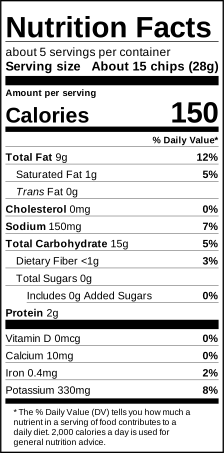
Serving size: what the RACC gives chips
The 30 g reference amount applies to “snacks: all varieties, chips, pretzels, popcorn, extruded snacks, fruit/vegetable chips” per 21 CFR 101.12’s reference amount table. You convert that into a label statement by counting how many whole chips of your product typically weigh close to 30 g, then writing it as “About [X] chips (28 g)” or similar; exact wording depends on your chip’s average piece weight. Package size is where the real decisions happen. A 1 oz (28 g) single-serve bag comes to 93.3% of the 30 g RACC (under 200%), so under 21 CFR 101.9(b)(6), a package sold individually containing less than 200% of the RACC must be labeled as one serving, meaning the whole 28 g bag is “1 serving per container.” A 2.5 oz (71 g) bag, by contrast, comes to about 237% of the RACC. That lands inside the 200%–300% band where 21 CFR 101.9(b)(12)(i) requires an additional column for the entire package alongside the per-serving column (a dual-column, per-serving/per-container label), unless the package instead qualifies for the tabular exception described below, in which case the dual-column requirement doesn’t apply (21 CFR 101.9(b)(12)(i)(A)).
What the panel must show
Every panel must carry the full run of mandatory nutrients under 21 CFR 101.9(c): calories, total fat, saturated fat, trans fat, cholesterol, sodium, total carbohydrate, dietary fiber, total sugars, added sugars, protein, vitamin D, calcium, iron, and potassium, each with %DV where FDA assigns one, plus the “Percent Daily Value is based on a 2,000 calorie diet” footnote (or its abbreviated form on qualifying small packages). For chips specifically, sodium and total fat are the numbers shoppers scan first, and %DV rounding matters: sodium rounds to the nearest 5 mg between 5–140 mg and to the nearest 10 mg above that, while fat rounds to the nearest 0.5 g under 5 g and the nearest gram above it (21 CFR 101.9(c)). Flavored chips (barbecue, ranch, chili-lime) often carry small amounts of added sugar from seasoning blends. That has to be declared and rounds to the nearest gram, or “Contains less than 1 gram” below that.
Format: which layout your package qualifies for
Most standard chip bags run a standard vertical panel. Smaller packages get more options: under 21 CFR 101.9(j)(13)(ii), a package with 40 sq in or less of available labeling surface may use a tabular layout, or a linear (string) layout if the surface is under 12 sq in or the package genuinely can’t fit a vertical or tabular block anywhere. That tabular/linear eligibility is also what waives the dual-column requirement for a 2.5 oz bag that would otherwise need one: if the bag’s labeling surface is 40 sq in or less, tabular format with a single column is allowed instead of the per-serving/per-container dual column. A package under 12 sq in with no nutrition claims can skip the panel entirely under 21 CFR 101.9(j)(13)(i), provided it carries a phone number or address for nutrition information. NutriLabels’ builder renders standard vertical, tabular, linear, and dual-column per serving/per container today.
Chips-specific traps
Claims are the fast way to turn a routine chip label into a compliance problem: “low sodium,” “reduced fat,” or “baked not fried” are nutrient content claims with specific FDA numeric thresholds, and using one without checking it first is a common mistake here. Acrylamide, a compound that forms in starchy foods during high-heat frying or baking, is a real FDA concern if you fry or bake chips, but it is not a Nutrition Facts label item; it doesn’t appear among the nutrients 21 CFR 101.9 requires or allows, so it has no place on the panel (FDA addresses it separately, as food safety and processing guidance). Multi-flavor variety packs fall under a more complex “aggregate” format NutriLabels’ builder doesn’t render; that case goes to the expert label service instead.
Ingredient statement and allergens
Ingredients list in descending order by weight, so a plain potato chip usually reads “Potatoes, vegetable oil (sunflower, corn, and/or canola), salt.” Seasoned chips need sub-ingredients broken out for any seasoning blend, and a “Contains” statement is required whenever the recipe includes one of the 9 major allergens under FALCPA and the FASTER Act: milk, eggs, fish, crustacean shellfish, tree nuts, peanuts, wheat, soybeans, or sesame (effective January 1, 2023). Cheese-powder seasonings bring milk; some tortilla and pretzel-style chips use wheat flour; frying oils and seasoning carriers are worth double-checking for soy. Corn is not one of the 9 major allergens and doesn’t require a “Contains” statement on its own.
Build the label
Knowing which side of the 200% line your bag sits on before you print means one run of bags instead of two. Enter your recipe, then see your chip label: the calorie count, the nutrient content claims you qualify for and your allergen line show free, no card required, while every other value and %DV stays hidden until you unlock it. $29 unlocks every other nutrient value and %DV, every FDA format your bag size qualifies for (vertical, tabular, dual-column, or linear), plus the ingredient statement and allergen declaration, all included. Start your label, or see how other snacks are sized in the serving sizes guide.
Chips (potato, tortilla, vegetable) label FAQ
What serving size does the FDA require for chips?
Chips fall under the "snacks: all varieties" category in 21 CFR 101.12, with a reference amount (RACC) of 30 g regardless of whether they're potato, tortilla, or vegetable chips. You state that as a household measure plus grams, such as "About 15 chips (28 g)."
Does a 1 oz single-serve chip bag need one serving or two?
At 28 g, a 1 oz bag is under 200% of the 30 g RACC, so 21 CFR 101.9(b)(6) requires it to be labeled as one serving: the entire bag.
Why does my 2.5 oz bag need two columns of numbers?
At 71 g, a 2.5 oz bag is about 237% of the 30 g RACC, which lands in the 200%–300% range where 21 CFR 101.9(b)(12)(i) requires a per-serving and a per-container column, unless the package qualifies for tabular or linear format instead.
Do I need to list acrylamide on a chip label?
No. Acrylamide isn't one of the nutrients 21 CFR 101.9 requires or permits on the Nutrition Facts label; FDA addresses it separately as a food-safety and processing topic, not a labeling one.
What allergens do I usually need to flag on a chip label?
Plain potato and corn chips often have none of the 9 major allergens, but cheese seasonings bring milk, some tortilla and pretzel-style chips use wheat, and most frying oils and seasoning blends are worth checking for soy.
Related products
Crackers, Popcorn, Tortillas (corn and flour), Trail mix and nuts. See the full all products.
Sources
- ecfr.gov/current/title-21/chapter-I/…101/subpart-A/section-101.12
- ecfr.gov/current/title-21/chapter-I/…-101/subpart-A/section-101.9
- fda.gov/food/food-allergies/faster-…me-ninth-major-food-allergen
- fda.gov/food/nutrition-facts-label/whats-nutrition-facts-label
- fdc.nal.usda.gov/food-details/169677/nutrients