
Last verified 16 Sep 2026 · Sources
Nut and seed butters (peanut, almond, cashew, sunflower seed) share one RACC (Reference Amount Customarily Consumed, the FDA’s reference serving for your product type). It’s 2 tbsp, about 32 g for most recipes (21 CFR 101.12). FDA regulates this category.
If you make peanut butter, there’s a second rule on top. The standard of identity in 21 CFR 164.150 requires peanut ingredients to be at least 90% of the finished product by weight. The trap you’re most likely to hit isn’t the serving size, though. It’s assuming your big jar is “one serving” because it’s sold as a single unit. It isn’t. Essentially any packaged nut butter sold at retail or wholesale needs a Nutrition Facts panel. The same exemptions apply as for any other food, like the small-package exemption or the FDA small-business exemption with no nutrition claims.
| Quick facts | Nut butter |
|---|---|
| Regulator | FDA |
| Reference amount (RACC) | 2 tbsp (nut and seed butters, pastes, or creams) |
| Typical serving statement | 2 tbsp (32 g) |
| Typical label format | Standard vertical for most jars (tabular or linear only for very small packages of 40 sq in or less, and a dual column is rare because most jars hold far more than 300% of the RACC) |
| Exemption | This product type isn’t exempt. The small-business exemption can still apply if you make no nutrition claims. |
| Watch out for | "Peanut butter" needs at least 90% peanuts. A 16 oz jar holds many servings, not one. |
| Common allergens | Peanuts or the specific tree nut used. Flavored or "no-stir" butters may add milk or soy. |
What is the serving size for nut butter? The FDA serving for nut butter is 2 tbsp (30g). The full serving-size reference shows the single-serving cut-off, the dual-column range and the servings per package.
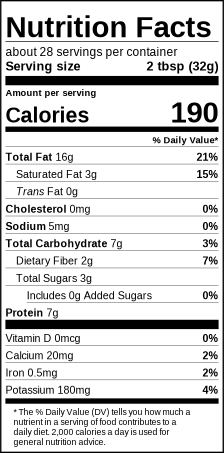
How big is a nut butter serving?
FDA’s reference amount for “nut and seed butters, pastes, or creams” is 2 tbsp (21 CFR 101.12). On your panel, state it as a household measure plus grams. “2 tbsp (32 g)” is typical for peanut or almond butter. Density shifts a little with add-ins like chocolate or crunch pieces, so weigh your own product rather than assuming exactly 32 g.
Package size drives the rest of the math. A 16 oz (454 g) jar is about 1,420% of the 32 g RACC. That’s nowhere close to a single-serving container, since 21 CFR 101.9(b)(6) saves that for packages under 200% of the RACC (roughly 64 g here, or about a 2 oz packet). So a 16 oz jar needs a standard multi-serving Nutrition Facts panel with a servings-per-container statement, not a “per jar” total. That’s about 14 servings for a 16 oz jar at 2 tbsp each.
The per-serving and per-container dual column under 21 CFR 101.9(b)(12)(i) only applies between 200% and 300% of the RACC (about 64 g to 96 g). Single-serve travel packets can land in that narrow window. Full-size jars almost never do.
What goes on the panel
All the required nutrients apply. They are calories, total fat, saturated fat, trans fat, cholesterol, sodium, total carbohydrate, dietary fiber, total sugars, added sugars, protein, vitamin D, calcium, iron and potassium, each with the % Daily Value (%DV) footnote required by 21 CFR 101.9(c). That footnote explains the percent column on the right side of the panel.
Pay attention to saturated fat and sodium. Nut butters are naturally dense in calories and fat. “No-stir” recipes often add palm oil, which raises saturated fat compared with a natural butter where the oil separates. Added sugars are the other thing to watch in honey, maple or chocolate versions. They have to be listed separately from total sugars under 21 CFR 101.9(c). That number comes from your recipe, not a database default. Rounding follows the same 21 CFR 101.9(c) steps as any other food. Fat under 5 g rounds to the nearest 0.5 g, and to whole grams above that. Carbohydrate and protein round to the nearest gram, with “less than 1 g” below 1 g.
Which layout fits your jar?
Most nut butter jars use a standard vertical panel. Small single-serve packets (travel-size peanut butter cups, for instance) may use tabular format under 21 CFR 101.9(j)(13)(ii). That applies if they have 40 sq in or less of total labeling surface and a shape that can’t fit a standard vertical column. Linear format is allowed only if a tabular layout won’t fit either.
The NutriLabels builder makes vertical, tabular and linear labels. Bilingual English and Spanish is also available. The builder doesn’t make two-form dual-column labels, for example a butter sold both as a spread and as a baking ingredient with different preparation steps. Our expert service handles those.
Where nut butter labels go wrong
The name “peanut butter” is protected by its own standard of identity. The finished product has to be at least 90% peanut ingredients by weight (21 CFR 164.150). Seasoning and stabilizing ingredients (salt, sweeteners, hydrogenated oil for no-stir texture) are capped at 10% combined. It also bans artificial flavorings, artificial sweeteners, chemical preservatives and color additives outright (21 CFR 164.150). Cross that 10% line, as a chocolate peanut spread might, and you’re outside the standard. That usually means calling your product something other than “peanut butter,” like “peanut spread.”
Almond, cashew and other tree-nut butters don’t have their own FDA standard of identity. They still follow the same allergen-naming rule, though. The specific tree nut must be named, not the umbrella term “tree nuts” (FDA allergen Q&A, Question C.5).
And again, watch the 16 oz jar trap. Treating a large jar as a single serving because it’s sold as one unit is one of the more common mistakes in this category. It understates every %DV on the label.
Your ingredient list and allergens
List your ingredients in descending order by weight. For straight peanut butter that’s usually just peanuts, then salt and any stabilizer. Flavored or blended butters need sub-ingredients listed too. For example, a “chocolate chips” ingredient still lists its own parts.
Follow with a “Contains” statement naming the specific nut. Add milk or soy if either is in a no-stir or flavored recipe. Under the FASTER Act, sesame must be declared too if tahini or sesame oil is part of a blended nut-and-seed butter.
Build your nut butter label
A servings-per-container count that matches your real jar keeps every %DV on your label honest. Enter your recipe, then see your nut butter label. Your label’s shape, calorie count, the claims you qualify for, your allergen line and the nutrient to watch show free, with no credit card required. The rest of the numbers on your label stay hidden until you buy a Single Product or the Studio plan.
A Single Product is $29. It unlocks the rest of the numbers on your label, every FDA format your jar or packet qualifies for, and a compliant ingredient statement and allergen declaration, ready to print. It includes 12 months of edits, and your downloads never expire. Start your nut butter label, or browse other product labels.
Nut butter label FAQ
What serving size do I use for peanut butter or almond butter?
FDA's RACC for "nut and seed butters, pastes, or creams" is 2 tbsp. For most nut butters that works out to about 32 g. State it on the label as "2 tbsp (32 g)."
Can I call my product "peanut butter" if I add chocolate or honey?
Only within limits. The peanut butter standard of identity (21 CFR 164.150) requires peanut ingredients to make up at least 90% of the finished product's weight. Seasoning and stabilizing ingredients are capped at 10% combined. Go past that and it needs a different name, like "peanut spread."
Does my 16 oz jar count as a single serving?
No. The single-serving rule in 21 CFR 101.9(b)(6) only applies when a package holds less than 200% of the RACC (about 64 g for nut butter). A 16 oz (454 g) jar is roughly 1,400% of the RACC. So it gets a standard multi-serving label with a servings-per-container count.
Do I need a dual-column label for a large jar?
Almost never for nut butter. The per-serving and per-container dual column in 21 CFR 101.9(b)(12)(i) only applies between 200% and 300% of the RACC (about 64 g to 96 g). Most retail jars are far bigger than that.
What allergens do I have to declare on a nut butter label?
Name the specific nut (peanuts, almonds, cashews and so on). Add milk or soy if your "no-stir" or flavored recipe uses them. FDA guidance says tree nuts must be named by type, not by the umbrella term "tree nuts."
Are added sugars an issue in flavored nut butters?
Yes. Honey, maple or chocolate nut butters often add real sugar beyond what's naturally in the nuts. That has to be listed as "Added Sugars," separate from "Total Sugars" (21 CFR 101.9).
Related products
Trail mix and nuts, Jam and Jelly, Granola bars, Chips (potato, tortilla, vegetable). See the full all products.