
Last verified 16 Sep 2026 · Sources
Energy drinks marketed as a conventional food use the same 360 mL Reference Amount Customarily Consumed (RACC) as any other carbonated or noncarbonated beverage (21 CFR 101.12); caffeine content doesn’t change the serving size math. A typical label statement is “8.4 fl oz (248 mL)” for a standard can. The trap more likely to catch you than any serving-size question is the fork between a Nutrition Facts panel and a Supplement Facts panel: FDA’s 2014 guidance on distinguishing the two categories decides which one your product needs, and getting it wrong means reprinting packaging. Every commercially sold energy drink needs one of those two panels. There’s no exemption for caffeinated beverages as a category.
| Quick facts | Energy drinks |
|---|---|
| Regulator | FDA |
| Reference amount (RACC) | Carbonated and noncarbonated beverages, wine coolers, water | 360 mL |
| Typical serving statement | 8.4 fl oz (248 mL) |
| Typical label format | Standard vertical Nutrition Facts for conventional-food energy drinks in 8.4–16 fl oz cans; Supplement Facts format instead if the product is marketed and labeled as a dietary supplement |
| Exemption | Not exempt; every commercially sold energy drink needs either a Nutrition Facts or a Supplement Facts panel |
| Watch out for | Nutrition Facts vs. Supplement Facts classification; caffeine isn't a mandatory nutrient so declaration practices vary |
| Common allergens | Usually none in the base formula; check taurine/amino-acid blends and flavor systems for milk or soy carriers |
What is the serving size for energy drinks? The FDA serving for energy drink is 12 fl oz (360 mL). See the full serving-size reference: single-serving cut-off, dual-column range, and servings per package.
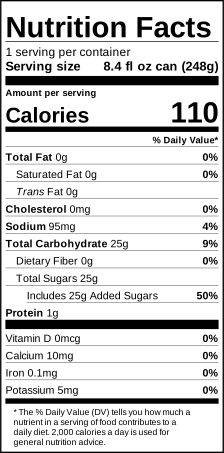
Serving size: what the RACC gives energy drinks
The RACC table doesn’t have a separate category for energy drinks; a conventional-food energy drink is a carbonated or noncarbonated beverage, so its reference amount is 360 mL like soda or flavored water (https://www.ecfr.gov/current/title-21/chapter-I/subchapter-B/part-101/subpart-A/section-101.12). To state that as a label serving, use the closest realistic fluid-ounce measure followed by the metric equivalent: “8.4 fl oz (248 mL)” for a standard small can.
Container size decides single-serving versus dual-column status the same way it does for soda. An 8.4 fl oz (248 mL) can, the classic small energy drink format, is 248 ÷ 360 = 68.9% of RACC, comfortably under 200%, so a product packaged and sold individually at that size is one serving, period (21 CFR 101.9(b)(6)). A 16 fl oz (473 mL) can, the larger and increasingly common format, is 473 ÷ 360 = 131.4% of RACC, still under the 150% mark where an optional additional column becomes available, so it stays a plain single-serving label too. You’d need to reach roughly 720 mL (about 24 fl oz) before crossing into the 200% RACC threshold where a mandatory per-serving/per-container dual column under 21 CFR 101.9(b)(12)(i) would apply.
What the panel must show
If your product is a conventional food, the panel carries the same 15 mandatory nutrients as any beverage under 21 CFR 101.9(c): calories, total fat, saturated fat, trans fat, cholesterol, sodium, total carbohydrate, dietary fiber, total sugars, added sugars, protein, vitamin D, calcium, iron, and potassium. Sodium and added sugars are usually the numbers that matter most for an energy drink, since sweetened caffeinated beverages tend to run higher in both than plain soda. Caffeine itself is not on that mandatory list. It’s not a nutrient listed in 21 CFR 101.9(c), so it may not appear inside the Nutrition Facts box. A voluntary caffeine amount can instead be stated elsewhere on the label, and FDA’s guidance on declaring caffeine is limited to it being truthful and not misleading, not a fixed placement rule. If the product is instead classified and labeled as a dietary supplement, it uses a Supplement Facts panel instead, with its own format and nutrient rules; that switch is exactly what FDA’s 2014 guidance addresses.
Format: which layout your package qualifies for
A conventional-food energy drink in an 8.4–16 fl oz can uses the standard vertical Nutrition Facts format, the same as most soda cans; tabular or linear layouts remain available under 21 CFR 101.9(j)(13)(ii) if the package’s labelable surface area is 40 sq in or less. A product labeled as a dietary supplement instead uses the Supplement Facts format defined in 21 CFR 101.36, which has its own header, nutrient list, and %DV rules distinct from 101.9. The NutriLabels builder renders standard vertical, tabular, linear, and dual-column Nutrition Facts formats for conventional-food beverages; Supplement Facts labeling for products classified as dietary supplements sits outside what the builder currently produces.
Energy drink-specific traps
The single biggest trap is choosing “beverage” or “supplement” status based on which one seems easier, rather than on how the product is actually marketed, packaged, and directed for use. FDA’s 2014 guidance (https://www.fda.gov/regulatory-information/search-fda-guidance-documents/guidance-industry-distinguishing-liquid-dietary-supplements-beverages) exists precisely because that decision has real labeling and enforcement consequences, and it’s a genuine legal judgment call worth running past a food-labeling attorney. A second trap is assuming caffeine content is optional to disclose anywhere on the package; while it’s not a mandatory Nutrition Facts nutrient, retailers and some state rules increasingly expect a caffeine statement regardless of what 21 CFR 101.9 technically requires. Nutrient content claims like “low sugar” or “high energy” also carry specific numeric thresholds under 21 CFR 101.13/101.54 that a sweetened energy drink often can’t meet.
Ingredient statement and allergens
Ingredients list in descending order by weight under 21 CFR 101.4, with amino-acid and vitamin blends broken into their individual components. Energy drink bases themselves typically carry no major allergens, but taurine and B-vitamin premixes, along with some flavor and coloring systems, can introduce milk or soy carriers that must appear in the ingredient list and a FALCPA “Contains” statement. Check flavor systems for sesame-derived ingredients too, since the FASTER Act folded sesame into the same nine-allergen “Contains” line starting in 2023.
Build the label
Settling Nutrition Facts or Supplement Facts before you order cans means the panel you print is the one your drink actually needs. Enter your recipe, then see your energy drink label: free with no card required, you see your calories, the claims you qualify for, your allergen line and the nutrient to watch, and every other value and %DV stays hidden until you unlock it. $29 unlocks every other nutrient value and %DV, every FDA format your product qualifies for, and the ingredient statement and allergen declaration, ready to print. Start your energy drink label, or check the 360 mL rule against other drinks in the serving sizes guide.
Energy drinks label FAQ
Does an energy drink use the same serving size as soda?
Yes, if it's labeled as a conventional food. Energy drinks fall under the same RACC as other carbonated and noncarbonated beverages, 360 mL (21 CFR 101.12), regardless of caffeine content.
How do I know if my product needs Nutrition Facts or Supplement Facts?
FDA's January 2014 guidance, "Distinguishing Liquid Dietary Supplements from Beverages," describes how the product's labeling, packaging, serving size, recommended use, and marketing as a conventional thirst-quencher versus a supplement determine which panel applies; when in doubt, talk to a food-labeling attorney before you print packaging.
Do I have to put caffeine content on the label?
No. Caffeine is not one of the mandatory nutrients listed in 21 CFR 101.9(c), so a conventional-food energy drink can choose to declare it voluntarily, though many brands do so as a matter of practice.
Is an 8.4 oz can a single serving or does it need a second column?
An 8.4 fl oz (248 mL) can is about 69% of the 360 mL RACC, well under 200%, so it's declared as one serving under 21 CFR 101.9(b)(6), with no dual column needed.
What about a 16 oz energy drink can?
A 16 fl oz (473 mL) can is about 131% of RACC, still under the 150% threshold where even an optional second column becomes available, so it's a straightforward single-serving label.
Related products
Soda and craft beverages, Juice, Coffee. See the full all products.
Sources
- ecfr.gov/current/title-21/chapter-I/…-101/subpart-A/section-101.9
- ecfr.gov/current/title-21/chapter-I/…101/subpart-A/section-101.12
- fda.gov/regulatory-information/sear…ietary-supplements-beverages
- federalregister.gov/documents/2014/01/14/2014-0…-from-beverages-availability
- fdc.nal.usda.gov/food-details/173210/nutrients