
Last verified 16 Sep 2026 · Sources
Granola’s Reference Amount Customarily Consumed (RACC) sits inside the FDA’s ready-to-eat breakfast cereal category, and it’s decided by a physical test, not a guess: how much a cup of your specific product weighs. Most bagged granola is dense and clumpy enough to weigh 43 g or more per cup, which lands it at the 60 g reference amount, so a realistic label statement is “1/2 cup (60 g).” The thing most likely to go wrong is skipping that weigh-in and copying a serving size off a competitor’s bag or a generic “cereal” template; the FDA sets serving size by category and density, not by brand preference. A Nutrition Facts label is required on virtually every packaged granola sold at retail, unless the small-business exemption covers your business and your label makes no nutrition claims.
| Quick facts | Granola |
|---|---|
| Regulator | FDA |
| Reference amount (RACC) | Breakfast cereals, ready-to-eat, weighing 43 g or more per cup (biscuit types): 60 g |
| Typical serving statement | 1/2 cup (60 g) |
| Typical label format | Standard vertical for most bagged granola; snack pouches with 40 sq in or less of labelable surface may qualify for tabular or linear per 101.9(j)(13)(ii) |
| Exemption | Not exempt: calories, fat and carbohydrate are present in significant amounts |
| Watch out for | Weight-per-cup RACC test picks your bracket, not the recipe; fiber/sugar claims need real %DV math |
| Common allergens | Tree nuts, peanuts; oats carry gluten cross-contact risk; check chocolate or yogurt coatings for milk and soy |
What is the serving size for granola? The FDA serving for granola depends on the weight of one piece. See the full serving-size reference: single-serving cut-off, dual-column range, and servings per package.
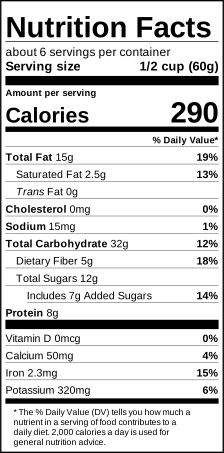
Serving size: what the RACC gives Granola
Under 21 CFR 101.12 Table 2, ready-to-eat breakfast cereals are split into three reference amounts by weight per cup: less than 20 g per cup gets 15 g, 20 g up to (but not including) 43 g per cup gets 40 g, and 43 g or more per cup (the “biscuit types” bracket) gets 60 g (21 CFR 101.12). “Granola” isn’t named as its own line in the table; it’s covered by this weight-per-cup test like every other ready-to-eat cereal. Because granola is baked into clusters and often carries oil, honey, and nuts, it’s usually denser than flaked or puffed cereals, so most recipes fall in the 43 g-or-more bucket. But that’s a tendency, not a rule. A very light, airy granola could weigh less per cup, so you (or your co-packer) need to actually weigh a level cup of the finished product before you set the RACC. Once you know the bracket, the label statement is a household measure that approximates that weight in grams: “1/2 cup (60 g)” is typical, though the exact cup-to-gram conversion depends on your product’s density.
Package size then determines the rest of the panel structure. A bag containing less than 200% of the RACC (under 120 g) is labeled as a single serving covering the entire contents (21 CFR 101.9(b)(6)). A bag between 150% and 200% of RACC (90 g to just under 120 g) may add an optional per-RACC column. From 200% up to 300% of RACC (120 g to 180 g), a dual-column label showing both “per serving” and “per container” values is required, unless the package instead qualifies for tabular or linear format, which skip that requirement. A typical family-size bag (12 to 16 oz, or 340 to 454 g) is well above 300% of RACC, so it’s ordinary multi-serving: one serving column, plus a servings-per-container count.
What the panel must show
The mandatory nutrients are calories, total fat, saturated fat, trans fat, cholesterol, sodium, total carbohydrate, dietary fiber, total sugars, added sugars, protein, vitamin D, calcium, iron, and potassium, each rounded and expressed as %DV per 21 CFR 101.9(c). For granola specifically, added sugars and dietary fiber are the two nutrients customers and reviewers look at first: a “good source of fiber” or “low sugar” claim only holds up if the actual formulation clears the FDA’s numeric threshold for that claim, not a general sense that granola is healthy. Sodium matters less here than in a savory snack, but if your granola is sweet-and-salty with real salt content, confirm its sodium %DV rather than assume it’s negligible. Saturated fat is worth checking too, since coconut oil and nut oils are common granola binders and can push that line higher than expected.
Format: which layout your package qualifies for
Most granola ships in bags well over 40 sq in of labelable surface, which puts them in standard vertical format, the full-column panel most shoppers recognize. Smaller snack pouches can fall at or under the 40 sq in threshold, opening the door to tabular format, or linear if the package is under 12 sq in or its shape can’t fit a tabular layout (21 CFR 101.9(j)(13)(ii)). The NutriLabels builder renders standard vertical, tabular, linear, and dual-column per serving/per container today, covering most granola packaging.
Granola-specific traps
The two traps that come up most: guessing the RACC bracket instead of weighing a cup of the finished product, and reaching for a fiber, sugar, or “whole grain” claim before checking it against the real numbers for that batch. Change the blend (more or less oil, a different sweetener, added dried fruit) and the cup weight and nutrient profile can both shift enough to move you into a different RACC bracket or invalidate an earlier claim.
Ingredient statement and allergens
Ingredients list in descending order by weight, with sub-ingredients of any multi-part component (like a yogurt coating or a fruit-and-nut mix) broken out. Tree nuts and peanuts are common in granola and must appear in the ingredient list and, along with any other major allergen present, in a plain-English “Contains” statement under FALCPA. If your recipe uses tahini, sesame oil, or a sesame-seed topping, sesame is the ninth major allergen as of the FASTER Act and belongs in that same statement (FDA, FASTER Act). Chocolate chips, yogurt coatings, and butter-based binders are easy places to miss a milk or soy allergen that isn’t obvious from a quick read of “granola” as a category.
Build the label
Once you’ve weighed a cup of your product and know your RACC bracket, the rest follows the standard rules for rounding, %DV, and mandatory nutrients, and any fiber or sugar claim on your bag rests on real numbers. Enter your recipe, then see your granola label: your calories, the claims you qualify for and your allergen line are free, no card required, and every other value and %DV stays hidden until you unlock it. $29 unlocks every other nutrient value and %DV, every FDA format your product qualifies for, and the ingredient statement and allergen declaration as print-ready files, with 12 months of edits included and downloads that never expire. Start your label free, or compare cereal brackets in the serving sizes guide.
Granola label FAQ
What serving size do I put on a granola label?
It depends on how much a cup of your specific granola weighs, not a standard "1/2 cup" guess. Weigh an actual cup of your finished product; 43 g or more per cup puts you at the 60 g reference amount, and the label statement is a household measure plus the gram equivalent, like "1/2 cup (60 g)."
Can I claim "good source of fiber" on granola?
Only if your product's fiber content actually clears the FDA's numeric threshold for that claim at your labeled serving size. A claim is checked against your real formulation, not against what granola typically contains.
Does a small granola snack pouch need the full vertical panel?
Not necessarily. If the pouch's total labelable surface area is 40 square inches or less, it may qualify for a tabular or linear format under 21 CFR 101.9(j)(13)(ii), depending on whether a standard column will physically fit.
Do oats need to be called out as an allergen?
Oats themselves aren't one of the nine major allergens, but they're frequently processed on shared lines with wheat, so a gluten-free claim requires verified cross-contact controls, not just an oats-only ingredient list.
What if my granola has chocolate chips or a yogurt coating?
Check those add-ins for milk and soy before finalizing the "Contains" line. Coatings are a common place to miss an allergen that isn't obvious from the granola base itself.
Is granola ever exempt from a Nutrition Facts label?
Generally no. Granola supplies meaningful calories, fat, and carbohydrate per serving, so it doesn't meet the "insignificant amounts of all nutrients" test that some very low-nutrient foods use for a 101.9(j)(4) exemption.
Related products
Granola bars, Protein bars, Bread, Beef jerky. See the full all products.