
Last verified 16 Sep 2026 · Sources
Nut and seed butters (peanut, almond, cashew, sunflower seed) share one RACC: 2 tbsp, about 32 g for most formulations (21 CFR 101.12). FDA regulates this category, and if you’re making peanut butter specifically, there’s a second rule stacked on top: the standard of identity in 21 CFR 164.150 requires peanut ingredients to be at least 90% of the finished product by weight. The trap you’re most likely to hit isn’t the serving size. It’s assuming your big jar is “one serving” because it’s sold as a single unit; it isn’t. A Nutrition Facts panel is required on essentially any packaged nut butter sold at retail or wholesale, with the same narrow small-package exemptions as any other food.
| Quick facts | Nut butter |
|---|---|
| Regulator | FDA |
| Reference amount (RACC) | 2 tbsp (nut and seed butters, pastes, or creams) |
| Typical serving statement | 2 tbsp (32 g) |
| Typical label format | Standard vertical for most jars; tabular/linear only for very small packages under 40 sq in; dual-column per serving/container is rare since most jars far exceed 300% of RACC |
| Exemption | Not exempt |
| Watch out for | "Peanut butter" needs ≥90% peanuts; a 16 oz jar is multi-serving, not one |
| Common allergens | Peanuts or the specific tree nut used; may include milk, soy in flavored or "no-stir" butters |
What is the serving size for nut butter? The FDA serving for nut butter is 2 tbsp (30g). See the full serving-size reference: single-serving cut-off, dual-column range, and servings per package.
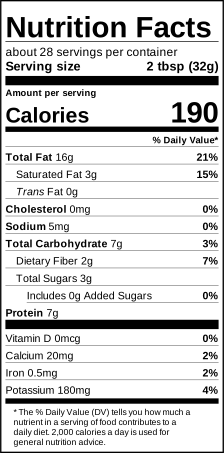
Serving size: what the RACC gives nut butter
FDA’s reference amount for “nut and seed butters, pastes, or creams” is 2 tbsp (21 CFR 101.12). On the panel, state it as a household measure plus grams: “2 tbsp (32 g)” is typical for peanut or almond butter, though density varies slightly with add-ins like chocolate or crunch pieces, so weigh your own product rather than assuming 32 g exactly. Package size drives the rest of the label math. A 16 oz (454 g) jar is about 1,420% of the 32 g RACC, nowhere close to a single-serving container, since 21 CFR 101.9(b)(6) reserves that treatment for packages under 200% of RACC (roughly 64 g here, or about a 2 oz packet). That means a 16 oz jar needs a standard multi-serving Nutrition Facts panel with a servings-per-container statement (about 14 servings for a 16 oz jar at 2 tbsp each), not a “per jar” total. Dual-column per-serving/per-container labeling under 21 CFR 101.9(b)(12)(i) only applies between 200% and 300% of RACC (about 64 g to 96 g), a narrow window that single-serve travel packets can land in but full-size jars almost never do.
What the panel must show
All mandatory nutrients apply: calories, total fat, saturated fat, trans fat, cholesterol, sodium, total carbohydrate, dietary fiber, total sugars, added sugars, protein, vitamin D, calcium, iron, potassium, each with the %DV footnote required by 21 CFR 101.9(c). Saturated fat and sodium deserve attention: nut butters are calorie- and fat-dense by nature, and “no-stir” formulas often add palm oil, which raises saturated fat versus a natural, oil-separating butter. Added sugars are the other watch point in honey-, maple-, or chocolate-flavored versions: they have to be broken out separately from total sugars under 21 CFR 101.9(c), and that number comes from your recipe, not a database default. Rounding follows the same 21 CFR 101.9(c) increments as any other food: fat and protein round to the nearest 0.5 g under 5 g, whole grams above.
Format: which layout your package qualifies for
Most nut butter jars use a standard vertical panel. Small single-serve packets (travel-size peanut butter cups, for instance) with 40 sq in or less of total labeling surface, and a shape that can’t fit a standard vertical column, may use tabular or linear formats under 21 CFR 101.9(j)(13)(ii). The NutriLabels builder renders vertical, tabular, and linear. Bilingual EN/ES is also available. What the builder doesn’t handle: two-form dual-column labels (for example, a butter sold both as a spread and as a baking ingredient with different preparation instructions). That’s expert-service territory.
Nut butter-specific traps
The name “peanut butter” is protected by its own standard of identity: 21 CFR 164.150 requires the finished product to be at least 90% peanut ingredients by weight, with any seasoning and stabilizing ingredients (salt, sweeteners, hydrogenated oil for no-stir texture) capped at 10% combined, and it bars artificial flavorings, artificial sweeteners, chemical preservatives, and color additives outright (21 CFR 164.150). Cross that 10% line (a chocolate peanut spread, for example) and you’re outside the standard, which usually means calling the product something other than “peanut butter,” like “peanut spread.” Almond, cashew, and other tree-nut butters don’t have their own FDA standard of identity, but they still carry the same allergen-naming rule: the specific tree nut must be named, not the umbrella term “tree nuts” (FDA allergen Q&A, Question C.5). And again: the 16 oz jar trap. Treating a large jar as a single serving because it’s sold as one unit is one of the more common errors in this category, and it understates every %DV on the label.
Ingredient statement and allergens
List ingredients in descending order by weight. For straight peanut butter that’s usually just peanuts, then salt and any stabilizer. Flavored or blended butters need sub-ingredients broken out (a “chocolate chips” ingredient still lists its own components). Follow with a “Contains” statement naming the specific nut, plus milk or soy if either appears in a no-stir or flavored formula; sesame requires declaration too if tahini or sesame oil is part of a blended nut-and-seed butter, per the FASTER Act.
Build the label
A servings-per-container count that matches your real jar keeps every %DV on your label honest. Enter your recipe, then see your nut butter label: its shape and calorie count, the claims you qualify for and your allergen line are free, no card required, and every other value and %DV stays hidden until you unlock it. $29 unlocks every other nutrient value and %DV, every FDA format your jar or packet qualifies for, and a compliant ingredient statement and allergen declaration, ready to print, with 12 months of edits included and downloads that never expire. Start your nut butter label, or browse other product labels.
Nut butter label FAQ
What serving size do I use for peanut butter or almond butter?
FDA's RACC for "nut and seed butters, pastes, or creams" is 2 tbsp, which for most nut butters works out to about 32 g. State it on the label as "2 tbsp (32 g)."
Can I call my product "peanut butter" if I add chocolate or honey?
Only within limits. The peanut butter standard of identity (21 CFR 164.150) requires peanut ingredients to make up at least 90% of the finished product's weight, with seasoning and stabilizing ingredients capped at 10% combined; go past that and it needs a different name, like "peanut spread."
Does my 16 oz jar count as a single serving?
No. The single-serving rule in 21 CFR 101.9(b)(6) only applies when a package holds less than 200% of the RACC (about 64 g for nut butter); a 16 oz (454 g) jar is roughly 1,400% of RACC, so it's a standard multi-serving label with a servings-per-container count.
Do I need a dual-column label for a large jar?
Almost never for nut butter. The dual per-serving/per-container column in 21 CFR 101.9(b)(12)(i) only kicks in between 200% and 300% of RACC (about 64 g to 96 g), and most retail jars are far bigger than that.
What allergens do I have to declare on a nut butter label?
The specific nut (peanuts, almonds, cashews, etc.) named individually, plus milk or soy if used in a "no-stir" or flavored formulation. FDA guidance requires tree nuts to be named by species, not the umbrella term "tree nuts."
Are added sugars an issue in flavored nut butters?
Yes. Honey-, maple-, or chocolate-flavored nut butters often add real sugar beyond what's naturally in the nuts, and that has to be broken out as "Added Sugars" separately from "Total Sugars" per 21 CFR 101.9.
Related products
Trail mix and nuts, Jam and Jelly, Granola bars, Chips (potato, tortilla, vegetable). See the full all products.