
Last verified 16 Sep 2026 · Sources
Corn or flour, tortillas take their FDA RACC from the same 21 CFR 101.12 category as biscuits, croissants, soft pretzels, corn bread and English muffins. RACC is the Reference Amount Customarily Consumed, the FDA’s reference serving for your product type. For tortillas it’s 55 g, whatever the flour base. FDA is the regulator.
The trap you’re most likely to hit isn’t the RACC itself. It’s the math for single pieces that comes after it. A small corn tortilla and a large burrito-size flour tortilla can fall under completely different serving-size rules, even though they share the same 55 g reference amount. Packaged tortillas need a Nutrition Facts panel, unless the package is small enough for the surface-area exemption covered below. It’s also not required if your business qualifies for the FDA small-business exemption and you make no nutrition claims.
| Quick facts | Tortillas (corn and flour) |
|---|---|
| Regulator | FDA |
| Reference amount (RACC) | 55 g (Biscuits, croissants, tortillas, soft bread sticks, soft pretzels, corn bread, hush puppies, scones, crumpets, English muffins) |
| Typical serving statement | 2 tortillas (60 g) for 30 g corn tortillas, 1 tortilla (70 g) for a burrito-size flour tortilla |
| Typical label format | Standard vertical for most stacks (a per-unit dual column for very large tortillas at 200–300% of the RACC) |
| Exemption | This product type isn’t exempt. The small-business exemption can still apply if you make no nutrition claims. |
| Watch out for | Discrete-unit math depends on the actual tortilla weight. Corn isn't a major allergen, but wheat is. |
| Common allergens | Wheat in flour tortillas is a major allergen. Corn is not, but it still goes in the ingredient list. |
What is the serving size for tortillas (corn and flour)? The FDA serving for tortilla depends on the weight of one piece. The full serving-size reference shows the single-serving cut-off, the dual-column range and the servings per package.
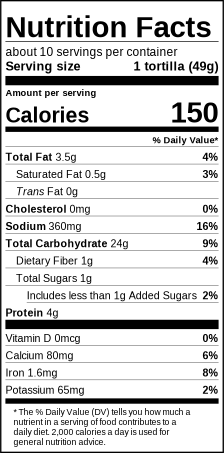
How big is a tortilla serving?
The FDA lists “biscuits, croissants, tortillas, soft bread sticks, soft pretzels, corn bread, hush puppies, scones, crumpets, English muffins” together at a 55 g reference amount (21 CFR 101.12). A tortilla is a single, countable piece, not something scooped or poured. So the rule for single pieces in 21 CFR 101.9(b)(2)(i) decides how 55 g becomes your labeled serving. It depends on how close your tortilla’s weight is to that RACC.
A 30 g corn tortilla is about 55% of 55 g, above the 50% line and below 67%. That puts it in the band where you may declare either 1 or 2 tortillas as the serving (21 CFR 101.9(b)(2)(i)).
A 70 g burrito-size flour tortilla is about 127% of 55 g, at or above 67% and under 200%. So the rule is simpler. The serving is one tortilla, full stop. One unit equals one serving.
A tortilla heavy enough to hit 200% to 300% of the RACC (110 to 165 g) would need its serving set at about the RACC amount, plus an extra per-unit column. That’s unusual for tortillas in practice.
What goes on the panel
The required nutrients under 21 CFR 101.9(c) apply in full. They are calories, total fat, saturated fat, trans fat, cholesterol, sodium, total carbohydrate, dietary fiber, total sugars, added sugars, protein, vitamin D, calcium, iron and potassium, each with % Daily Value (%DV, the percent column on the right side of the panel) and its standard footnote.
Sodium and total carbohydrate matter most here. Flour tortillas often run 700+ mg sodium per 100 g from the leavening and dough conditioners. Sodium rounds to the nearest 5 mg between 5 and 140 mg per serving, and to the nearest 10 mg above that (21 CFR 101.9(c)).
Added sugars in a tortilla (a small amount of sugar in flour-tortilla dough) come from your own recipe, not a nutrition database. The number should match what your recipe actually adds. Corn tortillas usually add none.
Which layout fits your bag?
A standard stack of 8, 10 or 12 tortillas in a resealable bag uses a standard vertical panel. Servings per container is simply the count divided by however many tortillas make one labeled serving.
A smaller package (a single-serve wrap kit, for instance) with 40 sq in or less of labeling surface may use tabular format under 21 CFR 101.9(j)(13)(ii) if a standard column won’t fit. It may use linear format only if a tabular layout won’t fit. The NutriLabels builder makes standard vertical, tabular, linear and dual per-unit column formats.
Where tortilla labels go wrong
The math for single pieces above is the main trap. It’s easy to default to “1 tortilla = 1 serving” without checking where your tortilla’s weight falls against the 55 g RACC. Getting that wrong throws off every %DV on your panel.
Refrigerated or shelf-stable doesn’t change the RACC or the 21 CFR 101.9 format rules. Both fall under the same 55 g category and the same format cutoffs. It does affect storage instructions and date coding, which live outside the Nutrition Facts panel. A tortilla mix sold to be made at home (add water, cook on a griddle) could add an optional “as prepared” column under 21 CFR 101.9(e). That’s a different case from a finished, ready-to-eat tortilla.
Your ingredient list and allergens
List your ingredients in descending order by weight. A basic flour tortilla usually reads “Enriched wheat flour, water, vegetable shortening, salt, leavening.” A corn tortilla is usually just “Corn masa flour, water, lime (calcium hydroxide).”
Wheat is one of the 9 major allergens under FALCPA and the FASTER Act, so flour tortillas need a “Contains wheat” statement. Corn isn’t one of the 9 major allergens and doesn’t need a “Contains” line, though it still belongs in the ingredient list. Check any added oils or dough conditioners for soy or dairy, which show up in some commercial flour-tortilla recipes.
Build your tortilla label
Weigh your actual tortilla before you set the serving. Then every %DV on your bag lines up with what your customer eats. Enter your recipe, then see your tortilla label. Your label’s shape, calorie count, the claims you qualify for, your allergen line and the nutrient to watch show free, with no credit card required. The rest of the numbers on your label stay hidden until you buy a Single Product or the Studio plan.
A Single Product is $29. It unlocks the rest of the numbers on your label, the serving size for your tortilla and every FDA format it qualifies for, and the ingredient statement and allergen declaration, ready to print. Start your tortilla label, or check the serving sizes for other breads.
Tortillas (corn and flour) label FAQ
What RACC applies to tortillas?
Tortillas share a 55 g reference amount with biscuits, croissants, soft pretzels, corn bread and English muffins under 21 CFR 101.12. The same 55 g applies to both corn and flour tortillas.
How do I label a small corn tortilla under the discrete-unit rule?
A 30 g corn tortilla is about 55% of the 55 g RACC. That falls in the band above 50% and below 67% (21 CFR 101.9(b)(2)(i)). In that band you may declare either 1 or 2 tortillas as the labeled serving.
What about a large burrito-size flour tortilla?
A 70 g burrito tortilla is about 127% of the 55 g RACC. That's at or above 67% and under 200%. So under 21 CFR 101.9(b)(2)(i), the serving is simply one tortilla. One unit is one serving.
Does refrigeration change the serving size or format rules?
No. The 55 g RACC and the format cutoffs in 21 CFR 101.9 don't depend on whether tortillas are shelf-stable or refrigerated. That difference affects storage instructions and date coding, not the Nutrition Facts panel itself.
Is corn a major allergen I need to declare?
No. Corn isn't one of the 9 major allergens under FALCPA and the FASTER Act, so it doesn't need a "Contains" statement. It still belongs in the ingredient list. Wheat, used in flour tortillas, is a major allergen and does need one.
Related products
Chips (potato, tortilla, vegetable), Salsa, Bread, Pasta (dry and fresh). See the full all products.