
Last verified 16 Sep 2026 · Sources
Yogurt’s reference amount is 170 g under the “Yogurt” line of 21 CFR 101.12, a single, category-wide number that doesn’t change for Greek, low-fat, or plant-based versions labeled as yogurt. That translates to a label statement like “3/4 cup (170 g)” for a multi-serving tub, or, for the common 5.3 oz (150 g) single cup, one full-container serving even though 150 g comes in under the RACC itself. FDA is the regulator, and the standard of identity that defines what can legally be called “yogurt” sits at 21 CFR 131.200, amended in 2021. The trap you’re most likely to hit: assuming your package under RACC needs less than a full serving declared, when the single-serving rule actually rounds up to “the whole container” any time a product is packaged and sold individually below 200% of RACC. A Nutrition Facts panel is required on virtually every commercial yogurt: cultured dairy products carry too many significant nutrients (protein, calcium, sodium, sugars) for any insignificant-nutrient exemption to apply.
| Quick facts | Yogurt |
|---|---|
| Regulator | FDA |
| Reference amount (RACC) | Yogurt | 170 g |
| Typical serving statement | 1 container (150 g) for a 5.3 oz cup; 3/4 cup (170 g) for a tub |
| Typical label format | Standard vertical; dual-column per serving/per container only if a single-sale unit runs 200–300% of 170 g |
| Exemption | Not exempt: routine nutrient claims and fortification remove any small-package exemption |
| Watch out for | 5.3 oz (150 g) cup labels as one serving even though it's under RACC; live-culture claims aren't nutrient content claims |
| Common allergens | Milk; check mix-in cups for tree nuts, gluten-containing granola, or soy |
What is the serving size for yogurt? The FDA serving for yogurt is 3/4 cup (170g). See the full serving-size reference: single-serving cut-off, dual-column range, and servings per package.
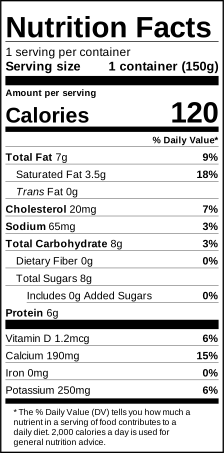
Serving size: what the RACC gives yogurt
The RACC for yogurt is verified at 170 g, with no separate line for Greek, drinkable, or flavored variants. They all fall under the same category. For a multi-serving tub (a 32 oz / 907 g container, for instance), the label statement is “3/4 cup (170 g),” and servings per container works out to roughly 907 ÷ 170 ≈ 5.3, typically declared as “about 5” per 101.9(b) rounding for serving counts.
The single-serving rule is where the 5.3 oz cup gets interesting. 21 CFR 101.9(b)(6) states that a product packaged and sold individually containing less than 200% of RACC is labeled as one serving: the entire contents. A 150 g cup is only about 88% of the 170 g RACC, well under 200%, so the whole cup is one serving regardless of being smaller than the reference amount itself; there’s no rounding up toward the RACC weight. That’s counterintuitive if you assume the panel should always reflect the 170 g figure. It doesn’t, once the package itself is the serving.
A 32 oz tub sits at roughly 533% of RACC, far past the 200–300% band in 101.9(b)(12)(i) that triggers a mandatory dual per-serving/per-container column, so it gets a standard multi-serving panel with a servings-per-container statement, not a dual column. Dual columns only bite yogurt packaging in the narrow case of a single-sale container sized between about 340 g and 510 g (200–300% of 170 g) sold as one unit.
What the panel must show
All mandatory nutrients under 21 CFR 101.9(c) apply, but for yogurt the ones that actually move are protein, calcium, total sugars, added sugars, and sodium. Total sugars in plain yogurt come almost entirely from naturally occurring lactose. Added sugars should read 0 unless you sweeten or add fruit, in which case that figure has to come from your recipe, not a generic database lookup, since FoodData Central’s plain-yogurt entries don’t carry any added-sugars value at all. Vitamin D is worth flagging: 21 CFR 131.200 allows optional fortification with vitamin A and D, each at not less than 10% Daily Value per RACC if added, and that value has to appear in your mandatory nutrient declaration. Round per 101.9(c): calories to the nearest 5 or 10, protein and fat to the nearest 0.5 g under 5 g, sodium to the nearest 5 mg under 140 mg.
Format: which layout your package qualifies for
A standard yogurt cup or tub clears the 40 sq in surface-area threshold easily, so standard vertical is the default format the NutriLabels builder renders. Very small individual cups (some 4 oz kids’ cups) with 40 sq in or less of labeling surface may use tabular format under 101.9(j)(13)(ii)(A), also rendered by the builder. A yogurt cup rarely qualifies for the under-12-sq-in exemption in 101.9(j)(13)(i), since fortification and live-culture claims are common and any nutrient content claim (not the culture statement itself) removes that exemption anyway.
Yogurt-specific traps
FDA’s June 2021 final rule (86 FR 31136) revoked the separate lowfat- and nonfat-yogurt standards and folded them into one amended standard at 21 CFR 131.200, setting a 3.25% milkfat floor for standard yogurt (with lower-fat versions handled by nutrient content claims like “low fat” rather than a separate standard of identity). “Contains live and active cultures” is a defined statement in 131.200 tied to a minimum 10^7 CFU/g at manufacture. It is not a nutrient content claim, so using it doesn’t by itself trigger a claim threshold or strip an exemption. Watch %DV rounding on calcium and sodium, which sit close to common claim thresholds (“good source of calcium,” “low sodium”). A claim you haven’t verified against the actual numeric threshold is the fastest way to turn a compliant label into a problem.
Ingredient statement and allergens
Ingredients list by descending weight: cultured milk first, then any sweeteners, fruit, or stabilizers. Milk is a FALCPA major allergen and must appear in the “Contains” statement even though it’s also the base ingredient. Granola, cookie, or nut mix-in cups can add tree nuts, wheat, or soy; under the FASTER Act, check any topping for sesame as well, since it’s folded into the same nine-allergen line.
Build the label
Labeling your 5.3 oz cup as one whole-container serving the first time saves a reprint of cups you already paid for. Enter your recipe, then see your label: free with no card required, you see your calories, the claims you qualify for, your allergen line and the nutrient to watch, and every other value and %DV stays hidden until you unlock it. $29 unlocks every other nutrient value and %DV, every FDA format your yogurt package qualifies for, and the ingredient statement and allergen declaration, ready to print. Start your label, or browse other product labels.
Yogurt label FAQ
Does a 5.3 oz yogurt cup need to show more than one serving?
No. At 150 g it's under the 170 g RACC, so under 21 CFR 101.9(b)(6) it's labeled as one serving covering the whole container regardless of the RACC math: any individually packaged product under 200% of RACC is a single serving.
When does a yogurt tub need a dual-column label?
Dual per-serving/per-container columns under 101.9(b)(12)(i) apply to a product packaged and sold as one item containing 200–300% of RACC. A 32 oz (907 g) tub is roughly 533% of the 170 g RACC, so it's a standard multi-serving panel with a servings-per-container count, not a dual column.
Is "contains live and active cultures" a nutrient content claim?
No. It's a structure/culture statement defined in 21 CFR 131.200, tied to a minimum of 10^7 CFU/g at manufacture, not a claim about a nutrient level like "low fat." It doesn't trigger nutrient-claim thresholds or remove any exemption on its own.
What changed in the 2021 yogurt standard?
FDA's June 2021 final rule revoked the separate standards for lowfat and nonfat yogurt and folded them into one amended yogurt standard at 21 CFR 131.200, while also permitting additional safe and suitable milk-derived ingredients and reconfirming the 3.25% milkfat floor for full-fat yogurt.
Can I fortify yogurt with vitamin D and put it on the label?
Yes. 21 CFR 131.200 allows optional vitamin A and D fortification, each at not less than 10% Daily Value per RACC, and you'd declare the resulting vitamin D value in the mandatory nutrient list.
Do added sugars show up automatically from a database lookup?
No. A generic "plain yogurt" database entry reports only naturally occurring lactose as sugars; any sweetened, flavored, or fruit-on-the-bottom variant needs its added-sugars figure calculated from your actual recipe, not pulled from FoodData Central alone.
Related products
Cheese, Ice cream, Granola, Kombucha. See the full all products.
Sources
- ecfr.gov/current/title-21/chapter-I/…101/subpart-A/section-101.12
- ecfr.gov/current/title-21/chapter-I/…-101/subpart-A/section-101.9
- ecfr.gov/current/title-21/chapter-I/…31/subpart-B/section-131.200
- federalregister.gov/documents/2021/06/11/2021-1…ndards-for-lowfat-yogurt-and
- fdc.nal.usda.gov/food-details/2259793/nutrients