
Last verified 16 Sep 2026 · Sources
Ice cream’s reference amount is 2/3 cup under 21 CFR 101.12, one of the few RACC entries that names a volume with no fixed gram weight attached, because the gram side of “2/3 cup (__ g)” depends on your product’s own density. FDA is the regulator for the nutrition panel, layered on the frozen-dessert standard of identity at 21 CFR 135.110, which sets ice cream’s minimum milkfat and total-solids floors. The single biggest thing to get wrong: assuming your pint container is automatically a simple 3-serving panel, when a pint sized at 3 servings of 2/3 cup lands exactly at 300% of RACC, the upper edge of the range that legally requires a dual per-serving/per-container column. A Nutrition Facts panel is required on essentially all packaged ice cream; only very small individually wrapped novelties under 12 sq in with zero nutrition claims can skip it.
| Quick facts | Ice cream |
|---|---|
| Regulator | FDA |
| Reference amount (RACC) | Ice cream, frozen yogurt, sherbet, ices | 2/3 cup (includes coatings/wafers) |
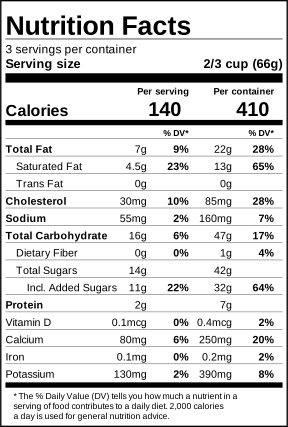
| Typical serving statement | 2/3 cup (66 g) |
| Typical label format | Standard vertical; dual-column per serving/per container mandatory for a pint at exactly 300% of RACC |
| Exemption | Not exempt: a standardized food under 21 CFR 135.110 with routine sodium, fat and sugar claims |
| Watch out for | The "(__g)" in 2/3 cup depends on your product's overrun, not a fixed number; a pint sits right at the 300% dual-column line |
| Common allergens | Milk; check mix-ins for tree nuts, peanuts, egg (custard bases), wheat, or soy |
What is the serving size for ice cream? The FDA serving for ice cream depends on the weight of one piece. See the full serving-size reference: single-serving cut-off, dual-column range, and servings per package.
Serving size: what the RACC gives ice cream
The verified reference amount is 2/3 cup, and 21 CFR 101.12’s own label-statement column leaves the gram figure blank on purpose (“2/3 cup (__ g)”) because overrun (the air whipped into the mix during freezing) changes how much a given volume weighs. A light, high-overrun product can run closer to 60 g per 2/3 cup; a dense, super-premium product with little overrun can run well over 100 g for the same 2/3 cup. You determine your own product’s gram equivalent by weighing an actual 2/3 cup scoop, not by copying a competitor’s label.
The math that bites hardest is the pint. Using a representative 66 g per 2/3 cup (a common real-world figure for standard-overrun ice cream), a 2-cup pint holds three 2/3 cup servings: 3 × 66 g ≈ 198 g, and 3 servings of 2/3 cup is exactly 2 cups, or 300% of the 2/3 cup RACC. Under 21 CFR 101.9(b)(12)(i), a product packaged and sold individually containing at least 200% and up to and including 300% of RACC must carry an additional column for the entire package alongside the per-serving column. A pint built this way sits right at that 300% ceiling, which is why dual per-serving/per-container labeling is standard on pint containers in the market. A denser product where 2/3 cup weighs more would need fewer servings to fill a pint and could fall under 200% or push past 300%, changing whether the dual-column requirement applies at all. The math depends entirely on your own product’s gram weight, not a fixed assumption.
What the panel must show
All mandatory nutrients under 21 CFR 101.9(c) apply, but saturated fat and added sugars are what actually move for ice cream: a typical vanilla base runs meaningful saturated fat from milkfat and, once sweetened, real added sugars beyond the small amount of naturally occurring lactose in the dairy. That added-sugars figure has to come from your formulation (sucrose, corn syrup, etc.), not a generic database entry, which won’t reliably separate added from naturally occurring sugar. Cholesterol and sodium also register due to the dairy and egg-yolk content in custard-style bases. Round per 101.9(c): calories to the nearest 5 or 10, fat and saturated fat to the nearest 0.5 g under 5 g, sodium to the nearest 5 mg under 140 mg. The %DV footnote is required except on tabular-abbreviated or linear panels.
Format: which layout your package qualifies for
A standard pint or quart container clears the 40 sq in surface-area threshold, so it uses the standard vertical format, with a dual per-serving/per-container column layered on top when the package sits in the 200–300% RACC band, both of which the NutriLabels builder renders. Small individually wrapped bars or cups under 40 sq in may use tabular format under 101.9(j)(13)(ii)(A); a wrapper under 12 sq in that can’t accommodate a tabular layout may use linear instead. A bar or cup under 12 sq in with no nutrition claims at all could qualify for the small-package exemption in 101.9(j)(13)(i), but any stated calorie count or fat claim removes it.
Ice-cream-specific traps
21 CFR 135.110(a) sets the standard-of-identity floor for “ice cream”: not less than 10 percent milkfat, not less than 1.6 pounds of total food solids per gallon, and a minimum finished weight of 4.5 pounds per gallon. Fall short on any of these and the product can’t legally be called ice cream (it may need to be labeled “frozen dairy dessert” or similar instead). Bulky ingredients like chocolate, fruit, or nuts get a carve-out: the regulation allows minimum milkfat and total milk solids to be calculated on the remainder after subtracting the bulky flavoring’s weight, though never below 8% milkfat and 16% total milk solids in the finished product. Sodium and saturated fat claims (“low fat,” “reduced sugar”) need to be checked against FDA’s actual numeric thresholds before printing, since ice cream’s naturally high fat and sugar content make it easy to overstate a claim.
Ingredient statement and allergens
List ingredients by descending weight: cream or milk first for most bases, then sweeteners, then stabilizers and mix-ins. Milk is a FALCPA major allergen and must appear in the “Contains” statement. Mix-in and swirl ingredients commonly bring in tree nuts, peanuts, wheat (cookie pieces), soy (lecithin), or egg (custard bases); under the FASTER Act, check any cookie or candy inclusion for sesame as well.
Build the label
Weighing your own 2/3 cup scoop before you print means the pint column on your label matches what’s in the container. Enter your recipe, then see your label: its shape and calorie count, the claims you qualify for and your allergen line are free, no card required, and every other value and %DV stays hidden until you unlock it. $29 unlocks every other nutrient value and %DV, every FDA format your ice cream package qualifies for, and the ingredient statement and allergen declaration built from your actual serving weight, ready to print. Start your label, or compare other product labels.
Ice cream label FAQ
Why doesn't 21 CFR 101.12 give a fixed gram weight for "2/3 cup"?
The regulation's own label statement is \"2/3 cup (__ g)\"; the blank is intentional. Ice cream's gram weight per cup depends on overrun (how much air is whipped in), so you measure your own product's density and fill in the actual figure; there's no single correct number across brands.
Does a pint of ice cream need a dual-column label?
A pint is 2 cups, and if 2/3 cup weighs about 66 g, three servings make up the full 2-cup pint, exactly 300% of the 2/3 cup RACC. Under 21 CFR 101.9(b)(12)(i), a product packaged and sold individually at 200% up to and including 300% of RACC must show an additional per-container column alongside per-serving, so a pint sized this way lands right at the edge that requires dual columns.
What's the minimum milkfat for a product to be called "ice cream"?
21 CFR 135.110(a) sets a floor of not less than 10 percent milkfat (with nonfat milk solids requirements that adjust as milkfat rises), plus not less than 1.6 pounds of total food solids and a minimum finished weight of 4.5 pounds per gallon.
Do frozen novelties or bars use a different reference amount?
They fall under the same RACC category, but 21 CFR 101.12's label statement adds "__ piece(s) (__ g) for individually wrapped or packaged products," so a bar or sandwich is labeled by the piece rather than by volume.
Are added sugars in ice cream a database value or a recipe value?
A generic USDA entry reports total sugars but not a verified added-sugars split; a real ice cream recipe's added sugar (sucrose, corn syrup, etc.) has to be calculated from your formulation, with only the natural lactose in the dairy base excluded.
Is a small 3.5 oz single-serve ice cream cup exempt from a panel?
Only if its available labeling surface is under 12 sq in and it carries no nutrition claims, per 21 CFR 101.9(j)(13)(i); most branded single-serve cups carry at least a calorie or fat statement that removes that exemption.
Related products
Yogurt, Candy, Chocolate, Cakes and cupcakes. See the full all products.