
Last verified 16 Sep 2026 · Sources
Yogurt’s reference amount is 170 g under the “Yogurt” line of 21 CFR 101.12. It’s one number for the whole category. It doesn’t change for Greek, low-fat or plant-based versions labeled as yogurt. On a multi-serving tub, that becomes a label statement like “3/4 cup (170 g).” The common 5.3 oz (150 g) single cup is different. It’s one full-container serving, even though 150 g is under the RACC itself.
FDA is the regulator. The standard of identity that defines what can legally be called “yogurt” is at 21 CFR 131.200, amended in 2021.
The trap you’re most likely to hit is thinking a package under the RACC should declare less than a full serving. The single-serving rule actually makes it “the whole container” any time a product is sold on its own below 200% of the RACC. Virtually every commercial yogurt needs a Nutrition Facts panel. Cultured dairy carries too many significant nutrients (protein, calcium, sodium, sugars) for any insignificant-nutrient exemption to apply. The FDA small-business exemption can still apply if you make no nutrition claims.
| Quick facts | Yogurt |
|---|---|
| Regulator | FDA |
| Reference amount (RACC) | 170 g (yogurt) |
| Typical serving statement | 1 container (150 g) for a 5.3 oz cup, 3/4 cup (170 g) for a tub |
| Typical label format | Standard vertical (a per-serving and per-container dual column only if a single container holds 200–300% of 170 g) |
| Exemption | This product type isn’t exempt. Routine nutrient claims and fortification remove any small-package exemption. The small-business exemption can still apply if you make no nutrition claims. |
| Watch out for | A 5.3 oz (150 g) cup is labeled as one serving even though it's under the RACC. Live-culture claims aren't nutrient content claims. |
| Common allergens | Milk. Check mix-in cups for tree nuts, gluten-containing granola or soy. |
What is the serving size for yogurt? The FDA serving for yogurt is 3/4 cup (170g). The full serving-size reference shows the single-serving cut-off, the dual-column range and the servings per package.
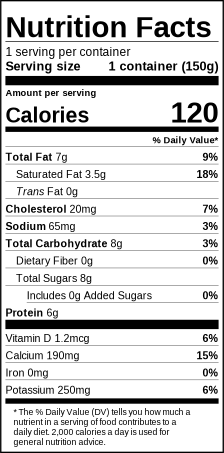
How big is a yogurt serving?
The RACC (Reference Amount Customarily Consumed, the FDA’s reference serving for your product type) for yogurt is 170 g. There’s no separate line for Greek, drinkable or flavored yogurt. They all fall in the same category. For a multi-serving tub (a 32 oz / 907 g container, for instance), the label statement is “3/4 cup (170 g).” Servings per container works out to roughly 907 ÷ 170 ≈ 5.3. That’s usually declared as “about 5,” per the 101.9(b) rounding for serving counts.
The single-serving rule is where the 5.3 oz cup gets interesting. A product sold on its own with less than 200% of the RACC is labeled as one serving, the entire contents (21 CFR 101.9(b)(6)). A 150 g cup is only about 88% of the 170 g RACC, well under 200%. So the whole cup is one serving, even though it’s smaller than the reference amount. There’s no rounding up toward the RACC weight. That’s surprising if you assume the panel should always reflect 170 g. It doesn’t, once the package itself is the serving.
A 32 oz tub sits at roughly 533% of the RACC. That’s far past the 200% to 300% band in 101.9(b)(12)(i) that calls for a mandatory per-serving and per-container dual column. So it gets a standard multi-serving panel with a servings-per-container statement, not a dual column. Dual columns only affect yogurt in one narrow case. That’s a container sold as one unit and sized between about 340 g and 510 g (200% to 300% of 170 g).
What goes on the panel
All the required nutrients under 21 CFR 101.9(c) apply. For yogurt, the ones that actually move are protein, calcium, total sugars, added sugars and sodium.
Total sugars in plain yogurt come almost entirely from natural lactose. Added sugars should read 0 unless you sweeten it or add fruit. If you do, that number has to come from your recipe, not a generic database lookup. FoodData Central’s plain-yogurt entries don’t carry any added-sugars value at all.
Vitamin D is worth a note. Vitamin A and D fortification is optional, each at not less than 10% Daily Value per RACC if added (21 CFR 131.200). That value has to appear in your required nutrient list. Round per 101.9(c). Calories go to the nearest 5 or 10. Fat goes to the nearest 0.5 g under 5 g. Carbohydrate and protein go to the nearest gram, with “less than 1 g” below 1 g. Sodium goes to the nearest 5 mg under 140 mg.
Which layout fits your cup or tub?
A standard yogurt cup or tub easily clears the 40 sq in surface-area cutoff. So standard vertical is the default format the NutriLabels builder makes. Very small single cups (some 4 oz kids’ cups) with 40 sq in or less of labeling surface may use tabular format under 101.9(j)(13)(ii)(A) if a standard column won’t fit. The builder makes that too.
A yogurt cup rarely qualifies for the under-12-sq-in exemption in 101.9(j)(13)(i). Fortification and live-culture claims are common. And any nutrient content claim (not the culture statement itself) removes that exemption anyway.
Where yogurt labels go wrong
FDA’s June 2021 final rule (86 FR 31136) revoked the separate lowfat and nonfat yogurt standards. It folded them into one amended standard at 21 CFR 131.200, with a 3.25% milkfat minimum for standard yogurt. Lower-fat versions are handled by nutrient content claims like “low fat,” not a separate standard of identity.
“Contains live and active cultures” is a defined statement in 131.200, tied to a minimum of 10^7 CFU/g at manufacture. It isn’t a nutrient content claim. So using it doesn’t by itself set off a claim cutoff or remove an exemption.
Watch % Daily Value rounding on calcium and sodium. Both sit close to common claim cutoffs (“good source of calcium,” “low sodium”). A claim you haven’t checked against the actual number cutoff is the fastest way to turn a compliant label into a problem.
Your ingredient list and allergens
List your ingredients in descending order by weight. Cultured milk comes first, then any sweeteners, fruit or stabilizers. Milk is a FALCPA major allergen. It must appear in the “Contains” statement, even though it’s also the base ingredient.
Granola, cookie or nut mix-in cups can add tree nuts, wheat or soy. Under the FASTER Act, check any topping for sesame as well, since it’s part of the same nine-allergen line.
Build your yogurt label
Labeling your 5.3 oz cup as one whole-container serving the first time saves reprinting cups you already paid for. Enter your recipe, then see your label. Your label’s shape, calorie count, the claims you qualify for, your allergen line and the nutrient to watch show free, with no credit card required. The rest of the numbers on your label stay hidden until you buy a Single Product or the Studio plan.
A Single Product is $29. It unlocks the rest of the numbers on your label, every FDA format your yogurt package qualifies for, and the ingredient statement and allergen declaration, ready to print. Start your label, or browse other product labels.
Yogurt label FAQ
Does a 5.3 oz yogurt cup need to show more than one serving?
No. At 150 g it's under the 170 g RACC. It's labeled as one serving covering the whole container, whatever the RACC math says (21 CFR 101.9(b)(6)). Any product sold on its own with less than 200% of the RACC is a single serving.
When does a yogurt tub need a dual-column label?
Per-serving and per-container dual columns under 101.9(b)(12)(i) apply to a product packaged and sold as one item with 200% to 300% of the RACC. A 32 oz (907 g) tub is roughly 533% of the 170 g RACC. So it gets a standard multi-serving panel with a servings-per-container count, not a dual column.
Is "contains live and active cultures" a nutrient content claim?
No. It's a culture statement defined in 21 CFR 131.200, tied to a minimum of 10^7 CFU/g at manufacture. It isn't a claim about a nutrient level like "low fat." On its own, it doesn't set off nutrient-claim cutoffs or remove any exemption.
What changed in the 2021 yogurt standard?
FDA's June 2021 final rule revoked the separate standards for lowfat and nonfat yogurt. It folded them into one amended yogurt standard at 21 CFR 131.200. It also allowed more safe and suitable milk-derived ingredients and confirmed the 3.25% milkfat minimum for full-fat yogurt.
Can I fortify yogurt with vitamin D and put it on the label?
Yes. Optional vitamin A and D fortification is allowed, each at not less than 10% Daily Value per RACC (21 CFR 131.200). You'd declare the resulting vitamin D value in the required nutrient list.
Do added sugars show up automatically from a database lookup?
No. A generic "plain yogurt" database entry reports only natural lactose as sugars. Any sweetened, flavored or fruit-on-the-bottom version needs its added sugars worked out from your actual recipe, not pulled from FoodData Central alone.
Related products
Cheese, Ice cream, Granola, Kombucha. See the full all products.
Sources
- ecfr.gov/current/title-21/chapter-I/…101/subpart-A/section-101.12
- ecfr.gov/current/title-21/chapter-I/…-101/subpart-A/section-101.9
- ecfr.gov/current/title-21/chapter-I/…31/subpart-B/section-131.200
- federalregister.gov/documents/2021/06/11/2021-1…ndards-for-lowfat-yogurt-and
- fdc.nal.usda.gov/food-details/2259793/nutrients