
Last verified 16 Sep 2026 · Sources
Tortillas, corn or flour, take their FDA reference amount (RACC) from the same 21 CFR 101.12 category as biscuits, croissants, soft pretzels, corn bread, and English muffins: 55 g, regardless of the tortilla’s flour base. The regulator is FDA. The trap you’re most likely to hit isn’t the RACC itself but the discrete-unit math that follows it: a small corn tortilla and a large burrito-size flour tortilla can land in completely different serving-size rules even though they share the same 55 g reference amount. A Nutrition Facts panel is required on packaged tortillas unless the package is small enough to qualify for the surface-area exemption covered below.
| Quick facts | Tortillas (corn and flour) |
|---|---|
| Regulator | FDA |
| Reference amount (RACC) | 55 g (Biscuits, croissants, tortillas, soft bread sticks, soft pretzels, corn bread, hush puppies, scones, crumpets, English muffins) |
| Typical serving statement | 2 tortillas (60 g) for a 30 g corn tortilla; 1 tortilla (70 g) for a burrito-size flour tortilla |
| Typical label format | Standard vertical for most stacks; dual per-unit column for large burrito-size tortillas at 200%–300% of RACC |
| Exemption | Not exempt |
| Watch out for | Discrete-unit math depends on actual tortilla weight; corn isn't an allergen, wheat is |
| Common allergens | Wheat in flour tortillas (major allergen); corn is not a major allergen but should still be declared as an ingredient |
What is the serving size for tortillas (corn and flour)? The FDA serving for tortilla depends on the weight of one piece. See the full serving-size reference: single-serving cut-off, dual-column range, and servings per package.
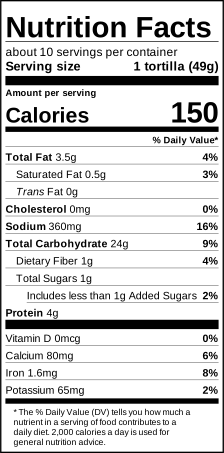
Serving size: what the RACC gives tortillas
21 CFR 101.12 lists “biscuits, croissants, tortillas, soft bread sticks, soft pretzels, corn bread, hush puppies, scones, crumpets, English muffins” together at a 55 g reference amount. Because a tortilla is a discrete, countable unit rather than something scooped or poured, 21 CFR 101.9(b)(2)(i)’s discrete-unit rule decides how you turn 55 g into an actual labeled serving, and it depends on how close your specific tortilla’s weight is to that RACC. A 30 g corn tortilla is about 55% of 55 g (above the 50% line and below 67%), which puts it in the band where you may declare either 1 or 2 tortillas as the serving (21 CFR 101.9(b)(2)(i)). A 70 g burrito-size flour tortilla is about 127% of 55 g (at or above 67% and under 200%), so the rule is simpler: the serving is one tortilla, full stop, one unit equals one serving. A tortilla heavy enough to hit 200%–300% of the RACC (110–165 g) would need the serving set at the amount approximating the RACC plus an additional per-unit column, though that’s unusual for tortillas in practice.
What the panel must show
The mandatory nutrients under 21 CFR 101.9(c) apply in full: calories, total fat, saturated fat, trans fat, cholesterol, sodium, total carbohydrate, dietary fiber, total sugars, added sugars, protein, vitamin D, calcium, iron, and potassium, each with %DV and the standard Percent Daily Value footnote. Sodium and total carbohydrate are the two numbers that matter most here: flour tortillas commonly run 700+ mg sodium per 100 g from the leavening and dough conditioners, and rounds to the nearest 5 mg between 5–140 mg per serving and the nearest 10 mg above that (21 CFR 101.9(c)). Added sugars in a tortilla recipe (a small amount of sugar in the flour-tortilla dough) come from your own formulation, not a nutrition database, and should reflect what your recipe actually adds. Corn tortillas typically add none.
Format: which layout your package qualifies for
A standard stack of 8, 10, or 12 tortillas in a resealable bag uses a standard vertical panel; servings per container is simply the count divided by however many tortillas make one labeled serving. A smaller package (a single-serve wrap kit, for instance) with 40 sq in or less of labeling surface may use tabular format under 21 CFR 101.9(j)(13)(ii), or linear format if the surface is under 12 sq in or truly can’t fit a tabular block anywhere. NutriLabels’ builder renders standard vertical, tabular, linear, and dual per-unit column formats.
Tortilla-specific traps
The discrete-unit math above is the main trap: it’s easy to default to “1 tortilla = 1 serving” without checking where your actual tortilla weight falls relative to the 55 g RACC, and getting that wrong throws off every %DV on the panel. Refrigerated vs. shelf-stable doesn’t change the RACC or the 21 CFR 101.9 format rules (both fall under the same 55 g category and the same format thresholds), but it does affect storage instructions and date coding, which live outside the Nutrition Facts panel itself. A tortilla mix sold to be prepared at home (add water, cook on a griddle) would need an “as prepared” column under 21 CFR 101.9(e), which is a different case from a finished, ready-to-eat tortilla.
Ingredient statement and allergens
Ingredients list in descending order by weight: a basic flour tortilla usually reads “Enriched wheat flour, water, vegetable shortening, salt, leavening”; a corn tortilla is typically just “Corn masa flour, water, lime (calcium hydroxide).” Wheat is one of the 9 major allergens under FALCPA and the FASTER Act, so flour tortillas need a “Contains wheat” statement; corn is not one of the 9 major allergens and doesn’t require a “Contains” line, though it still belongs in the ingredient list itself. Check any added oils or dough conditioners for soy or dairy, which show up in some commercial flour-tortilla recipes.
Build the label
Weighing your actual tortilla before you set the serving means every %DV on your bag lines up with what your customer eats. Enter your recipe, then see your tortilla label: your calories, the claims you qualify for and your allergen line are free, no card required, and every other value and %DV stays hidden until you unlock it. $29 unlocks every other nutrient value and %DV, the discrete-unit serving size and every FDA format your tortilla qualifies for, and the ingredient statement and allergen declaration, ready to print. Start your tortilla label, or check the serving sizes for other breads.
Tortillas (corn and flour) label FAQ
What RACC applies to tortillas?
Tortillas share a 55 g reference amount with biscuits, croissants, soft pretzels, corn bread, and English muffins under 21 CFR 101.12. The same 55 g applies to both corn and flour tortillas.
How do I label a small corn tortilla under the discrete-unit rule?
A 30 g corn tortilla is about 55% of the 55 g RACC, which under 21 CFR 101.9(b)(2)(i) falls in the band above 50% and below 67% where you may declare either 1 or 2 tortillas as the labeled serving.
What about a large burrito-size flour tortilla?
A 70 g burrito tortilla is about 127% of the 55 g RACC, which is at or above 67% and under 200%, so under 21 CFR 101.9(b)(2)(i) the serving is simply one tortilla: one unit, one serving.
Does refrigeration change the serving size or format rules?
No. The 55 g RACC and the format thresholds in 21 CFR 101.9 don't turn on whether tortillas are shelf-stable or refrigerated; that distinction affects storage instructions and date coding, not the Nutrition Facts panel itself.
Is corn a major allergen I need to declare?
No. Corn is not one of the 9 major allergens under FALCPA and the FASTER Act, so it doesn't require a "Contains" statement, though it still belongs in the ingredient list. Wheat, used in flour tortillas, is a major allergen and does require one.
Related products
Chips (potato, tortilla, vegetable), Salsa, Bread, Pasta (dry and fresh). See the full all products.