
Last verified 16 Sep 2026 · Sources
A children 1-3 Nutrition Facts label is the panel required on any food, other than infant formula, that’s “represented or purported to be specifically for…children 1 through 3 years of age” (21 CFR 101.9(j)(5)(i)). It keeps every standard nutrient and % Daily Value (%DV) line. But it works out %DV from child-sized reference values and uses a 1,000-calorie footnote. If you make toddler puffs, pouches or other snacks marketed by age or with “toddler” branding, this is the panel the rule calls for.
| Quick facts | Children 1 through 3 years |
|---|---|
| Governing rule | 21 CFR 101.9(j)(5)(i) and (j)(5)(iii) |
| Allowed when | Only for foods represented or purported to be specifically for children 1 through 3 years |
| Required when | Required for any such food, other than infant formula (101.9(j)(5)(i)) |
| Package area | Any |
| In the NutriLabels builder | Renders in the NutriLabels builder |
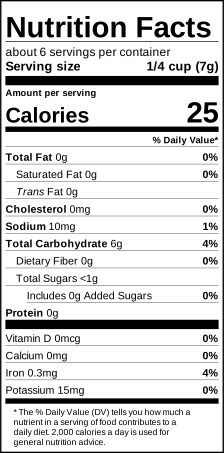
When can you use it?
Like the infant format, this one isn’t a layout you can pick for any product. It applies to foods marketed to this age group.
The nutrient list is the same as for the infant format (101.9(j)(5)(i)). The rule reads: “calories, total fat, saturated fat, trans fat, cholesterol, sodium, total carbohydrates, dietary fiber, total sugars, added sugars, protein, and the following vitamins and minerals: Vitamin D, calcium, iron, and potassium.”
The numbers for children come from the Reference Daily Intake and Daily Reference Value tables at 101.9(c)(8)(iv) and (c)(9). The Daily Reference Values are total fat 39 g, saturated fat 10 g, cholesterol 300 mg, total carbohydrate 150 g, sodium 1,500 mg, dietary fiber 14 g, protein 13 g and added sugars 25 g. The Reference Daily Intakes are 700 mg calcium, 7 mg iron, 3,000 mg potassium and 15 mcg Vitamin D. All of these are based on a 1,000-calorie reference diet instead of the adult 2,000-calorie one.
When do you have to use it?
Foods for this age group “shall bear nutrition labeling” (101.9(j)(5)(i)). This paragraph has no separate small-business or package-size exemption written into it.
The infant formula exception doesn’t come up here in practice, because formula is marketed to infants, not to 1-3-year-olds. But a toddler food still goes through the usual exemption check (retailer exemption, small package exemption and so on under 101.9(j)), the same way an adult product would. This age-group format changes what the panel says, not whether you need a panel at all.
What changes on the panel?
The nutrient order and the required list match the adult and infant panels. The difference from the infant format is that 101.9(j)(5)(iii) doesn’t remove any %DV lines. Every nutrient with a Daily Reference Value or Reference Daily Intake for children gets a percentage, worked out from the child figures, not the adult ones.
What does change is the footnote. It’s not the adult “2,000 calorie” text, and it’s not left off like on the infant panel. The rule requires this (101.9(j)(5)(iii)): “*The % Daily Value tells you how much a nutrient in a serving of food contributes to a daily diet. 1,000 calories a day is used for general nutrition advice.”
Every other format rule (abbreviations, type size, footnote placement) follows whichever format your package size qualifies for, whether vertical, tabular or linear.
Mistakes to watch for
- Reusing the adult 2,000-calorie footnote instead of the 1,000-calorie children’s version required by 101.9(j)(5)(iii).
- Taking %DV from the adult Daily Reference Value table instead of the child figures in 101.9(c)(8)(iv) and (c)(9). That understates how much of a child’s daily needs a serving provides.
- Thinking this format drops %DV lines the way the infant format does. There’s no such exception in 101.9(j)(5)(iii).
- Marketing a snack as “great for toddlers” without checking whether that copy counts as “represented or purported to be specifically for” this age group under 101.9(j)(5)(i).
- Mixing infant and children reference values on the same panel when a product is aimed at both age ranges. Pick the right table for the audience you name.
Which products usually use it?
Build your label
With child reference values and the 1,000-calorie footnote, the %DV on your toddler snack fits the age group you made it for. Enter your recipe and then see your label. The calorie count, the nutrient content claims you qualify for and your allergen line show free, and no credit card is required. The rest of the numbers on your label stay hidden until you buy a Single Product ($29) or the Studio plan ($299 a year). A Single Product unlocks the rest of the numbers on your label, every FDA format your product qualifies for (the children 1-3 format included), the ingredient statement and the allergen declaration. Or send us the recipe and we’ll build it for you (done-for-you, $249, within 5 business days). Start your label, or see the infant format and the rest.
Children 1 through 3 years format FAQ
Does the children 1-3 panel skip any % Daily Value lines the way the infant panel does?
No. The rule for this age group only adds a footnote requirement (101.9(j)(5)(iii)). Unlike 101.9(j)(5)(ii)(A) for infants, it has no exception that drops %DV for any nutrient. Every nutrient with a Daily Reference Value or Reference Daily Intake for children 1-3 gets a %DV.
What footnote goes on a children 1-3 label?
The rule calls for this exact text (101.9(j)(5)(iii)): "*The % Daily Value tells you how much a nutrient in a serving of food contributes to a daily diet. 1,000 calories a day is used for general nutrition advice." That 1,000-calorie reference is lower than the 2,000-calorie line on an adult panel.
Which reference values does the %DV use for this age group?
It uses the children 1-3 Daily Reference Value and Reference Daily Intake figures in 101.9(c)(8)(iv) and (c)(9). For example, that's 39 g total fat, 10 g saturated fat, 150 g total carbohydrate and 700 mg calcium, all lower than the adult figures.
What nutrients are declared on this panel?
It's the same list as the infant format under 101.9(j)(5)(i). That's calories, total fat, saturated fat, trans fat, cholesterol, sodium, total carbohydrate, dietary fiber, total sugars, added sugars, protein, Vitamin D, calcium, iron and potassium.
Can a toddler snack use the standard adult panel instead?
If the product is "represented or purported to be specifically for" children 1-3, 101.9(j)(5)(i) applies. Then the rule calls for the child reference values and footnote. If you're unsure whether your package copy or marketing counts, talk to a food-labeling attorney.
Related formats
Infants (through 12 months), Bilingual (English/Spanish), Standard vertical. See the full all label formats.