
Last verified 16 Sep 2026 · Sources
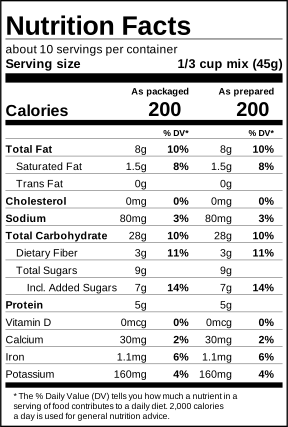
If your product is a dry mix, a cooked-before-eating food, or a food customarily combined with something else, your Nutrition Facts label can voluntarily show two columns (one “as packaged” and one “as prepared”) under 21 CFR 101.9(e), which lets you present “nutrition information…for two or more forms of the same food (e.g., both ‘as purchased’ and ‘as prepared’).” It’s the format on a boxed cake mix, a packet of dry soup, pancake mix, or a bag of microwave popcorn, where the numbers on the box alone don’t tell the whole story of what a customer actually eats.
| Quick facts | Dual column: as packaged / as prepared |
|---|---|
| Governing rule | 21 CFR 101.9(e) |
| Allowed when | Food is commonly prepared, cooked, or combined with another food before eating |
| Required when | Never required; voluntary alternative to a single "as packaged" column |
| Package area | Any |
| In the NutriLabels builder | Renders in the NutriLabels builder |
When you may use it
101.9(e) is written as a permission, not a mandate: nutrition information “may be presented for two or more forms of the same food,” which covers both a food prepared differently before eating (dry mix vs. baked cake) and a food customarily combined with another ingredient before eating (cereal typically eaten with milk). The rule applies whether the change comes from cooking, reconstituting with water or milk, or simply the way people habitually eat the product. There’s no size or category threshold here the way there is for the mandatory per-serving/per-container dual column in 101.9(b)(12)(i). Eligibility turns on whether the food is genuinely prepared or combined before eating, not on package dimensions or RACC percentage.
When it is required
It’s never required. If you make cake mix, you can label only the dry-mix values and stop there; the second column exists so you can choose to show customers what the finished product looks like nutritionally, which is often more useful information for a category where the packaged form bears little resemblance to what’s eaten. The one place this voluntary format interacts with a mandatory rule is in 101.9(b)(12)(i)(C), which exempts products already carrying an “as prepared” or combination-food column under (e) from also having to add the separate mandatory per-serving/per-container column, so choosing to use (e) can, in effect, take the place of that other dual-column requirement rather than stack on top of it.
What changes on the panel
Both columns run side by side, each with its own quantitative nutrient amounts; 101.9(e) directs that “equal prominence shall be given to both sets of values,” so neither column can be relegated to fine print or an asterisked afterthought. Column headings have to say exactly what’s being measured; the regulation’s own example headings are along the lines of “Per 1/4 cup mix” and “Per prepared portion,” rather than a bare “as packaged” and “as prepared” with no quantity attached, since the reader needs to know what amount of each form the numbers describe. Percent Daily Value is shown for both forms, not just one, and the two columns are set off from each other visually with a vertical rule between them, required directly by 101.9(e)(3), the same way the mandatory dual-column format separates its two columns. Everything else about the panel (mandatory nutrient list, order, footnote) stays the same as the format it’s layered onto (vertical, tabular, or simplified).
Common mistakes
- Treating the “as prepared” column as required for every mix or dry product. It’s optional under 101.9(e), and plenty of dry-mix labels validly show only the packaged form.
- Giving the “as prepared” numbers more visual weight than the “as packaged” numbers (larger type, bolder heading), when the rule calls for equal prominence between the two.
- Using a vague heading like “Prepared” without stating the amount or method it refers to, leaving the reader unable to tell what quantity the column describes.
- Showing nutrient amounts for the prepared form but skipping %DV for it, when both forms need their own %DV.
- Confusing this voluntary as-prepared column with the mandatory per-serving/per-container dual column required at 200–300% of RACC under 101.9(b)(12)(i). They solve different problems and have different trigger conditions.
Products that usually need this
This format is common on products meant to be cooked or combined before eating: cakes-cupcakes mixes, soup mixes, pasta with sauce packets, popcorn sold for microwave preparation, and granola or cereal-style products commonly eaten with milk.
Build it
A prepared column lets a customer see the numbers for the cake they actually bake, right beside the dry mix in the box. Enter your recipe, then see your label: the calorie count, the nutrient content claims you qualify for and your allergen line show free, no card required, while every other value and %DV stays hidden until you unlock it. $29 unlocks every other nutrient value and %DV, every FDA format your product qualifies for (including an as-packaged/as-prepared second column if your product is cooked or combined before eating), the ingredient statement and allergen declaration. Start your label, or compare the other label formats.
Dual column: as packaged / as prepared format FAQ
Do I have to add an "as prepared" column?
No. 21 CFR 101.9(e) uses "may be presented," making the second column voluntary. A mix or dry product can label "as packaged" values only.
What has to appear if I do add one?
Both forms need their own quantitative amounts, and the columns need clear headings describing exactly what each represents (for example "Per 1/4 cup mix" and "Per prepared portion"), with equal prominence given to both.
Does %DV need to be shown for both columns?
Yes. When you present two forms, both need their nutrient amounts and %DV, not just the packaged form.
Is this the same as the "per serving/per container" dual column?
No. That format (101.9(b)(12)(i)) is about package size relative to the RACC and can be mandatory. This one (101.9(e)) is about whether the food changes when prepared or combined, and it's always voluntary.
Can cereal-with-milk use this format?
Yes. Cereal eaten with milk is handled as a "common combination of food" under the general (e) language, by way of 101.9(h)(4), rather than through a separate numbered subparagraph of its own.
Related formats
Dual column: per serving / per container, Standard vertical, Tabular. See the full all label formats.